.
Abdullahi Qarshe (Somali: Cabdullahi Kharshee, Arabic: عبد الله خارسهي) (1924 - 1994) was a Somali musician, poet and playwright known as the "Father of Somali music".
Biography
Qarshe was born in 1924 in the Somali expatriate community in Moshi, Tanzania. In 1931, at the behest of his family, he left Tanzania and settled in Aden, Yemen for his education. It is in Aden where Abdullahi had his first encounter with cinema and radio playing western films and Indian and Arabic music, which inspired him to buy a lute to accomplish his new goal of creating music in the Somali language.
Qarshe was the inception of the modern Somali music, and the first generation were Ali Feiruz, Mohamed Nahari and others.
An innovative musician, Qarshe often employed a wide variety of instruments in his art, such as the guitar, piano, and oud. He was also known for his poems and his theatrical work at Mogadishu and Hargeisa venues.
In addition, Qarshe was a member of the pioneering Somali musical ensemble Waaberi.
Waaberi
As Somalia's foremost musical group, Waaberi spawned many popular artists who would go on to enjoy successful individual careers and shape the face of Somali music for years to come. Prominent members of the band included
Abdullahi Qarshe
Ali Feiruz
Fadumo Qasim Hilowle
Hasan Adan Samatar
Hibo Nuura
Hussein Aw Farah
Magool
Maryam Mursal
Mohamed Aden Da'ar
Mohamed Suleiman Tube
Omar Dhule Ali
Saado Ali
Salaad Darbi
Salaad Maxamed Sahardi
Seinab Haji Ali Bahsan
Abdikavy Abdullahi Botan
Kinsi Haji Aden
History
The first major form of modern Somali music began in the mid-1930s, when northern Somalia was a part of the British Somaliland Protectorate. This style of music was known as Xer-Dhaanto, an innovative, urban form of Somali folk dance and song. This period also saw the rise of the Xaaji Baal Baal Dance Troupe, which became very influential over the course of its long career.
Somali popular music began with the balwo style, which was created by Abdi Sinimo. This style began in Dilla, and then spread throughout the area. It was a mixture of modern poetry and Somali dance music.
Cabdillahi Qarshe rose to fame in the early 1940s as part of the qaraami style. Many qarami songs from this era are still extremely popular today. This musical style is mostly played on the kaban (oud). The first somali kaban players were: Ali Feiruz, Mohamed Nahari, and others in 1950s.
During the Siad Barre regime, music was suppressed except for a small amount of officially-sanctioned music. There were many protest songs produced during this period.
Interview with the late Abdullahi Qarshe
(1994) at the Residence of Obliqe Carton
in Djibouti
Mohamed-Rashid Sheikh Hassan
mrsh: Let us start with the basics. When and where were you born?
aq: I was born in Moshe, Tanzania, in 1924.
mrsh: People know you as Abdullahi Qarshe, but what is your real
name?
aq: Oh, yes, that is true. My real name is Mahmud Muhammad, and
Qarshe was the nickname of my father. He was a businessman and
trader in the livestock business in East Africa. He was regarded as a
frugal man and was fortunate in business. We were five brothers and
one sister. We lived in a big house on the outskirts of Moshe.
mrsh: Tell us more about the background of your family and the reason
your father moved to Tanzania.
aq: My father emigrated from Sanaag region in what was at that time
called British Somaliland. In those days, emigration (tacabbir) was popular.
Men used to travel for work and a better life, but it was not an
easy task. Those who emigrated to East Africa, my father included,
went through southern Somalia first of all, then proceeded to Tanzania.
They had to travel by road or foot through harsh and unfriendly
territories. Some of the migrants died along the way, and my father
was one of the fortunate who survived.
In the Sanaag region, my father’s family lived in the Maydh district.
They were involved in the fish industry and the exportation of livestock
and animal hides, as well as timber, to the Gulf countries. My
family was also a religious one, as they were the “keepers of the
shrine” of Shaykh Ishaaq.
65
mrsh: So your family were the muruud (keepers) of the shrine. Likewise,
I come from a muruud family and I am familiar with the system.
aq: Yes, we were the muruud of Shaykh Ishaaq, therefore we were very
well respected because of this role and position. With regard to Tanzania,
my father died in 1931. My mother refused to marry my father’s
brother, who lived in Tanzania with us, so she sold all the family property
so we could move back to Somaliland. First of all, we arrived at
Aden, Yemen, and remained there for some time. Then we traveled by
boat to Maydh, then from there by road to Cerigavo. We lived there for
two years, then we returned to Aden, which eventually became our
permanent home.
mrsh: What was your first engagement, meaning did you follow your
father’s footsteps and enter business or did you go to school?
aq: My first engagement was to study the Quran. While we were in
Tanzania, there was a Quranic teacher who gave me private lessons in
Quranic studies at home. During the two years that we were in Cerigavo,
I was sent to a madrasah (Quranic school). Apart from the Quran,
I also had my first experience with Arabic language there.
When we settled in Aden, I entered a madrasah that was established
by the Somali community. I was not really interested in continuing my
Quranic studies, but my mother shuttled me to many madrasahs to reignite
my interest somehow. I do not understand why I was bored,
because I was not only a good student but a popular one as well. I even
became a classroom assistant (kabiir). Another of my father’s brothers,
who resided in Aden, married my mother and thus became our
guardian. He was a very good man who commanded the respect of all
the Somalis of Aden. I believe this was related to the title of muruud
inherited from my father.
After I lost interest in religious studies, I was attracted to the secular
British schools in Aden. I requested that my uncle take me to one of
these schools one day. However, when this day arrived, we left the
house and walked some distance, but I felt that my uncle had other
plans. On our way, various friends of his offered him a ride but he
refused, saying that we were not going far. Suddenly, he stopped and
faced me, and said, “Abdullahi, I really want you to study religion and
I do not approve of you going to the British schools. If anything happens
to me, then you will be my successor. This is what I wanted to tell
you along the way today.” Then I replied, “Why did it take so long for
Bildhaan Vol. 2
66
you to tell me this?” Thus, I respected his wishes and entered a
madrasah where I finished the thirty parts of the Quran.
mrsh: So you read the whole of the Quran? Amazing! This is the first
time that I became aware that Abdullahi Qarshe, the composer and
musician, read the whole of the Quran!
aq: Indeed, not only did I read the whole Quran, but I also studied
Arabic grammar, fiqh (Islamic jurisprudence), and other Islamic subjects,
as I was supposed to be heir to my uncle, the head of our muruud
family. One day, my elder brother called to advise me that my previous
conviction to go to school was better for me than following the
muruud way. I went to a British school for a while, particularly night
school. However, again I became completely bored with formal learning
and I became more enticed by music. So instead of spending my
time on learning and schooling, I spent many hours watching Indian
movies, primarily to listen to accompanying Indian songs.
mrsh: Was that, then, the beginning of your career/interest in music,
or what Somalis more generally call fenn?
aq: Yes. Also, my interest in music came about because of another
event. During the Second World War, the British authorities in Aden
established a radio station. Among the foreign languages broadcast
were Hindi, Arabic, and Somali, which were given half an hour airtime.
Both the Hindi and Arabic programs included music, but the
Somali broadcast did not. A newsreader called Mahdi Eleeye read the
news that was followed by classical Somali poetry (gabay) and took the
remainder of the time. When Arabs visited Somali cafes, they would
ask them, “Don’t you have your own music?” As I said earlier, my
taste for music was first inspired by Indian music, and later I realized
that broadcasters in the Arabic department were also using some
aspects of Indian music and incorporating it into their melodies.
Hence, I thought of doing the same, but at that stage I could not play
any instrument. As far as singing was concerned, I used to sing religious
songs at some gatherings, so I knew that if I could play the lute, I
could sing along with it. One day, I saw a man in the market selling a
lute and I wanted to buy it. Once I acquired the money for one, I
approached the seller and out of the corner of my eye noticed another
young man who also coveted the instrument. I pleaded with him to let
me buy it. He was kind enough to do so and, thus, I took immediate
possession. Now, where could I put this lute? I could not take it home
since having one, according to my family, was tantamount to blas-
Mohamed-Rashid Sheikh Hassan
67
phemy! An idea came to mind: I put it in a box and approached a family
friend and told him to pretend that it belonged to him. This was so
that he could leave it in my home, and if anyone discovered the lute,
then I could not be blamed. This friend did exactly this. Then, when
the time for my departure to Somaliland came, he collected the box
and brought it to me at the port before I embarked on my journey to
Hargeisa.
mrsh: So what followed?
aq: I arrived in Hargeisa and stayed with a family friend called Mahmud
Abdi Arale. Abdi Sinimo’s belwo was already making an impact
on the urban population. However, there were only a few musicians
and they were either Arabs or Indians inspired by the new Somali
genre of the belwo. There were two main characters: Ina Beenaale, an
Indian, and Abdo Yusuf, a Yemeni. They played basic instruments, the
most important being the violin. They invited me to join them, so I did,
but I was not yet really proficient in playing. We tried to create softer
lyrics than classical Somali poetry and accompany it with music. In the
beginning, it was not easy, and our band consisted of a mixture of
clapping, the tambourine, and drumming. For instance, we wanted to
inject some music into Elmi Bowdheri’s famous love poetry, and formulate
songs. Where the alliteration was not feasible, we added Arabic
or Hindi lyrics. At this stage, I wanted to earn some money and make
use of the educational skills I acquired in Aden. Thus, I applied for a
clerical post in the British colonial administration and succeeded. As a
result, I was transferred first to Burao and then later to Berbera. It was
in Berbera that I started to focus more on practicing my lute, after I met
an elderly man named Bakri whom I asked to teach me the basics of
the instrument. We agreed that he would teach me in exchange for a
daily portion of khat. Ina Beenaale and Abdo Yusuf were not willing to
do the same. I suppose they were afraid that I would steal the limelight
from them, since I was the first would-be Somali musician and composer.
mrsh: What was the first piece of music that you composed?
aq: At this stage, I was not in a position to write music, so I used the
melodies of old songs. However, the first composition I wrote was for
the song “Ka Kacay! Ka Kacay!” (Wake up! Wake up!). This was 1948.
mrsh: This must have been a crucial period of the mobilization for
independence in Somaliland, when the territory entered a new phase
of national consciousness.
Bildhaan Vol. 2
68
aq: You’re right. There was the wind of change of nationalism, which
as a political force inspired many people, including the educated few.
Political organizations, such as the Somali National Society (SNS) and
the Somali Youth League (SYL), were formed and were popular. The
SNS established branches in the main towns of the protectorate, such
as Hargeisa, Burao, Borama, Erigavo. It started as a welfare organization
and later developed into a political party, the Somali National
League (SNL). At this time, the belwo became very popular, to such an
extent that the religious establishment became very nervous about it.
For instance, one night we were practicing and playing songs in a private
house in the Zakata Lire quarter of Hargeisa. When dawn broke, a
well-known religious personality called Shaykh Ali Jawhar made the
call to prayer and followed it with a warning directed at us to stop
these “songs of innovation,” as he called them. When this story
entered the city, the public’s disgust with us grew even more. They
changed the term Belwo into Balaayo (evil).
mrsh: Were there not any sympathetic groups?
aq: Some of the more educated appreciated the fact that the belwo itself
had developed Somali literature and art in general. Among them was
Yusuf Haji Aden, a teacher who had already contributed several
nationalist songs. He suggested the change of the term Belwo to Heello,
so as to rid it of the evil stigma. Yusuf Ismail Samatar, another teacher,
supported our cause.
During this time, the former District Commissioner of the National
Frontier District (NFD), Mr. Reece (also known as “Kamakama” by the
Somalis), was transferred to Somaliland. His arrival coincided with the
building of the first churches in Hargeisa. I had heard that Reece had
been an oppressive colonial character in the NFD. I did not know how
it came to me, but I decided to compose a song, which became the
well-known song “Ka Kacaay! Ka Kacaay!” (Wake up! Wake up!):
Ka kacaay ka kacaay ka kacaay! Wake up, wake up, wake up!
Ka kacaay ka kacaay ka kacaay! Wake up, wake up, wake up!
Ka kacaay ka kacaay ka kacaay! Wake up, wake up, wake up!
Ka kacaay ka kacaay ka kacaay! Wake up, wake up, wake up!
Ka kacaay ka kacaay ka kacaay! Wake up, wake up, wake up!
kalhore nujabnee We have been defeated before
kaftankii ma jiree T this is no time for joking
Koroley la gubyay Koroley has been burnt to the ground
kufaceen la dilyay Our people have been killed
And the infidels have increased in number.
kufrigii badayay.
mrsh: What other songs did you compose after that?
aq: “Ka Kacaay! Ka Kacaay!” was not so serious. I think the first one I
wrote was “Garta naqa” (Sort out the Claims):
Gadh baan leeyahay oo I am a grown man
Guddida ma galee But I am not consulted by the elders
Gugaygu ma weynee I am still young
Garta naqa. Make your own judgment
Labada gelin gaalaa i dirata Morning and afternoon I serve the
infidels
Habeenki ma gam’ee And at night I remain sleepless
Garta naqa. Make your own judgment
Wax kaa gooni ah oo Something that is a part of you
Aan jidhkaaga gelayn oo But yet detached from you
Aan kaa gaabinayn And that cannot be reconnected
Garta naqa. Make your own judgment
Gabadha cishqiqeedi baa i gel oo I’m overwhelmed by the love of this
woman
Wax ba ku gudban ee But I am barred from her
Garta naqa. Make your own judgment
Haddaan guursan lahaa If I married her
Gob weeyaan She would be a most suitable bride
Haddana ma geeye ee Yet she is out of reach
Garta naqa. Make your own judgment
These songs were composed in 1948. As I mentioned earlier, I was
working as a clerk for the British Protectorate police force from 1948 to
1949. The police force had a musical group called Band Boys, in Mandera.
I was interested in becoming involved in this group and I asked
another clerk, a friend of mine who was working in Mandera, if we
could swap our posts so I could work there. He agreed. I wrote a letter
to the authorities regarding this transfer, which was accepted. Some
people thought I had been transferred as a punishment for my song
“Ka Kacaay! Ka Kacaay!” In reality, however, it was I who had asked for
the transfer.
mrsh: While you were in Mandera you composed a love song, didn’t
you?
Bildhaan Vol. 2
70
aq: Oh, yes. The song was for the girl I married and who became the
mother of my son. However, she remarried later on, so I prefer not to
revisit this song.
mrsh: I remember the song myself. It started like this:
Intaanan dhiman dhahay dhahay Say it, say it, say it, before I die
dhahay
Aqalkay ku jirto iyo agta u dhowee The house she lived in and its
surroundings
Maandheera oo idil way udgoontahay And the whole city of Mandera
exude a fragrant smell
Udgoon dhahay dhahay. Say it, say it, all are fragrant.
The girl you sing about, wasn’t she the daughter of Abdullahi Abi
Farah?
aq: Yes, she was. We agreed to marry each other, but then I realized
that she was promised to another man. Also, financially I was not
ready for marriage. When I heard that her family had set her up with
another man, I rushed to my kin members in Hargeisa for help, so that
they would approach her family for her hand on my behalf. Among
the prominent members of my family were two civil servants, Mahmud
Abdi Arale and Ali Said Arale. They particularly questioned my
eligibility for marriage. They asked me how much money I had. I said,
“One hundred dollars.” They laughed at me and said that they could
not possibly approach her family if I was in this sorry state. I said to
them that I had already made my own decision. I would propose
directly to her family myself and either be accepted or rejected. If I
were rejected, then they would be humiliated. After a heated debate,
Mahmud Abdi Arale interjected and said that Abdullahi would fulfill
his threat and bring shame (ceeb) if they did not comply. So the next
day, they accompanied me to her house with the dowry and the marriage
was agreed and completed. However, I still had to meet the
expenses of the second stage, when the bride moves into a house with
her husband. I was lucky because at that time I recorded some songs
with a company in Aden, which was owned by two Somalis and an
Arab. They suggested that I become a shareholder, but I retorted that I
required the money immediately for my marriage expenses.
mrsh: What were the songs that you recorded for the company?
aq: I really do not remember, but they were some of the oldest songs
that I recorded. In London, one day, a Somali woman played these
songs for me on a gramophone. I asked her if she knew the singer, and
Mohamed-Rashid Sheikh Hassan
71
she replied “yes.” I told her that the singer was me, but she insisted
that the voice was that of Abdullahi Laangadhe (Abdullahi with the
limp). Then, I told her that that was my old nickname because of my
leg injury.
mrsh: By the way, what happened to your leg?
aq: People often say that an evil wind affected it, but in fact it was the
result of a mosquito bite, which happened to me in Tanzania about
two years before I returned to Somaliland.
mrsh: When did you marry and did you have any children?
aq: I had a boy in my first marriage. His name was Artan. I took the
name from the play called Cartan iyo Ceebla because he was born when
my performing group was involved in this play.
mrsh: Back to the world of music and songs. Now we have Abdullahi
Qarshe, married in 1950 and working in Mandera. What followed
next?
aq: While living in that village, I composed several songs and some of
them had no names. Soon, I resigned from my job and decided to
return to Hargeisa. I got a job at Radio Hargeisa, where I had a dual
responsibility: I was an administrator as well as a news broadcaster. In
addition to that, during after hours, I used to write music and play
with available musicians.
mrsh: Let us now focus on the plays that you either produced or coproduced.
What was the first play in which you participated?
aq: I forgot to mention something earlier. When I was at school in
Aden, I asked my teacher if I could join the end-of-year play. He said
that, unfortunately, there was no character with a limp for me to play,
so I was a little disappointed about that. However, he said that if I was
interested, I should hang around the rehearsals.
The first play in which I performed was in Burao, and was written
by Yusuf Ismail Samatar. Somaliland plays used to originate in schools
at the end of the school year, not from professional groups. Samatar
pioneered a new genre in the production of the play. He incorporated
Somali, Arabic, and English into a play he wrote. The Arabic part was
about revenge. The English part commented on the British authorities
and the public. The Somali section was a critique of those who were
anti-belwo or anti-heello. Samatar included some of the administrative
clerks of the protectorate in his play, and a prominent character was an
interpreter who could not speak English properly. For example, he did
Bildhaan Vol. 2
72
not competently convey the wishes of the public to the authorities, nor
those of the authorities to the public.
Afterwards, the Somali civil servants’ official Union Centre became
the new location, a kind of salon, for exchanging ideas on production. I
produced a play called Waano Aabbe (The Advice of a Father) and I was
not satisfied with the acting, but otherwise it was a decent creative
effort. Thereafter, I thought of forming an artistic group, so subsequently,
I created Walaalo Hargeisa (The Hargeisa Brothers).
mrsh: When was Walaalo Hargeisa formed? Tell me a little about its
background.
aq: It must have been the beginning of 1955; and the group was drawn
from ordinary artists and civil servants. Of particular note was an
Indian artist who played the flute with extraordinary flair.
mrsh: He must be Mr. Rao?
aq: Yes, it was Rao, an artist of the highest order, who was my right
hand. Walaalo Hargeisa became a talented and select group of artists
who were to raise Somali modern music to new heights.
mrsh: If we look at many of the lyrics of that time, they sound rather
frivolous. For instance, let us take the line: “Silsilad gubatay, Siraad xaajay,
Sariirta ma noo goglaysaa” (A scattered and broken necklace, you,
Sirad Haji, will you prepare the bed for us?).
aq: True, the early songs were too playful, but still amusing — for
instance: “Sidii Talyinkii, Tacliin badan ee, Maryama tiijar ee, Take my
self!” (Like the Italians, one so educated is she, Maryama the teacher,
Take my self!). Another example is: “Naftaydana hoo, Naftaadana keen,
Ha la isku tumee, Tib ii keen!” (Take my soul! And give me yours! Let
them be as one, to crush them together, bring me the pestle!). In addition:
“Hablaha dhaanka wada, Ma a dhuuntaa, Mid uun dhexda ma iska
duubaa” (Shall I lie in waiting for, one of the girls collecting water?
Shall I snatch one and wrap myself around her like a snake?).
The next two examples are more serious: “Guduudo Carwooy, Gugii
la arkaba, Allow yaa gashaanti kaa dhigaaa” (By every year that passes,
Dear God! If only you could be made young again!); and “Sidii cir ku
hooray, Meel cusub loo, Cadceeddi u soo baxda ayaad tahay” (You are like
lush nature, showered by rain and graced by the sun).
mrsh: After forming Walaalo Hargeisa, what was the first play that you
took part in?
Mohamed-Rashid Sheikh Hassan
73
aq: It was called Soomaalidii Hore iyo Soomaalidii Dambe (Somalis of the
Past and Somalis of the Present), and it coincided with the handing over
of the Hawd area to Ethiopia in 1955. The play was a lamentation of
this dreadful event and other similar happenings in Somali territories
still under colonial occupation. It started with a man who carried a
message about Italian oppression in the south of Somalia to a woman,
married and living in Berbera. The message contained a request from
her family in the south for her help. Subsequently, she convinced her
husband to let her leave and aid her people. When he asked her about
the welfare of their children, she replied that the fate of the country
was more important. The essence of the play was to inform the audience
about how the Somalis in the past fought for their country.
The play had only one song, called “Taah” (Sighing), which goes as
follows: “Intay adiga iyo arliga tahay, Asaanay laabi labo ahaanayn, agtayda
ha marin, ishayduna ayaynu ku arkin, Ha ii iman” (When it comes to you
and the country, My heart cannot be divided, Do not come near me,
And let not my eye fall upon you, Stay away from me!).
mrsh: Obviously, as a group (i.e., Walaalo Hargeisa), you were largely
defined by the historical and nationalistic era. Did this mean a neglect
of other themes such as love and romance?
aq: We thought about a plot that could combine love and Pan-Somali
sentiments. We wanted to take such a performance to Mogadishu,
Aden, and Djibouti. So the group produced a play called Cartan iyo
Ceebla (Artan and Ebla). Muhammad Said Guronjire (another major figure
of our group) and I composed new songs and music. We benefited
from already existing songs, such as “Jowhara Luula” and “Daawac,”
whose style we mixed with the new compositions.
mrsh: Was the idea for Cartan and Ceebla borrowed from the Arabic
love story Layla and Majnoon?
aq: No, not at all. It was an original Somali play and had nothing to do
with that.
mrsh: Can you capture for us the main plot of the play?
aq: A man is in love with a girl whose family had already made
arrangements with another suitor. Subsequently, the girl became possessed
with demons and the family tries every doctor and remedy to
cure her. One day, an old woman visits the family and declares that the
girl is not sick but merely in love. It was a story intertwining tradition,
parental powers, and individual autonomy.
Bildhaan Vol. 2
74
The next play was called Isa Seeg (Mutual Miss), and was of a greater
complexity. It had seven new songs; among them were “Nugul,”
“Damaq,” “Dankeli,” and “Wadaag.” The characters included a man in
love with a woman who, in turn, was smitten by a man who, in turn,
was attracted to another woman. It is a play full of pretensions and
deception. The play attracted a lot of praise from the public. One of the
memorable lines of one song was: “Wiilooy, Warsamo ku weheeshanayee,
Wiilooy, Ha is cunsiin waraabaha” (Oh tomboy! Warsame is your companion.
Oh tomboy! Don’t let the hyenas eat you!).
mrsh: I thought this was a political play.
aq: There was a lot of metaphor that could be interpreted as political.
For example: “Laba darran, Dooro la yidhi” (Between two horrible
options, I am condemned to choose) was understood as a reference to
the Djiboutian election of 1958, when the public was asked to vote
“Yes” for continued occupation by France, or “No,” which meant independence.
Among the main actors were Mohammad Ahmed, Omar
Dhuule (both playing women’s roles), Ahmed Ali Dararamle, Hasan
Geni (who took the part of a maid), and Abdullahi Jama Magalo (who
played the father of the main female character). Mohammad Ahmed
and Omar Dule assumed those roles because the public did not yet
approve of female actors.
The next play was titled Kibiroow! Kab iga Xuur! (Oh Ingratitude! You
have turned Me into a Pauper!). Despite the absence of any gabay or geeraar,
I think that this was probably the most important play that
Hargeisa Brothers ever performed. The story goes like this: The wife of
a working class man with a limited income comes under the influence
of a businesswoman. This businesswoman often brings her a variety of
clothes and other items and persuades her to buy them. Eventually, the
wife becomes fed up and tells the woman that she cannot afford to buy
any of her wares since she and her husband have a low income. The
businesswoman then says, “Don’t worry. I will lend you what you
need and you can pay me back later.” The wife buys more clothes. The
husband complains to his wife about her profligate and consumerist
expenditures, and tells her he will not pay any more. The businesswoman
tells the wife that if her husband cannot give her what she
desires, he does not deserve to be her husband and she must leave
him, demand a divorce, and have her dowry paid in cash. She suggests
that the money of the dowry could be invested in the khat business.
Mohamed-Rashid Sheikh Hassan
75
The businesswoman also suggests that the woman could attract other
men after her divorce.
The play depicted how a poor but decent family was corrupted and
then destroyed by the influence of an intruder who used self-serving
intrigue and deception.
mrsh: Now we approach 1960. So what followed?
aq: In 1960, we produced a play that we already discussed, Gardiid waa
Alla diid (He who Refuses Justice, Refuses Allah). This play coincided with
the 1960 election for independence in Somaliland. The play predicted
the outcome of the election and what political parties might win. In
fact, we put forth that the SNL/USP would win the majority of the
seats and the results confirmed our intuition.
mrsh: Were you and your fellow artists, the Hargeisa Brothers, supporters
of those political parties?
aq: Oh, yes, Walaala Hargeisa were fully involved in the political
process for independence. However, there were other artists, such as
Osman Mohamed (“Ga’anloo”) and Ali Fayrus, who supported other
parties such as the NUF (National United Front). Among the songs in
this play were “Aan maalno hasheena Maandeeq” (Let us milk our shecamel
Maandeeq), “Waa Mahad Alle” (Thanks be to Allah), and “Geeskii
Afrikaa gabyoo, wuxuu yidhi” (The Horn of Africa Recited Poetry and
Said).
mrsh: Was this play written by Balaayo ‘As (Barkhad ‘As)?
aq: No, it was written by Sahardiid Mohamed, who also composed
some outstanding love songs.
mrsh: When Somaliland achieved its independence on June 26, 1960,
followed by the July 1 union of Somaliland and Somalia to make the
new Somali Republic, what was the state of the arts in Somalia?
aq: On June 27, 1960, the majority of Walaalo Hargeisa and I hired a car
and went by road to Mogadishu to take part in the momentous 1st of
July celebrations. At that time, in my opinion, there were no artists of
our caliber in the South. Only small groups of traditional dancers participated
with us in the celebrations.
mrsh: What about artists such as Ali Malehan, Hilole Maalin, and
Dalays?
Bildhaan Vol. 2
76
aq: These artists were there but their production skills were not as
sophisticated as ours, nor did they compose the same standard of
songs and music as we did.
mrsh: During the 1960s, two of your songs stood out. One was
“Lumumba Mana Noola Mana Dhiman” (Lumumba is neither Alive nor
Dead). The second was “Dugsiyada Ogaada u Aada” (Be Alert to Education
and Go to School!). Could you remind us of some of the lines of
the first song?
aq: Oh, yes: “Lumumba mana noola mana dhiman, Labada midna ha u
malaynina, Inu maqanyahay ha u moodina, Laba midna ha a malaynina”
(Lumumba is neither alive nor dead, Don’t think that he is either, for
his spirit is with us, Don’t think he has disappeared. Don’t think that
he is either, for his spirit is with us).
mrsh: How did this song come to you?
aq: One day, I came out from my house and saw a crowd listening to
the radio in front of a tea shop. The news was about the crisis in Congo
in 1962. The U.N. forces had just intervened in the civil war, ostensibly
to save the Prime Minister of Congo, Patrice Lumumba, who was
arrested and later assassinated by his opponents. “Lumumba mana noola
mana dhiman” had a kind of Pan-African sentiment because of
Lumumba’s nationalist vision and courage.
mrsh: Could you remind us of some of the lines of the song that underscores
the importance of learning?
aq: “Aqoon-La’aani waa iftiin la’aan, Waa aqal iyo ilays La’aan, Ogaada
ogaada dugsiyada ogaada, U aada u aada dugsiyada u aada, Walaalayaal u
aada dugsiyada u aada, Indhaha aan ku kala qaadne, ifka ugu ilbaxsanaane,
Ogaada, ogaada dugsiyada ogaada.” (Ignorance is darkness. It is a house
without light. Be aware! Be aware! Be alert to education! Go! Go! Go to
school! Go to school, my people! Go to school! Let us open our eyes to
the wonder of knowledge, and let us be the most educated and civilized!).
mrsh: I cannot recall the name of this other play, but it was about the
Northern Frontier District of Kenya. Do you remember it?
aq: It was called Indho-sercaad (Elusive Reality). This was a most important
political play, with rich melodies and lyrics, performed by Walaalo
Hargeisa. When we played in the capital, Mogadishu, it attracted huge
publicity and audiences. For example, the first Prime Minister of the
Republic, Abdirashid Ali Sharmarke, requested that we perform the
Mohamed-Rashid Sheikh Hassan
77
play one night for the diplomatic community in Mogadishu. The Commander
of Police, General Mohamed Abshir Muuse, invited us to do
the same for the police force. It is often said that this play was a source
of inspiration during the war between Somalia and Ethiopia over the
****** territory in 1964.
mrsh: Had the standard of Somali plays and songs improved when
you moved to Mogadishu? If so, what was your role in this?
aq: Immediately after the July celebrations, I moved to a hotel in
Mogadishu. I had little money and was waiting for some return on my
recordings to pay for my expenses. A group of artists from Mogadishu,
including Abdi Muhumad Amin and Ahmed Naaji Saad, who had
already established a musical group called Kaah, asked me to join
them. So I did, and subsequently moved from the hotel to private
accommodations. Later, we all became members of Radio Mogadishu
dramatic arts group and produced more songs and plays together,
with good instruments and recording equipment. When I wrote the
Lumumba song, many people who didn’t know me became more
interested in my work.
mrsh: So the Lumumba song raised you to new heights and status?
aq: Remember, I was not only a musician, but I had been a known
administrator and broadcaster in the British Protectorate of Somaliland.
I could have pleaded for my job back, but I didn’t ask the new
government and no one offered to reinstate me.
mrsh: The lyrics and accompanying music for the national flag,
“Qolaba calankoo waa cayn” (Every Nation has its Own Flag), must be
your most important nationalistic composition. True or not?
aq: The music for the flag was meant to be the national anthem.
Although it was not adopted officially, the song remained in the public
domain as the national anthem. The great composer, Hussein Aw
Farah, my co-producer and one of the founders of Walaalo Hargeisa,
wrote the lyrics and I composed the music. We started working on it in
1955, after we saw the new national flag. The color and design of the
flag was the idea of a man called Awale Libaan, who sent his idea, in
1954, to the committee that was overseeing the design of a new flag,
who then accepted it. In 1960, on the eve of Somaliland’s independence,
a British band arrived from Aden to rehearse for the celebrations.
I was asked to produce a tune that was fit for the occasion. I
played “Every Nation has its Own Flag” for them. Then the conductor
Bildhaan Vol. 2
78
said, “Do you have anything else?,” so I played the tune of another
song called “Dhulkayaga” (Our Land), and they chose this one for the
occasion.
mrsh: Regarding your only trip to London, when was it and what were
the reasons for it?
aq: I traveled to London in 1961, and the main reason was medical
treatment for my leg. First, the Soviet embassy in Mogadishu suggested
that I go to Moscow. However, perhaps the Somali Government
was not in favor of that, so they found an alternative, and I was offered
a one-year music scholarship and medical treatment by the British
Council in Britain.
mrsh: During that year in London, did you compose and play any
music or meet any foreign artists?
aq: In 1962, there were disastrous floods in East Africa, particularly in
Somalia, and there was a charity organization collecting money in London
for this emergency. I participated with other artists to raise money
in aid of the victims. On another occasion, I played at the BBC World
Service’s Somali Section, at Bush House in London, in celebration of
the second anniversary of the Somali Republic. This was arranged by
the Somali ambassador and the staff of the Somali Section.
mrsh: What other places have you visited?
aq: Many. I visited China, Sudan, Yemen (many times), Egypt, Kenya,
Zimbabwe, Iraq, Italy, France, and Nigeria.
mrsh: You mentioned earlier a connection between Somali and Indian
music. You have visited and performed in China, and China built the
National Theatre in Mogadishu. Is there any affinity between Somali
and Chinese music?
aq: Definitely. There is a hint of Chinese melodies in Somali music.
Some female members of our later Waaberi group, such as Hibo
Muhammad, Fadumo Qasim, and Dalays and Maryam Mursal, sang
several Chinese songs in Beijing when we were on tour there. Similarly,
the Chinese orchestra played a Somali song by Huriyo in praise
of Mao Tse-Tung, for which I had written the tune. However, Chinese
music is more multidimensional—they even play classical European
music, which we don’t.
mrsh: Did you write a tune for a song in praise of Chinese foreign minister
Chou en-Lai when he visited Somalia in 1962?
Mohamed-Rashid Sheikh Hassan
79
aq: That song was written by the incomparable Ali Sugule.
mrsh: The Somali people and others regard you as the “Father of
Somali Music.” Is this how you see yourself?
aq: No. There was always music: for weddings, lullabies, watering animals,
working, dancing (shurbo), night dancing (sacab habeenkii la tumo),
exorcism (saar). All these existed, so one can only say that there were
no musical instruments to accompany them. One cannot say, therefore,
that I am the “Father of Somali Music.” Even modern music was in the
air at the time of Abdi Sinimo, who is widely regarded as the genius
who formulated and organized it into the belwo and thus took welldeserved
credit and honor for it. Perhaps, I am the first Somali to set
Somali songs to the music of the lute (kaman).
mrsh: Did you ever meet Abdi Sinimo?
aq: I met him in Djibouti in 1956, when we performed our first play.
mrsh: What did he look like?
aq: We sat together and conversed about how the belwo emerged. He
was neither tall nor short, neither fat nor thin, but on the slim side. He
was brownish in tone and you could tell he was an artist by the way he
walked. He used to go to the barber and have his hair cut, all except a
bit on the crown of his head.
I asked him how the belwo came to him. He said that once, whilst he
was driving his truck, he came into a desert area. The truck ran into
some difficulty and he had no spare parts. Other trucks approached to
help, but they had no spare parts either. This situation, in which people
are eager to help you but are unable to, gave rise to the belwo. Abdi
Sinimo told me that in the solitude there was something of inspiration,
and he just started to sing the following lines: “Balwooy, Hooy belwooy/
Waxaa I baleeyay baabuur/Waxaa I baleeyay Borama.” (Abdi Sinimo
was going in the direction of Borama and came from Djibouti. He
envisaged his friends in Borama having a nice time.) As we know now,
these few lines gave rise to the modern Somali heello.
mrsh: You recorded an interview for the BBC Somali Service while you
were in Britain in 1962. In this interview, you said that Somali music
does not need many instruments. What did you mean?
aq: What I meant was that the music that needs many instruments is
often one that has a written form like Western classical music. In written
music, each musician plays a certain tune in order to produce an
orchestra. On the other hand, Somali music is not as yet written. There-
Bildhaan Vol. 2
80
fore, it is more beautiful when played with basic traditional instruments,
such as the lute. Numerous instruments could result in cacophony.
But I believe that there are many musical sounds in the Somali
language, some very ancient. If the tragic collapse of the Somali state
did not happen, perhaps we might have finally written our music and
preserved many musical sounds.
mrsh: Do you actually write music?
aq: No. I tried several times. While I was in Britain, I took a course on
the theory of music.
mrsh: Who do you think is the best Somali musician, in your judgment?
aq: I think it is Mohamed Saeed (Gu’roon-Jire). We started writing
music at the same period, and there was a healthy competition
between us. He produced delightful melodies and played the lute with
exceptional magnificence.
mrsh: What about lyric writers and playwrights?
aq: With regard to the lyrics, it must be the late Belaayo Cas or
Barkhad Cas, as people now like to refer to him. He was a supremely
original as well as a firm nationalist. His lyrics were largely about
Somali nationhood and the struggle for independence. As for playwrights,
I can say Husein Aw Farah, my co-producer, was the best of
our generation. Ali Sugule was impressive as well, but his plays were
mainly limited to politics. There are many songwriters, playwrights,
and musicians of later generations whose work I have not followed
systematically. I am sure there are stars here too.
mrsh: There are legendary women singers such as Magool, Maandeeq,
Hibo Muhamad, and Marian Mursal. Why don’t we have women composers
of music and songs?
aq: This is a good question and maybe they did not try. I am sure that
if they did, they could write music or play instruments like their male
colleagues.
mrsh: Let us focus for a moment on 1969, when the military junta
seized power in the Somali Republic. You wrote songs to welcome the
change but you also had a political opinion. Can you enlighten us on
your view on this?
aq: I was in favor of the change and I fully supported it. For example, I
put together a song for that historic moment, starting with: “Baga,
Mohamed-Rashid Sheikh Hassan
81
Baga, xoogayaga waan u baahnayne baga baga, Hadii uu baarlamaankii baguugaha
ka dhigay waan u baahnayne baga baga, Bishaara bishaara bishaara
bilatayee oktoobar, Bilkheyr dhaha bilkheyr dhaha” (Let it be, let it be, We
needed our armed forces, Let it be, let it be, If they abolished the corrupted
parliament, Let it be, let it be, Good tidings, good tidings, good
tidings, October has begun, Celebrate the good news, October has
brought a change, Celebrate the good news).
But, as you must know, this joy about the military take-over, which
I shared with many Somalis, did not last. My last songs prior to the collapse
of the Somali state were all banned from being broadcast by
Radio Mogadishu. Among them was “Ma Allaah baday suuqa madow,
Ma Allaah baday” (Did Allah condemn us to this dark alley, did Allah
condemn us?) I realized, like many others, the destruction that the military
caused the society, and the song was a reflection of such an agonizing
realization.
mrsh: Siyaad Barre escaped, in the belly of a tank, from the presidential
palace in Mogadishu on January 27, 1991. Where were you at that
time?
aq: I was in my home, which was only a short distance from the presidential
palace, Villa Somalia. The fleeing Siyaad Barre and his bodyguards
passed in front of my house. Many friends took refuge with
me, so my house was akin to Abu Sufyan’s abode. I think people knew
that if they came there, they would probably be safe. In my house there
was the engineer, Saeed Antaana, who had the keys of the main studios
of Radio Mogadishu. He also belonged to Siyaad Barre’s kin,
which was, at this point, the target. The United Somali Congress of
General Aideed sent a cohort to my house to take Saeed Antaana to
open the national studios. I told them that the man was under my protection
in my house, and therefore I would not allow them to take him.
They said, “Abdullahi Qarshe, we know you and no harm will be
done. We only want Saeed to open the studio for us.” They did what
they promised. After few days, I left Mogadishu and arrived here in
Djibouti.
mrsh: This is exile. How are you coping?
aq: First, the Djibouti Government promised accommodation and support,
but somehow this did not materialize. Later, some members of
my extended family group started to collect contributions, which
turned out to be a significant sum to support my needs. This was not
Bildhaan Vol. 2
82
my preference. I would have liked to have been helped by Somalis in
general rather than relying on a kin donation.
mrsh: Doesn’t this show the denudation of Somali nationalism
(Soomaalinimo) at this historical juncture?
aq: Very much so.
mrsh: What are your plans now?
aq: I have sent the family to Hargeisa and I am preparing to go to London.
With regard to the general question, the Somali people are now
passing a critical stage in their history. This is a time of destruction and
flagrant abuses. The consequence is less interest in nationalist songs,
the mainstay of my creative imagination. It is so disheartening that the
evil vanquished the good. Now tribalism or clanism (qabyaalad) and
the explosion of the gun (qarax) dominate the Somali social scene. In a
situation like this, we must seek refuge in Allah. My two most recent
songs take this direction. The following is a prayer for peace and harmony:
“Roonoow Rabbiyoow Rahmaanoow, Soomaalida u roonoow” (O,
benevolent and gracious God, extend your mercy to Somalis). It is a
song about peace and harmony.
mrsh: Given your outstanding contribution to Somali literature and
arts, and in conjunction with the independence movement, have you
been nationally honored?
aq: Yes, in 1959, even before independence, I was awarded a medal
together with other artists, at the Mogadishu celebrations. Moreover,
the military regime also awarded me medals on a number of occasions
—a silver one, a gold one, and one of copper. But more importantly,
for me, I have treasured the love and support extended to me by the
entire nation. Such is the greatest ambition of any artist.
http://digitalcommons.macalester.edu...ntext=bildhaan
Monday, May 7, 2012


Friday, May 4, 2012
Assimilation Cultural Imperialism acculturation
Assimilation the process of expecting minority cultures to disappear from public view of as distinctive groups. The tools used in the past included indirect and sometimes direct social and govermental policy to promote assimilation. Efforts to do so here, as well as U.S, have been proven ineffective, and also have promoted social conflict.
Anglo- Confromity in referenve to the perceived absorption of immigrants into Canada and the assimilation in compliance with British .-style values and priorities, with the subseaquent loss of cultural, languge and primary identity. This is similar to the melting pot concept of U.S, implying that there is a "dominant culture" into which all other cultures must yeild to.
Aboriginal peoples as being the original inhabitants of this land with certain inalienable rights to resources and power over their political, economic, cultural and social affairs.
Culture concept of shared mianings(beliefs, values and symbols that typifies a group whether as a nationality, a race or religion.
Anglo- Confromity in referenve to the perceived absorption of immigrants into Canada and the assimilation in compliance with British .-style values and priorities, with the subseaquent loss of cultural, languge and primary identity. This is similar to the melting pot concept of U.S, implying that there is a "dominant culture" into which all other cultures must yeild to.
Aboriginal peoples as being the original inhabitants of this land with certain inalienable rights to resources and power over their political, economic, cultural and social affairs.
Culture concept of shared mianings(beliefs, values and symbols that typifies a group whether as a nationality, a race or religion.
SOMALI DIR DAROOD HAWIYE RAHANWEYN PAPER
IN-DEPTH
Warning This Artical Contains Many Inaccurate Information About The Somali Clans Especially The Dir Clan.

Reunification of the Somali People
Jack L. Davies
Appendix 4:
The Somali Ethnic Group and Clan System <103>
Table of Contents
Ethnic Origins of the Somali People
Founding the Somali Ethnic Group
The Clan Structure of the Somali People
A.4.1 Ethnic Origins of the Somali People
Almost all of the many different ethnic groups on the Horn of Africa trace their origins on the male side either
as Hamitic people back to Ham, the second son of Noah or
as Semitic people back to Shem, the first son of Noah.
The Somali people are one of several Hamitic ethnic groups in East Africa known as Cushites, descendants of the Kingdom of Cush. Their language is also one of several related languages referred to as Cushitic languages. As Hamites, they probably migrated from the Arabian Peninsula sometime earlier. One can speculate that the Kingdom of Cush was originally founded by Cush, the first son of Ham, who was the second son of Noah.<104> According to the elders of the Beja ethnic group in Ethiopia, another Cushitic ethnic group, they do explicitly claim to be descendents of Cush, the son of Ham, the son of Noah.<105>
The Kingdom of Cush was formed about 1000 B.C., i.e. about 30 to 40 generations before Christ. It lasted until about 330 A.D, with a lifespan of about 1300 years or 40 to 50 generations -- much longer than that of any modern nation. Its written language has never been deciphered completely and therefore there is only scanty knowledge about its history.<106> Since the language of Egypt at that time has been deciphered, much of what we know about Cush is due to incidental references to Cush in the history of Egypt as its neighbor.
The Kingdom of Cush was the immediate neighbor of Egypt to the South, in what is now the Sudan. Its first capital was in Napata on the Nile River, but the capital moved from Napata to Meroë around 600 B.C. There was much trade and interchange of ideas between Egypt and Cush, as well as major battles between them. Prior to formation of this Kingdom, the Cushitic people may have been largely dominated by Egypt. During the existence of this Kingdom, there was a closer balance of power, back-and-forth, whereby the Kingdom of Cush supplied the Kings who ruled Egypt in its 25'th Dynasty.<107>
The Kingdom of Cush played a major role in introducing the technology and production of iron and iron implements in this region. However, the history of the beginning of the Iron Age is unclear, particularly concerning whether this technology developed at one location and spread to other locations or developed spontaneously at several different locations at about the same time. It appears that the Cushites developed this technology for producing and using iron themselves, but there is no firm proof.
The move of their capital from Napata to Meroë was probably due to the combination of an Egyptian military expedition that occupied Napata and the better conditions for producing iron at Meroë.
Warning This Artical Contains Many Inaccurate Information About The Somali Clans Especially The Dir Clan.
The Kingdom of Cush exchanged ambassadors with Rome and probably provided elephants and training of elephants for military use in the Roman empire and by its adversaries. It maintained extensive trade with Arabia to its East and with Africa to its South. From a high point of about 200 B.C., the fortunes of the Kingdom of Cush declined, particularly due to the growing power of the Auxumites from Auxum (located in the province of Tigray of modern Ethiopia). Their military defeat of the Cushites around 330 A.D. appears to have marked the end of the Kingdom of Cush.

The origin of the Auxumites appears to have been as Saebean settlers, who crossed the Red Sea from Southern Arabia around 1000 B.C. and who intermarried with local African people. Their famous "Queen of Sheba" (sometimes "Queen of Saba" or "Queen of the South") went to Jerusalem at the time of King Solomon.<108,109> According to legend, the Ethiopian monarchy was founded by Menelik I, who is supposed to be a son of King Solomon and the Queen of Sheba. Emperor Haile Selasse of Ethiopia claimed to be in the 225'th generation.<110>
Again according to legend, Menelik I is also also supposed to have visited his father, King Solomon, for one year as a young man for his Bar Mitzvah. When he returned to Auxum, King Solomon sent a bodyguard with him, consisting of the eldest sons of the elders. The Falasha Jews of Ethiopia claim to be descendents of this bodyguard. It is also conceivable that the larger Hamitic Agaw ethnic group, with whom the Falashas live, could also have the same descent, since they have been surrounded by the Semitic Amharas. Judaism< may actually have come to the Horn of Africa during the reign of King Solomon, where it is still practiced in its pre-Talmudic form.<111>
The Orthodox Church of Ethiopia has been associated with the Coptic Church of Egypt some of the time. Christianity was changed and adapted by the Orthodox Church of Greece and the Roman Catholic Church of Rome as it spread from Israel to Europe. The same process took place in adapting the original Christian faith of Israel in the first few hundred years after Christ to the Horn of Africa. It assimilated some elements of local religions, the same as the Christian faith assimilated some elements of European religions as it migrated into Europe. Therefore, the Ethiopian Orthodox Church today appears from a European perspective to have many elements of Judaism and local religious components integrated within it. It is possible that it is closer to the original Christian faith in Israel at the time of Christ than the Roman Catholic Church.
The Auxumites developed their own written language, Ge'ez, written differently from their original Saebean language, from left to right and including diacritical markings. It is still used in Ethiopia today, particularly in the Ethiopian Orthodox Church. The inscriptions on many old monuments are in all three languages: Saebean, Ge'ez, and Greek -- indicating that all 3 languages and alphabets were used at the same time.
The history of the descendants of the Kingdom of Cush is very scanty after the collapse of their Kingdom around 330 A.D. due to the growing power of Auxum. Apparently some of the Cushites migrated Southwards along the Horn of Africa, into the areas of modern Ethiopia, Djibouti, Somalia, and Northern Kenya by 1000 A.D. Along the way, they intermarried with original African settlers. Others migrated Westward to Lake Tschad, where they brought their technology for making iron and iron implements. The dynamics of these migrations are unclear, but probably include forced migration due to conflicts with neighbors and the search for better grounds when fleeing droughts. It is also possible that these migrations took place much earlier.
Today, most of these Cushitic ethnic groups still have strong Caucasian features, often including straight hair more rather than the kinky hair that is more typical of Africans with whom they intermarried. Some groups of Cushites even have rather light-colored skins and some have rich green or blue eyes.
The Somali Coast was referred to as the Land of Punt by ancient Egyptian and Greek sailors, but it is quite likely that it was not occupied by the Somali people at that time. Rather, there appears to have been a long process of Cushites interacting and intermarrying with African Bantu farmers while gradually driving them Southwards around the Horn of Africa into Kenya. This process was complicated by Arabian traders establishing trade along the whole coast of East Africa, with settlements and interactions with local people along the coast. Even before Christ, there were significant settlements of not only Arabs, but also Indian and Malysian traders along the coast, intermarrying and introducing their cultural influences.
Arabian traders from Southern Arabia, today's Oman, introduced the Islamic religion along the coast and it spread inwards, displacing Christianity and other older local religions. This process started within the lifetime of Mohamed, the Prophet. However, the Islamic religion in East Africa retained strong elements of the older local religions, including the earlier Christianity.
As one example of this phenomenon, the circumcision of women plays an important role in most of the older religions of this region. (The partial or complete removal of the clitoris in a semi-religious ceremony.) Although circumcision of women is not mentioned in the Koran, it has been retained as a key and mandatory element of the Islamic faith as practiced today in most of East Africa, even though it is not practiced by Islamic people in most other Islamic countries. This same example also applies to the earlier Christian religion, since many Christian ethnic groups in this region also practice circumcision of women, as well as of men. In fact the practice of polygamy along the rules of Islam is common even among members of Protestant and Roman Catholic faiths, that were introduced much later. Similarities among religions have contributed to a high level of tolerance for different religions as well as a large number of conversions back-and-forth within the lifespan of individuals in some cases.<112>
A.4.2 Founding the Somali Ethnic Group
There were many Arab settlers along the Coast of East Africa, who intermarried with local people and had cultural influence in this region. A very small number of Arab settlers founded the current Somali ethnic group about 1200 A.D. At that time, it appears that the territory which is now the Republic of Somaliland, the former British Somaliland, was occupied primarily by the Oramo ethnic group. They are a Cushitic ethnic group that makes up about 40% of the population of Ethiopia today -- sometimes called the Galla, although they themselves do not like the name of Galla. This hypothesis is supported by the fact that the Somali and Oramo languages are both distinct Cushitic languages that are more similar to each other than to other nearby Cushitic languages, such as of the Afars (Danakils) living today as neighbors both in Djibouti (40% of the population) and in the Danakil Desert of Eastern Ethiopia and Eritrea.
The following Somali legend concerning its foundations seems to be reasonably substantiated by the available evidence.<113,113a>
Darod landed first at Heis, about 10 miles (16 km) West of Mait on the Northern Coast of the Republic of Somaliland. Isaq probably landed later at Mait, where there is still a stone memorial at his grave. They married local women, developed a traditional clan structure based upon descendants on the male side, and gradually spread out, particularly into the South, including Eastern Ethiopia, the former Italian Somalia, and Northern Kenya. They either assimilated local people by marrying their women or drove them back so that they made up well over 90% of the population in their territory. When Somalis and Oramos meet each other as strangers on a street today, they are usually unable to distinguish whether the other person is a Somali or an Oramo, unless they are wearing traditional clothing or begin to speak in their own native language.
There are also hypotheses that the Oramos were primarily herders of cattle, which were susceptible to the frequent minor and major droughts. The Arabian influence on the Somalis placed a higher emphasis upon camels, sheep, and goats -- which were better suited for this environment. Whenever the Oramos moved out of dry rangelands during periods of drought, the Somalis pushed them back toward Ethiopia, with their better mixture of livestock.<114>
This simple version is complicated by the fact that some Somali clans were founded by at least two earlier settlers, Ram Nag and Samarone. They probably were Arabs who landed at or near Zeila, next to the border with Djibouti. Therefore, Darod and Isaq are not the oldest forefathers of the Somali ethnic group and not all of the Somali ethnic group derive directly from them. Yet, they are considered to be the cultural heros or fathers who brought their relatives together within the clan structure that now defines the Somali ethnic group. Most Somalis also claim to be direct descendents of the Prophet Mohamed (founder of the Islamic religion), who is their religious hero.
Darod married a daughter of Dir Irrir, a great grandson of Ram Nag. Therefore, all of the descendents of Ram Nag became relatives of the descendents of Darod -- as in-laws on the side of his wife.
These early relationships are illustrated in Figure A-4-1, including the foundations of a few of the Somali clans and groups of clans.

Figure A-4-1: The Foundations of the Somali Ethnic Group
The Somali people, as in most ethnic groups of this region, only use given first names and no family name, as is customary in Europe. For better identification, each individual states the names of his or her father, grandfather, etc. to an optional number of levels after their own given name. This is often confusing for us, since we often call a Somali with the name of X Y Z simply Mr. Z. However, this is improper, since Y, the name of his father, is more important than Z, the name of his grandfather. Women also have a given name plus the names of their father, grandfather, etc. Therefore, married women do not take on any of the names of their husband when they marry. Sometimes, the given name is replaced by a nickname. When a clan is based upon a man who is better known by his nickname that his given name, then the clan may bear the nickname, rather than the given name of the founder. The word "Sheikh" is usually used as a title, rather than as a name. It can be included as appropriate in the list of given names that a person uses.
Many Somali men have memorized the names of all of their male ancestors back to these origins, usually about 25 or more generations back, which does agree with the alleged origin about 800 years ago, since 800 / 25 = 32 as the average age of fathers when each son was born. This leads to the unusual situation where each Somali knows his own individual heritage in great detail and depth, but very little about the overall big historical picture -- the exact opposite of Europeans who know their big historical picture much better but do not know their own individual heritages in nearly this depth or detail. When the first modern census is taken, using computers for processing the data, it should be possible to put together a fairly accurate genealogy of the Somali ethnic group, going back about 25 generations to its foundations.
Warning This Artical Contains Many Inaccurate Information About The Somali Clans Especially The Dir Clan.
Some experts challenge at least parts of this legend for the creation of the Somali ethnic group. As examples, some people believe that
Isaq was a later descendent of Dir Irrir Zumali,
there was a son with the name of Esi between Irrir and Dir,
Madoba< was a son of Dir instead of Irrir, and
the Gadabursi group of clans are also descendents of Dir Irrir Zumali rather than a separate Arab settler by the name of Samarone.
There also appear to be a small number of descendents from at least 8 brothers of Zumali Ram Nag. They are not shown in Figure A-4-1, which is only a simplification to see the overall structure. As one example, one brother was Meyle Zumali Ram Nag and the Hawadle clan was formed about 3 generations later by a grandson or great-grandson. Many members of the Hawadle clan live in Mogadishu and they have played an important role as mediators in the conflict in Mogadishu between the supporters of Ali Mahdi and General Aidid.
It may not be so important for us to solve the uncertainties of the origins of the various Somali groups of clans. Rather, it is more important for us to understand the relationships of clans within the major groups of clans -- in order to understand the current political situation in Somalia. When the first modern census is taken, it should be possible to resolve the uncertainties at the top of this clan structure.
There is no clear proof as to where the name "Somali" comes. Some people claim that it comes from the two words "so", meaning "go", and "mal meaning the verb "milk". Whenever a visitor visited a family of Somalis, the first words that he usually heard were "so mal", meaning to go fetch some milk to treat the guests.<115> However, the focal point of the discussion above is upon the role of Zumali Ram Nag as the key father of the Somali people. Therefore, we suspect that the name "Somali" comes from the name "Zumali", with a slightly different spelling and pronunciation. The Somalis themselves sometimes spell the name "Zumali" as "Samaale" and sometimes refer to him as Sheikh Cushman. There is also an Arabic word with similar pronunciation, meaning "wealthy". The Somalis sometimes divide themselves into the Somaale (usually nomads) and Saab (usually settlers between the 2 rivers).
We should also at least note that there are a large number of small clans who do not appear to fit into this structure at all, but are more-or-less considered to belong to the Somali< ethnic group today. Some of them
* live in specific locations, closely associated with other clans, such as the possibly pre-Somali Hinjinleh and Magdleh clans, that live together with the Dhulbahante clan,
the Turyer< clan, who also live together with the Dhulbahante clan,
descendents of Turkish, Arabic, and Portuguese settlers, who live mainly in Mogadishu and Merca, or
the Zeilawi< clan, which is a mixed race from the ancient city of Zeila; or
* are uniformly distributed throughout all of the Somali people, such as the pre-Somali Midgan clans (Musa Derieh and Madiban< who are usually hunters< or leather workers,
the Yibir clan, especially among the Majerteen clan, who are sorcerers, and
the pre-Somali Tomal clan, who are usually blacksmiths.
Whenever a son is born, a member of the Yibir clan comes. If the family does not pay the Yibir with an animal or otherwise mistreat him, they believe that their son will not grow up to be normal.
Figure A-4-2: Two Chains Leading into the Somali Ethnic Group
Figure A-4-2 illustrates the two larger chains that define the Somali ethnic group. One is from the Hamitic Kingdom of Cush and the the other is from Semitic Arab settlers. They merged together to create the Somali ethnic group. Genetically and culturally, the older Cushitic chain is the dominant force. The Somali language comes from this chain. In terms of clan structure and religion, the more recent chain from about 4 Arab settlers may be the dominant force. However, the Islamic religion was present before these clans originated and both the clan structure and other traditions are very similar to those of the Oramo ethnic group that lived there earlier.
There is a very new genetic technique, based upon comparing the DNA molecules in human mitichondria, that enables geneticists to estimate the number of generations back when two people had a common mother. Using this technique, it should now be possible, as an example, to determine how closely the different Cushitic ethnic groups are related to each other. This technique may be very useful in closing the gap from about 330 AD until about 1200 AD, where we know very little about how the Cushitic people evolved.<116>
Concerning religion, these 4 Arab settlers, as well as others in the region at that time, were Sunni Moslems belonging to the Kadirieh sect. Practically all Somalis are Moslems today. Around the end of the last century, the Sudanese Mohamed Salih founded the Salihiya sect. There may be parallels between the role of this sect in Islam and the reformist roles of Martin Luther and John Calvin in Christianity. The Somali, Sayid Mohamed Abdullah Hassan, known in Great Britain as the "Mad Mullah" for fighting against British colonialism, was converted to this sect in Mecca by Mohamed Salih and then brought this reformist Islamic sect to Somalia in 1895, where it has many followers today.<117>
However, the nomadic culture of the Cushites evolved in this region over a much longer period of time, in equilibrium with the local ecology. Therefore, the cultural and economic patterns were dominated by this historical background. The Somali people kept their original Cushitic language, although Arabic became their defacto written language for religious matters.
Since the Somali language was not a written language until about 1972, the Somali people developed an "oral tradition and "oral history". They preserved legends and history as both narratives and poems that they passed down from generation to generation orally. Particularly the poems, which are memorized word-for-word, transfer historical information from one generation to the next with a minimal loss or distortion of information. With the introduction of the new option of writing in their own language, there was much literary activity after 1972. Part of this activity consisted of documenting the existing oral history, part consisted of creatively modifying this history in new forms, and part consisted of glorification of the socialist revolution of General Barre, with some parallels to art under Mao in China.<118>
Most of this oral history only goes back to the origins of the Somali ethnic group, about 800 years ago. One could propose the hypothesis that the introduction of the Islamic religion even earlier placed a greater emphasis upon history after the arrival of Islam than the culture and history within the framework of other earlier religions. This hypothesis is based upon the more recent experience, where the conversion of Black Africa to Christianity by missionaries in the last 2 centuries was accompanied by Christian schools that taught European history while neglecting or de-emphasizing traditional local history.
A.4.3 The Clan Structure of the Somali People

Many of the ethnic groups of Northeastern Africa and Arabia have clan structures, where membership in a clan is based upon having the same male ancestors. They are family trees of male descendants, that generally do not consider the roles of women, unless a man has more than one wife and there is a distinction between his sons by different wives. Much of the early chapters of the Christian Holy Bible is devoted to documenting such early Jewish clan structures.
However, this does not mean that women have no importance in such male hierarchies. Rather, there are subtle roles for women, that differ in the clan structures from one ethnic group to another ethnic group. As one example, there are exogan ethnic groups, such as the Hadjerai, who are farmers in the mountains of Tschad. Among the Hadjerais, it is forbidden for a man to marry a woman from his own clan. He may marry several women, but the process is complex. He has to serve practically as the slave of each father-in-law for several years as was also practiced by the Jewish people in ancient times.<119> Therefore most men have only one wife. Although his wife joins him in living among his clan, she remains a member of her original clan and does not join the clan of her husband -- and her children.<120>
Among the Somali clans, a man is free to marry a member of his own clan or subclan, a member of any other clan or subclan, or a non-Somali. As Moslems, Somali men are allowed to be married up to a maximum of 4 wives at one time, but economic conditions seldom allow them to have more than 1 or 2 wives at one time. When a man dies, a brother sometimes marries the widow as a part of assuring social security within the extended family.
Intermarriage among clans and subclans also has important political functions. When a small group from one clan moves into a territory dominated by another clan, it is prudent for their men to marry women from the larger clan, and vice versa, in order achieve peaceful relations. There are many similarities to the way that the royal families in Europe intermarried for several hundred years, more out of political reasons than simple love.
The importance of a given clan or subclan depends more upon the size of the clan or subclan and its wealth, usually measured by the number of animals that it owns, rather than the age of the clan or position of the founding father in the Somali family hierarchy. Small clans may effectively merge with larger clans for survival and small clans also often live for long periods of time interspersed within a larger clan, as if they were members of that clan.
Figure A-4-1 above illustrated the top of the hierarchy of the Somali ethnic group, including some of the earliest clans or groups of clans. The Somali ethnic group can be divided into 3 major groups of clans:
the clans founded from descendents of Ram Nag,
the clans founded by a small number of other Arab settlers,
the clans founded by original inhabitants, who do not derive on the male side from Arab settlers who arrived about 1200 AD.
For the clans founded by Ram Nag, it appears to be reasonably certain that Ram Nag was an Arab settler and that his wife was a local Oramo woman. Going down the family tree from Ram Nag, his son Zumali Ram Nag and one of his several grandsons, Irrir Zumali Ram Nag, played a major role in defining the Somali clan structure. Figure A-4-3 illustrates the structure of the clans founded by the 9 sons of Zumali, but not yet going into detail for the descendents of Irrir Zumali. One of these clans, the Hawadle, has played a significant role in the fighting in Mogadishu between the factions of General Aidiid and Ali Mahdi, since they have been one of the several neutral clans in the middle who have stopped some fighting between these two factions.

Figure A-4-3: The Somaale People, Defined by Zumali Ram Nag
Figure A-4-1 above already illustrates the next level below, for the clans founded by descendents of Irrir. There is still some confusion concerning
whether Dir is a son of Irrir, or a grandson with Esi in between, and
whether Madoba was a son of Irrir or a son of Dir.
Figure A-4-4 shows the structure of the clans founded by descendents of Dir. There is also some dispute here concerning whether Isaq, the founder of the Isaq group of clans was a descendent of Dir or not. The alleged position of Isaq in this hierachy under Dir is shown in Figure A-4-4. However, there is some evidence that Isaq was an Arab settler who landed on the Somali coast sometime after Darod landed there.

Figure A-4-4: The Foundations of the Dir Group of Clans

Figure A-4-5: The Foundations of the Hawiye Group of Clans
Figure A-4-5 illustrates the hierarchy of the clans founded by Hawiye Irrir Zumali Ram Nag, now known as the Hawiye group of clans.<121>
The Hawiye group of clans is a large and complex group of clans, where it is necessary to understand relationships among subclans as well as clans.<122>
Two of the several major clans in the Hawiye group of clans are the Habar Gedir clan and the Abgal clan, where each clan has several major subclans. General Mohamed Farah Hassan (`Aidid') comes from the Saad subclan of the Habar Gedir clan and Ali Mahdi comes from the Harti subclan of the Abgal clan. In the fighting in Mogadishu, the personal loyalties of the respective subclans to General `Aidid' and Ali Mahdi respectively have been as important than personal loyalties of these two clans. Therefore, the "clan bases" for personal loyalty and support for these two leaders has been relatively small, probably representing less than 1% of the Somali people. (In the Index, you will see that we have listed over 60 different Somali clans, which is far from being complete, and in this case, we are talking about 2 subclans from the approximately dozen subclans of these two clans!) It is extremely misleading when reporters visit Mogadishu for a few days and then report that the fighting there is primarily a clan conflict between the Habar Gedir and Abgal clans and even exaggerating further that these two clans are "the" two major clans in Somalia!
There are also other major related clans and subclans that make up a substantial part of the population in Mogadishu. They include the Hintire subclan of the Abgal clan, the Murasade clan, the Gugundhabe clan, and the Sheikh Gendershe subclan of the Sheikhal clan -- all belonging to the Hawiye group of clans. There are also the Hawadle clan, that are descendants of Meyle Zumali Ram Nag and do not belong to any of the major groups of clans.
It should also be noted that these individual Hawiye clans are also spread out very widely geographically. As one example, the Qudubi subclan of the Sheikkal clan lives primarily in the Republic of Somaliland, over 1000 km away from the Sheihk Gendershe subclan of the same clan that lives mainly in Mogadishu. Most of the Habar Gedir clan, of General Aidid, live near Galkayo in the Muduq Region, about 600 km from Mogadishu. In fact, most of the members of the Saad subclan (General Aidid) of the Habar Gedir clan and of the Harti subclan (Ali Mahdi) of the Abgal clan do not live in Mogadishu.
There are claims that Abgal, the founder of the Abgal clan, had 8 sons and 1 daughter, and that this daughter married Habar Gedir. Therefore, she is supposed to be the matriarch of all members of the Saad subclan (General `Aidid'). Therefore, the members of the Abgal clan consider themselves to be clan uncles of the Saad subclan. This would imply that the two subclans of General `Aidid' and Ali Mahdi are very closely related in the clan structure. However, the chart of Figure A-4-5 shows several generations of difference between Habar Gedir and Abgal, which may challenge either these claims or the details of this chart. In any event, they have had no previous history of fighting each other.
Figure A-4-6: The Foundations of the Isa Group of Clans
Figure A-4-6 illustrates the hierarchy of clans founded by Isa Madoba Irrir Zumali Ram Nag, now known as the Isa group of clans. As noted earlier, there is uncertainty as to whether Madoba was a son of Irrir or Dir. There are also 3 other clans that live together with the Isa group of clans, even though they were founded by 3 different men, of unknown origins, probably Arab settlers (Urweina, Wardikh, and Horone). Since most of the Isa group of clans did not live in British Somaliland, this chart is probably tentative and incomplete.
Usually, only the sons of a man are listed that led to the formation of clans under them.<123>
Figure A-4-7: The Foundations of the Isaq Group of Clans
Figure A-4-7 illustrates the hierarchy of clans founded by Isaq, now known as the Isaq group of clans. Each of the 6 major clans has a complex structure of subclans. The chain of subclans down to the Esa Musa subclan are shown as an example, since this subclan was involved in fighting at Burao and Berbera during 1992.
Figure A-4-8: The Foundations of the Darod Group of Clans
Figure A-4-8 illustrates the hierarchy of clans founded by Darod and a daughter of Dir Irrir Zumali Ram Nag, now known as the Darod group of clans. The Aurtoble clan is a relatively small clan that lives interspersed with the larger Majerteen clan -- even though they are quite far apart in this family tree. However, the Majerteen, Dhulbahante, and Warsangeli clans live as neighbors, which is not surprising, due to their close relations. The are often referred to as the "Harti group of clans", since they have Harti as a common ancestor.
Figure A-4-9: The Foundations of the Gadabursi Group of Clans
Figure A-4-9 shows the foundations of the Gadabursi group of clans, founded by Samarone. One peculiarity of this particular group of clans is that the Habar Affan clan is composed of the descendents of 3 descendents of Samarone, plus the descendents of 4 other men of unknown origin, most likely also Arab settlers (Hebjirreh, Jibrain, Ali Ganun, and Gobo). As noted earlier, there is a dispute concerning whether the Gadabursi were founded by Samarone, an Arab settler, or by Ahmed, a grandson of Dir.
Figure A-4-10: The Structure of the Saab Group of Clans
The Somalis sometimes think of the Somali people as being divided primarily between the Samaale, descendents of Zumali Ram Nag, and the Saab. The Samaale are primarily nomads who are widely scattered in the region and the Saab are settled farmers, living mainly between the two rivers of Juba and Shebelle in the former Italian Somalia. We have not yet been able to trace the origins of the Saab group of clans and we do not know whether they are organized internally with the same structures as the other Somalia clans. Figure A-4-10 shows the structural relationships among some of the main clans in this group. The names "Siyed" and "Sagal" in the Somali language mean "8" and "9" respectively, for the two groups of 8 and 9 clans in the Rahanweyn group of clans.
The Rahanweyn clan or group of clans is important for understanding the situation in Somalia today since they are the predominant clan living in and around Baidoa. Since their SDM liberation movement essentially split the two Marehan/Darod groups of supporters of General Barre after he fled Mogadishu in January 1991, they have been special targets for genocide and oppression by the military forces of General Barre since January 1991. This is the reason why there have been so many former farmers and their families starving to death in Baidoa. These victims were almost entirely members of the Rahanweyn clan who suffered deliberate oppression by the military forces of General Barre.
Groups of Clans Population Camels Sheep Goats Cattle
People %
Isa 55,000 8.6% 125,000 225,000 225,000 30,000
Gadabursi 45,000 7.0% 60,000 100,000 300,000 60,000
Isaq 420,000 65.6% 710,000 1,390,000 720,000 108,100
Habar Awal Saad Musa 100,000 15.6% 125,000 370,000 130,000 100,000
Habar Awal Esa Musa 30,000 4.7% 15,000 100,000 200,000 5,000
Arab 20,000 3.1% 50,000 80,000 30,000
Eidegalla 40,000 6.2% 100,000 170,000 50,000
Habar Yunis (Burao) 90,000 14.1% 220,000 370,000 110,000
Habar Yunis (other) 40,000 6.2% 50,000 100,000 100,000 2,000
Habar Tojala Mohd Abokr 60,000 9.4% 150,000 200,000 100,000 1,000
Habar Tojala Mohd Abokr and Omr 40,000 6.2% 40,000 200,000 200,000 100
Darod 120,000 18.8% 265,000 440,000 200,000 25,000
Dhulbahante 100,000 15.6% 240,000 370,000 130,000 20,000
Warsengeli 20,000 3.1% 25,000 70,000 70,000 5,000
Totals
640,000 100% 1,200,000 2,335,000 1,645,000 223,100
Figure A-4-11: Estimates for the Size of the Population and their Livestock Herds within the former British Somaliland as of 1944
Figure A-4-11 shows the relative sizes of the major clans within the former British Somaliland as of 1944. These relative sizes give at least a first estimate for the current relative sizes of the major clans in the Republic of Somaliland today. However, the total size of the population has grown substantially since then, to a little less than 3 million, and a few hundred thousand Isaqs were killed during the program of genocide against them in the early 1980's and the war-of-liberation that resulted from this genocide -- which probably implies that they now have a slightly smaller relative size compared to the non-Isaq clans who suffered much fewer casualties during the war-of-liberation.
Figure A-4-12 shows the locations of some clans and their liberation movements as of 1991.

Figure A-4-12: The Geographical Distribution of Major Liberation Movements and Some Somali Clans in 1991


Footnotes for Appendix 4
103. This Appendix is copied from Chapter 1 of "Somaligate: The Decision to Suppress Democracy in Somalia", Abdulkarim Ahmed Guleid and Jack L. Davies, Davies Consulting GmbH. Somali readers are invited to send corrections and additions to the author.
104. Genesis 10:1-8 in the Holy Bible.
105. "African Ark", Carol Beckwith & Angela Fisher, Collins Harvill, London, 1990, pp 80 and "Islam in Ethiopia", J. S. Trimingham, London, 1952.
106. "Africans and Their History", Joseph E. Harris, New American Library, 1972, pages 36 and 42-45.
107. See "The City of Meroe: John Garstan's Excavations in the Sudan", by Lázió Török, Kegan Paul International, 1992, London for more details about the Kingdom of Cush.
108. See 1 Kings 10:1-13
109. See also the Holy Qur'an, Chapter 27, Verses 23 - 45
110. Assuming an average of 25 years per generation, 25 x 225 = approximately 5,625 years; i.e., approximately 3,600 B.C., which is earlier than some historians claim that the Sabeans migrated to the Horn-of-Africa.
111. "African Ark", Carol Beckwith & Angela Fisher, Collins Harvill, London, 1990, pp 10, 17, 49-52
112. "Hadiya Bauern in Ethiopia", Museum für Völkerkunde in Frankfurt, 1979, pages 23 - 26.
113. See "A General Survey of the Somaliland Protectorate: 1944 - 1950", by John A. Hunt, prepared as the final report on "An Economic Survey and Reconnaissance of the British Somaliland Protectorate 1944-1950" under the Colonial Development and Welfare Scheme D.484, and published in 1951. This "legend" is summarized on pages 150-151 and the structure of the Somali clans derived from these two founders is presented in detail in Table 21 on pages 125-150.
113a Note: This reference with hyperlink was added after the publication of this book in 1996: “Historical Aspects of Genealogies in Northern Somali Social Structure (1)”, I. M. Lewis, Reprinted from Journal of African History, Ill I (1962) pp. 35 – 48 - This is an excellent analysis of the reliability of Somali genealogies as passed down orally in documenting actual history.
114. "African Ark", Carol Beckwith & Angela Fisher, Collins Harvill, London, 1990, pp 176.
115. "Ursachen der Arbeitslosigkeit, Inflation und Marktspaltung und ihre Auswirkungen auf die Somalische Wirtschaft", Mohamed Noor, Kyrill Method Verlag, 1991, pp 8.
116. "The Recent African Genesis of Humans: Genetic studies reveal that an African woman of 200,000 years ago was our common ancestor", Allan C. Wilson and Rebecca L. Cann, Scientific American, April 1992.
117. See "Socialist Somalia: Rhetoric & Reality", Ahmed I. Samatar, Institute for African Alternatives and Zed Books Ltd, 1988, pages 26-28
118. "Rise of Written Somali Literature, B. W. Andrzejewski, the manuscript for a speech given on 16 August 1975 at the Somali Institute of Development Administration and Management, under the auspices of the Academy of Culture.
119. As an example, Jacob agreed to serve Laban for 7 years in order to marry Laban's daughter, Rachel -- Genesis 29:18>
120. See "Sudan: Landschaft, Mensche, Kulturen zwischen Niger und Nil" by Peter Fuchs, Verlag Anton Schroll & Co, 1977, pp 107
121. We do not know the original source of the detailed document that we used for constructing this chart -- probably from a member of the Hawiye group of clans.
122. "A Summary of the Political Situation in the Republic of Somaliland and the Former Italian Somaliland", Abdulkarim Ahmed Guleid and Jack L. Davies, Davies Consulting GmbH, 9 March 1992, pp 7-8.
123. This chart, as most of the charts of clan structures was derived from the detailed lists of descendents of the founders, 25 pages long, from "A General Survey of the Somaliland Protectorate: 1944 - 1950" by John A. Hunt. Exceptions are the charts for the Dir, Hawiye, and Saab groups of clans, which did not live in British Somaliland at that time and were therefore not included in his lists, other than just their founders.


Warning This Artical Contains Many Inaccurate Information About The Somali Clans Especially The Dir Clan.
Reunification of the Somali People
Jack L. Davies
Appendix 4:
The Somali Ethnic Group and Clan System <103>
Table of Contents
Ethnic Origins of the Somali People
Founding the Somali Ethnic Group
The Clan Structure of the Somali People
A.4.1 Ethnic Origins of the Somali People
Almost all of the many different ethnic groups on the Horn of Africa trace their origins on the male side either
as Hamitic people back to Ham, the second son of Noah or
as Semitic people back to Shem, the first son of Noah.
The Somali people are one of several Hamitic ethnic groups in East Africa known as Cushites, descendants of the Kingdom of Cush. Their language is also one of several related languages referred to as Cushitic languages. As Hamites, they probably migrated from the Arabian Peninsula sometime earlier. One can speculate that the Kingdom of Cush was originally founded by Cush, the first son of Ham, who was the second son of Noah.<104> According to the elders of the Beja ethnic group in Ethiopia, another Cushitic ethnic group, they do explicitly claim to be descendents of Cush, the son of Ham, the son of Noah.<105>
The Kingdom of Cush was formed about 1000 B.C., i.e. about 30 to 40 generations before Christ. It lasted until about 330 A.D, with a lifespan of about 1300 years or 40 to 50 generations -- much longer than that of any modern nation. Its written language has never been deciphered completely and therefore there is only scanty knowledge about its history.<106> Since the language of Egypt at that time has been deciphered, much of what we know about Cush is due to incidental references to Cush in the history of Egypt as its neighbor.
The Kingdom of Cush was the immediate neighbor of Egypt to the South, in what is now the Sudan. Its first capital was in Napata on the Nile River, but the capital moved from Napata to Meroë around 600 B.C. There was much trade and interchange of ideas between Egypt and Cush, as well as major battles between them. Prior to formation of this Kingdom, the Cushitic people may have been largely dominated by Egypt. During the existence of this Kingdom, there was a closer balance of power, back-and-forth, whereby the Kingdom of Cush supplied the Kings who ruled Egypt in its 25'th Dynasty.<107>
The Kingdom of Cush played a major role in introducing the technology and production of iron and iron implements in this region. However, the history of the beginning of the Iron Age is unclear, particularly concerning whether this technology developed at one location and spread to other locations or developed spontaneously at several different locations at about the same time. It appears that the Cushites developed this technology for producing and using iron themselves, but there is no firm proof.
The move of their capital from Napata to Meroë was probably due to the combination of an Egyptian military expedition that occupied Napata and the better conditions for producing iron at Meroë.
Warning This Artical Contains Many Inaccurate Information About The Somali Clans Especially The Dir Clan.
The Kingdom of Cush exchanged ambassadors with Rome and probably provided elephants and training of elephants for military use in the Roman empire and by its adversaries. It maintained extensive trade with Arabia to its East and with Africa to its South. From a high point of about 200 B.C., the fortunes of the Kingdom of Cush declined, particularly due to the growing power of the Auxumites from Auxum (located in the province of Tigray of modern Ethiopia). Their military defeat of the Cushites around 330 A.D. appears to have marked the end of the Kingdom of Cush.
The origin of the Auxumites appears to have been as Saebean settlers, who crossed the Red Sea from Southern Arabia around 1000 B.C. and who intermarried with local African people. Their famous "Queen of Sheba" (sometimes "Queen of Saba" or "Queen of the South") went to Jerusalem at the time of King Solomon.<108,109> According to legend, the Ethiopian monarchy was founded by Menelik I, who is supposed to be a son of King Solomon and the Queen of Sheba. Emperor Haile Selasse of Ethiopia claimed to be in the 225'th generation.<110>
Again according to legend, Menelik I is also also supposed to have visited his father, King Solomon, for one year as a young man for his Bar Mitzvah. When he returned to Auxum, King Solomon sent a bodyguard with him, consisting of the eldest sons of the elders. The Falasha Jews of Ethiopia claim to be descendents of this bodyguard. It is also conceivable that the larger Hamitic Agaw ethnic group, with whom the Falashas live, could also have the same descent, since they have been surrounded by the Semitic Amharas. Judaism< may actually have come to the Horn of Africa during the reign of King Solomon, where it is still practiced in its pre-Talmudic form.<111>
The Orthodox Church of Ethiopia has been associated with the Coptic Church of Egypt some of the time. Christianity was changed and adapted by the Orthodox Church of Greece and the Roman Catholic Church of Rome as it spread from Israel to Europe. The same process took place in adapting the original Christian faith of Israel in the first few hundred years after Christ to the Horn of Africa. It assimilated some elements of local religions, the same as the Christian faith assimilated some elements of European religions as it migrated into Europe. Therefore, the Ethiopian Orthodox Church today appears from a European perspective to have many elements of Judaism and local religious components integrated within it. It is possible that it is closer to the original Christian faith in Israel at the time of Christ than the Roman Catholic Church.
The Auxumites developed their own written language, Ge'ez, written differently from their original Saebean language, from left to right and including diacritical markings. It is still used in Ethiopia today, particularly in the Ethiopian Orthodox Church. The inscriptions on many old monuments are in all three languages: Saebean, Ge'ez, and Greek -- indicating that all 3 languages and alphabets were used at the same time.
The history of the descendants of the Kingdom of Cush is very scanty after the collapse of their Kingdom around 330 A.D. due to the growing power of Auxum. Apparently some of the Cushites migrated Southwards along the Horn of Africa, into the areas of modern Ethiopia, Djibouti, Somalia, and Northern Kenya by 1000 A.D. Along the way, they intermarried with original African settlers. Others migrated Westward to Lake Tschad, where they brought their technology for making iron and iron implements. The dynamics of these migrations are unclear, but probably include forced migration due to conflicts with neighbors and the search for better grounds when fleeing droughts. It is also possible that these migrations took place much earlier.
Today, most of these Cushitic ethnic groups still have strong Caucasian features, often including straight hair more rather than the kinky hair that is more typical of Africans with whom they intermarried. Some groups of Cushites even have rather light-colored skins and some have rich green or blue eyes.
The Somali Coast was referred to as the Land of Punt by ancient Egyptian and Greek sailors, but it is quite likely that it was not occupied by the Somali people at that time. Rather, there appears to have been a long process of Cushites interacting and intermarrying with African Bantu farmers while gradually driving them Southwards around the Horn of Africa into Kenya. This process was complicated by Arabian traders establishing trade along the whole coast of East Africa, with settlements and interactions with local people along the coast. Even before Christ, there were significant settlements of not only Arabs, but also Indian and Malysian traders along the coast, intermarrying and introducing their cultural influences.
Arabian traders from Southern Arabia, today's Oman, introduced the Islamic religion along the coast and it spread inwards, displacing Christianity and other older local religions. This process started within the lifetime of Mohamed, the Prophet. However, the Islamic religion in East Africa retained strong elements of the older local religions, including the earlier Christianity.
As one example of this phenomenon, the circumcision of women plays an important role in most of the older religions of this region. (The partial or complete removal of the clitoris in a semi-religious ceremony.) Although circumcision of women is not mentioned in the Koran, it has been retained as a key and mandatory element of the Islamic faith as practiced today in most of East Africa, even though it is not practiced by Islamic people in most other Islamic countries. This same example also applies to the earlier Christian religion, since many Christian ethnic groups in this region also practice circumcision of women, as well as of men. In fact the practice of polygamy along the rules of Islam is common even among members of Protestant and Roman Catholic faiths, that were introduced much later. Similarities among religions have contributed to a high level of tolerance for different religions as well as a large number of conversions back-and-forth within the lifespan of individuals in some cases.<112>
A.4.2 Founding the Somali Ethnic Group
There were many Arab settlers along the Coast of East Africa, who intermarried with local people and had cultural influence in this region. A very small number of Arab settlers founded the current Somali ethnic group about 1200 A.D. At that time, it appears that the territory which is now the Republic of Somaliland, the former British Somaliland, was occupied primarily by the Oramo ethnic group. They are a Cushitic ethnic group that makes up about 40% of the population of Ethiopia today -- sometimes called the Galla, although they themselves do not like the name of Galla. This hypothesis is supported by the fact that the Somali and Oramo languages are both distinct Cushitic languages that are more similar to each other than to other nearby Cushitic languages, such as of the Afars (Danakils) living today as neighbors both in Djibouti (40% of the population) and in the Danakil Desert of Eastern Ethiopia and Eritrea.
The following Somali legend concerning its foundations seems to be reasonably substantiated by the available evidence.<113,113a>
Darod landed first at Heis, about 10 miles (16 km) West of Mait on the Northern Coast of the Republic of Somaliland. Isaq probably landed later at Mait, where there is still a stone memorial at his grave. They married local women, developed a traditional clan structure based upon descendants on the male side, and gradually spread out, particularly into the South, including Eastern Ethiopia, the former Italian Somalia, and Northern Kenya. They either assimilated local people by marrying their women or drove them back so that they made up well over 90% of the population in their territory. When Somalis and Oramos meet each other as strangers on a street today, they are usually unable to distinguish whether the other person is a Somali or an Oramo, unless they are wearing traditional clothing or begin to speak in their own native language.
There are also hypotheses that the Oramos were primarily herders of cattle, which were susceptible to the frequent minor and major droughts. The Arabian influence on the Somalis placed a higher emphasis upon camels, sheep, and goats -- which were better suited for this environment. Whenever the Oramos moved out of dry rangelands during periods of drought, the Somalis pushed them back toward Ethiopia, with their better mixture of livestock.<114>
This simple version is complicated by the fact that some Somali clans were founded by at least two earlier settlers, Ram Nag and Samarone. They probably were Arabs who landed at or near Zeila, next to the border with Djibouti. Therefore, Darod and Isaq are not the oldest forefathers of the Somali ethnic group and not all of the Somali ethnic group derive directly from them. Yet, they are considered to be the cultural heros or fathers who brought their relatives together within the clan structure that now defines the Somali ethnic group. Most Somalis also claim to be direct descendents of the Prophet Mohamed (founder of the Islamic religion), who is their religious hero.
Darod married a daughter of Dir Irrir, a great grandson of Ram Nag. Therefore, all of the descendents of Ram Nag became relatives of the descendents of Darod -- as in-laws on the side of his wife.
These early relationships are illustrated in Figure A-4-1, including the foundations of a few of the Somali clans and groups of clans.
Figure A-4-1: The Foundations of the Somali Ethnic Group
The Somali people, as in most ethnic groups of this region, only use given first names and no family name, as is customary in Europe. For better identification, each individual states the names of his or her father, grandfather, etc. to an optional number of levels after their own given name. This is often confusing for us, since we often call a Somali with the name of X Y Z simply Mr. Z. However, this is improper, since Y, the name of his father, is more important than Z, the name of his grandfather. Women also have a given name plus the names of their father, grandfather, etc. Therefore, married women do not take on any of the names of their husband when they marry. Sometimes, the given name is replaced by a nickname. When a clan is based upon a man who is better known by his nickname that his given name, then the clan may bear the nickname, rather than the given name of the founder. The word "Sheikh" is usually used as a title, rather than as a name. It can be included as appropriate in the list of given names that a person uses.
Many Somali men have memorized the names of all of their male ancestors back to these origins, usually about 25 or more generations back, which does agree with the alleged origin about 800 years ago, since 800 / 25 = 32 as the average age of fathers when each son was born. This leads to the unusual situation where each Somali knows his own individual heritage in great detail and depth, but very little about the overall big historical picture -- the exact opposite of Europeans who know their big historical picture much better but do not know their own individual heritages in nearly this depth or detail. When the first modern census is taken, using computers for processing the data, it should be possible to put together a fairly accurate genealogy of the Somali ethnic group, going back about 25 generations to its foundations.
Warning This Artical Contains Many Inaccurate Information About The Somali Clans Especially The Dir Clan.
Some experts challenge at least parts of this legend for the creation of the Somali ethnic group. As examples, some people believe that
Isaq was a later descendent of Dir Irrir Zumali,
there was a son with the name of Esi between Irrir and Dir,
Madoba< was a son of Dir instead of Irrir, and
the Gadabursi group of clans are also descendents of Dir Irrir Zumali rather than a separate Arab settler by the name of Samarone.
There also appear to be a small number of descendents from at least 8 brothers of Zumali Ram Nag. They are not shown in Figure A-4-1, which is only a simplification to see the overall structure. As one example, one brother was Meyle Zumali Ram Nag and the Hawadle clan was formed about 3 generations later by a grandson or great-grandson. Many members of the Hawadle clan live in Mogadishu and they have played an important role as mediators in the conflict in Mogadishu between the supporters of Ali Mahdi and General Aidid.
It may not be so important for us to solve the uncertainties of the origins of the various Somali groups of clans. Rather, it is more important for us to understand the relationships of clans within the major groups of clans -- in order to understand the current political situation in Somalia. When the first modern census is taken, it should be possible to resolve the uncertainties at the top of this clan structure.
There is no clear proof as to where the name "Somali" comes. Some people claim that it comes from the two words "so", meaning "go", and "mal meaning the verb "milk". Whenever a visitor visited a family of Somalis, the first words that he usually heard were "so mal", meaning to go fetch some milk to treat the guests.<115> However, the focal point of the discussion above is upon the role of Zumali Ram Nag as the key father of the Somali people. Therefore, we suspect that the name "Somali" comes from the name "Zumali", with a slightly different spelling and pronunciation. The Somalis themselves sometimes spell the name "Zumali" as "Samaale" and sometimes refer to him as Sheikh Cushman. There is also an Arabic word with similar pronunciation, meaning "wealthy". The Somalis sometimes divide themselves into the Somaale (usually nomads) and Saab (usually settlers between the 2 rivers).
We should also at least note that there are a large number of small clans who do not appear to fit into this structure at all, but are more-or-less considered to belong to the Somali< ethnic group today. Some of them
* live in specific locations, closely associated with other clans, such as the possibly pre-Somali Hinjinleh and Magdleh clans, that live together with the Dhulbahante clan,
the Turyer< clan, who also live together with the Dhulbahante clan,
descendents of Turkish, Arabic, and Portuguese settlers, who live mainly in Mogadishu and Merca, or
the Zeilawi< clan, which is a mixed race from the ancient city of Zeila; or
* are uniformly distributed throughout all of the Somali people, such as the pre-Somali Midgan clans (Musa Derieh and Madiban< who are usually hunters< or leather workers,
the Yibir clan, especially among the Majerteen clan, who are sorcerers, and
the pre-Somali Tomal clan, who are usually blacksmiths.
Whenever a son is born, a member of the Yibir clan comes. If the family does not pay the Yibir with an animal or otherwise mistreat him, they believe that their son will not grow up to be normal.
Figure A-4-2: Two Chains Leading into the Somali Ethnic Group
Figure A-4-2 illustrates the two larger chains that define the Somali ethnic group. One is from the Hamitic Kingdom of Cush and the the other is from Semitic Arab settlers. They merged together to create the Somali ethnic group. Genetically and culturally, the older Cushitic chain is the dominant force. The Somali language comes from this chain. In terms of clan structure and religion, the more recent chain from about 4 Arab settlers may be the dominant force. However, the Islamic religion was present before these clans originated and both the clan structure and other traditions are very similar to those of the Oramo ethnic group that lived there earlier.
There is a very new genetic technique, based upon comparing the DNA molecules in human mitichondria, that enables geneticists to estimate the number of generations back when two people had a common mother. Using this technique, it should now be possible, as an example, to determine how closely the different Cushitic ethnic groups are related to each other. This technique may be very useful in closing the gap from about 330 AD until about 1200 AD, where we know very little about how the Cushitic people evolved.<116>
Concerning religion, these 4 Arab settlers, as well as others in the region at that time, were Sunni Moslems belonging to the Kadirieh sect. Practically all Somalis are Moslems today. Around the end of the last century, the Sudanese Mohamed Salih founded the Salihiya sect. There may be parallels between the role of this sect in Islam and the reformist roles of Martin Luther and John Calvin in Christianity. The Somali, Sayid Mohamed Abdullah Hassan, known in Great Britain as the "Mad Mullah" for fighting against British colonialism, was converted to this sect in Mecca by Mohamed Salih and then brought this reformist Islamic sect to Somalia in 1895, where it has many followers today.<117>
However, the nomadic culture of the Cushites evolved in this region over a much longer period of time, in equilibrium with the local ecology. Therefore, the cultural and economic patterns were dominated by this historical background. The Somali people kept their original Cushitic language, although Arabic became their defacto written language for religious matters.
Since the Somali language was not a written language until about 1972, the Somali people developed an "oral tradition and "oral history". They preserved legends and history as both narratives and poems that they passed down from generation to generation orally. Particularly the poems, which are memorized word-for-word, transfer historical information from one generation to the next with a minimal loss or distortion of information. With the introduction of the new option of writing in their own language, there was much literary activity after 1972. Part of this activity consisted of documenting the existing oral history, part consisted of creatively modifying this history in new forms, and part consisted of glorification of the socialist revolution of General Barre, with some parallels to art under Mao in China.<118>
Most of this oral history only goes back to the origins of the Somali ethnic group, about 800 years ago. One could propose the hypothesis that the introduction of the Islamic religion even earlier placed a greater emphasis upon history after the arrival of Islam than the culture and history within the framework of other earlier religions. This hypothesis is based upon the more recent experience, where the conversion of Black Africa to Christianity by missionaries in the last 2 centuries was accompanied by Christian schools that taught European history while neglecting or de-emphasizing traditional local history.
A.4.3 The Clan Structure of the Somali People
Many of the ethnic groups of Northeastern Africa and Arabia have clan structures, where membership in a clan is based upon having the same male ancestors. They are family trees of male descendants, that generally do not consider the roles of women, unless a man has more than one wife and there is a distinction between his sons by different wives. Much of the early chapters of the Christian Holy Bible is devoted to documenting such early Jewish clan structures.
However, this does not mean that women have no importance in such male hierarchies. Rather, there are subtle roles for women, that differ in the clan structures from one ethnic group to another ethnic group. As one example, there are exogan ethnic groups, such as the Hadjerai, who are farmers in the mountains of Tschad. Among the Hadjerais, it is forbidden for a man to marry a woman from his own clan. He may marry several women, but the process is complex. He has to serve practically as the slave of each father-in-law for several years as was also practiced by the Jewish people in ancient times.<119> Therefore most men have only one wife. Although his wife joins him in living among his clan, she remains a member of her original clan and does not join the clan of her husband -- and her children.<120>
Among the Somali clans, a man is free to marry a member of his own clan or subclan, a member of any other clan or subclan, or a non-Somali. As Moslems, Somali men are allowed to be married up to a maximum of 4 wives at one time, but economic conditions seldom allow them to have more than 1 or 2 wives at one time. When a man dies, a brother sometimes marries the widow as a part of assuring social security within the extended family.
Intermarriage among clans and subclans also has important political functions. When a small group from one clan moves into a territory dominated by another clan, it is prudent for their men to marry women from the larger clan, and vice versa, in order achieve peaceful relations. There are many similarities to the way that the royal families in Europe intermarried for several hundred years, more out of political reasons than simple love.
The importance of a given clan or subclan depends more upon the size of the clan or subclan and its wealth, usually measured by the number of animals that it owns, rather than the age of the clan or position of the founding father in the Somali family hierarchy. Small clans may effectively merge with larger clans for survival and small clans also often live for long periods of time interspersed within a larger clan, as if they were members of that clan.
Figure A-4-1 above illustrated the top of the hierarchy of the Somali ethnic group, including some of the earliest clans or groups of clans. The Somali ethnic group can be divided into 3 major groups of clans:
the clans founded from descendents of Ram Nag,
the clans founded by a small number of other Arab settlers,
the clans founded by original inhabitants, who do not derive on the male side from Arab settlers who arrived about 1200 AD.
For the clans founded by Ram Nag, it appears to be reasonably certain that Ram Nag was an Arab settler and that his wife was a local Oramo woman. Going down the family tree from Ram Nag, his son Zumali Ram Nag and one of his several grandsons, Irrir Zumali Ram Nag, played a major role in defining the Somali clan structure. Figure A-4-3 illustrates the structure of the clans founded by the 9 sons of Zumali, but not yet going into detail for the descendents of Irrir Zumali. One of these clans, the Hawadle, has played a significant role in the fighting in Mogadishu between the factions of General Aidiid and Ali Mahdi, since they have been one of the several neutral clans in the middle who have stopped some fighting between these two factions.
Figure A-4-3: The Somaale People, Defined by Zumali Ram Nag
Figure A-4-1 above already illustrates the next level below, for the clans founded by descendents of Irrir. There is still some confusion concerning
whether Dir is a son of Irrir, or a grandson with Esi in between, and
whether Madoba was a son of Irrir or a son of Dir.
Figure A-4-4 shows the structure of the clans founded by descendents of Dir. There is also some dispute here concerning whether Isaq, the founder of the Isaq group of clans was a descendent of Dir or not. The alleged position of Isaq in this hierachy under Dir is shown in Figure A-4-4. However, there is some evidence that Isaq was an Arab settler who landed on the Somali coast sometime after Darod landed there.
Figure A-4-4: The Foundations of the Dir Group of Clans
Figure A-4-5: The Foundations of the Hawiye Group of Clans
Figure A-4-5 illustrates the hierarchy of the clans founded by Hawiye Irrir Zumali Ram Nag, now known as the Hawiye group of clans.<121>
The Hawiye group of clans is a large and complex group of clans, where it is necessary to understand relationships among subclans as well as clans.<122>
Two of the several major clans in the Hawiye group of clans are the Habar Gedir clan and the Abgal clan, where each clan has several major subclans. General Mohamed Farah Hassan (`Aidid') comes from the Saad subclan of the Habar Gedir clan and Ali Mahdi comes from the Harti subclan of the Abgal clan. In the fighting in Mogadishu, the personal loyalties of the respective subclans to General `Aidid' and Ali Mahdi respectively have been as important than personal loyalties of these two clans. Therefore, the "clan bases" for personal loyalty and support for these two leaders has been relatively small, probably representing less than 1% of the Somali people. (In the Index, you will see that we have listed over 60 different Somali clans, which is far from being complete, and in this case, we are talking about 2 subclans from the approximately dozen subclans of these two clans!) It is extremely misleading when reporters visit Mogadishu for a few days and then report that the fighting there is primarily a clan conflict between the Habar Gedir and Abgal clans and even exaggerating further that these two clans are "the" two major clans in Somalia!
There are also other major related clans and subclans that make up a substantial part of the population in Mogadishu. They include the Hintire subclan of the Abgal clan, the Murasade clan, the Gugundhabe clan, and the Sheikh Gendershe subclan of the Sheikhal clan -- all belonging to the Hawiye group of clans. There are also the Hawadle clan, that are descendants of Meyle Zumali Ram Nag and do not belong to any of the major groups of clans.
It should also be noted that these individual Hawiye clans are also spread out very widely geographically. As one example, the Qudubi subclan of the Sheikkal clan lives primarily in the Republic of Somaliland, over 1000 km away from the Sheihk Gendershe subclan of the same clan that lives mainly in Mogadishu. Most of the Habar Gedir clan, of General Aidid, live near Galkayo in the Muduq Region, about 600 km from Mogadishu. In fact, most of the members of the Saad subclan (General Aidid) of the Habar Gedir clan and of the Harti subclan (Ali Mahdi) of the Abgal clan do not live in Mogadishu.
There are claims that Abgal, the founder of the Abgal clan, had 8 sons and 1 daughter, and that this daughter married Habar Gedir. Therefore, she is supposed to be the matriarch of all members of the Saad subclan (General `Aidid'). Therefore, the members of the Abgal clan consider themselves to be clan uncles of the Saad subclan. This would imply that the two subclans of General `Aidid' and Ali Mahdi are very closely related in the clan structure. However, the chart of Figure A-4-5 shows several generations of difference between Habar Gedir and Abgal, which may challenge either these claims or the details of this chart. In any event, they have had no previous history of fighting each other.
Figure A-4-6: The Foundations of the Isa Group of Clans
Figure A-4-6 illustrates the hierarchy of clans founded by Isa Madoba Irrir Zumali Ram Nag, now known as the Isa group of clans. As noted earlier, there is uncertainty as to whether Madoba was a son of Irrir or Dir. There are also 3 other clans that live together with the Isa group of clans, even though they were founded by 3 different men, of unknown origins, probably Arab settlers (Urweina, Wardikh, and Horone). Since most of the Isa group of clans did not live in British Somaliland, this chart is probably tentative and incomplete.
Usually, only the sons of a man are listed that led to the formation of clans under them.<123>
Figure A-4-7: The Foundations of the Isaq Group of Clans
Figure A-4-7 illustrates the hierarchy of clans founded by Isaq, now known as the Isaq group of clans. Each of the 6 major clans has a complex structure of subclans. The chain of subclans down to the Esa Musa subclan are shown as an example, since this subclan was involved in fighting at Burao and Berbera during 1992.
Figure A-4-8: The Foundations of the Darod Group of Clans
Figure A-4-8 illustrates the hierarchy of clans founded by Darod and a daughter of Dir Irrir Zumali Ram Nag, now known as the Darod group of clans. The Aurtoble clan is a relatively small clan that lives interspersed with the larger Majerteen clan -- even though they are quite far apart in this family tree. However, the Majerteen, Dhulbahante, and Warsangeli clans live as neighbors, which is not surprising, due to their close relations. The are often referred to as the "Harti group of clans", since they have Harti as a common ancestor.
Figure A-4-9: The Foundations of the Gadabursi Group of Clans
Figure A-4-9 shows the foundations of the Gadabursi group of clans, founded by Samarone. One peculiarity of this particular group of clans is that the Habar Affan clan is composed of the descendents of 3 descendents of Samarone, plus the descendents of 4 other men of unknown origin, most likely also Arab settlers (Hebjirreh, Jibrain, Ali Ganun, and Gobo). As noted earlier, there is a dispute concerning whether the Gadabursi were founded by Samarone, an Arab settler, or by Ahmed, a grandson of Dir.
Figure A-4-10: The Structure of the Saab Group of Clans
The Somalis sometimes think of the Somali people as being divided primarily between the Samaale, descendents of Zumali Ram Nag, and the Saab. The Samaale are primarily nomads who are widely scattered in the region and the Saab are settled farmers, living mainly between the two rivers of Juba and Shebelle in the former Italian Somalia. We have not yet been able to trace the origins of the Saab group of clans and we do not know whether they are organized internally with the same structures as the other Somalia clans. Figure A-4-10 shows the structural relationships among some of the main clans in this group. The names "Siyed" and "Sagal" in the Somali language mean "8" and "9" respectively, for the two groups of 8 and 9 clans in the Rahanweyn group of clans.
The Rahanweyn clan or group of clans is important for understanding the situation in Somalia today since they are the predominant clan living in and around Baidoa. Since their SDM liberation movement essentially split the two Marehan/Darod groups of supporters of General Barre after he fled Mogadishu in January 1991, they have been special targets for genocide and oppression by the military forces of General Barre since January 1991. This is the reason why there have been so many former farmers and their families starving to death in Baidoa. These victims were almost entirely members of the Rahanweyn clan who suffered deliberate oppression by the military forces of General Barre.
Groups of Clans Population Camels Sheep Goats Cattle
People %
Isa 55,000 8.6% 125,000 225,000 225,000 30,000
Gadabursi 45,000 7.0% 60,000 100,000 300,000 60,000
Isaq 420,000 65.6% 710,000 1,390,000 720,000 108,100
Habar Awal Saad Musa 100,000 15.6% 125,000 370,000 130,000 100,000
Habar Awal Esa Musa 30,000 4.7% 15,000 100,000 200,000 5,000
Arab 20,000 3.1% 50,000 80,000 30,000
Eidegalla 40,000 6.2% 100,000 170,000 50,000
Habar Yunis (Burao) 90,000 14.1% 220,000 370,000 110,000
Habar Yunis (other) 40,000 6.2% 50,000 100,000 100,000 2,000
Habar Tojala Mohd Abokr 60,000 9.4% 150,000 200,000 100,000 1,000
Habar Tojala Mohd Abokr and Omr 40,000 6.2% 40,000 200,000 200,000 100
Darod 120,000 18.8% 265,000 440,000 200,000 25,000
Dhulbahante 100,000 15.6% 240,000 370,000 130,000 20,000
Warsengeli 20,000 3.1% 25,000 70,000 70,000 5,000
Totals
640,000 100% 1,200,000 2,335,000 1,645,000 223,100
Figure A-4-11: Estimates for the Size of the Population and their Livestock Herds within the former British Somaliland as of 1944
Figure A-4-11 shows the relative sizes of the major clans within the former British Somaliland as of 1944. These relative sizes give at least a first estimate for the current relative sizes of the major clans in the Republic of Somaliland today. However, the total size of the population has grown substantially since then, to a little less than 3 million, and a few hundred thousand Isaqs were killed during the program of genocide against them in the early 1980's and the war-of-liberation that resulted from this genocide -- which probably implies that they now have a slightly smaller relative size compared to the non-Isaq clans who suffered much fewer casualties during the war-of-liberation.
Figure A-4-12 shows the locations of some clans and their liberation movements as of 1991.
Figure A-4-12: The Geographical Distribution of Major Liberation Movements and Some Somali Clans in 1991
Footnotes for Appendix 4
103. This Appendix is copied from Chapter 1 of "Somaligate: The Decision to Suppress Democracy in Somalia", Abdulkarim Ahmed Guleid and Jack L. Davies, Davies Consulting GmbH. Somali readers are invited to send corrections and additions to the author.
104. Genesis 10:1-8 in the Holy Bible.
105. "African Ark", Carol Beckwith & Angela Fisher, Collins Harvill, London, 1990, pp 80 and "Islam in Ethiopia", J. S. Trimingham, London, 1952.
106. "Africans and Their History", Joseph E. Harris, New American Library, 1972, pages 36 and 42-45.
107. See "The City of Meroe: John Garstan's Excavations in the Sudan", by Lázió Török, Kegan Paul International, 1992, London for more details about the Kingdom of Cush.
108. See 1 Kings 10:1-13
109. See also the Holy Qur'an, Chapter 27, Verses 23 - 45
110. Assuming an average of 25 years per generation, 25 x 225 = approximately 5,625 years; i.e., approximately 3,600 B.C., which is earlier than some historians claim that the Sabeans migrated to the Horn-of-Africa.
111. "African Ark", Carol Beckwith & Angela Fisher, Collins Harvill, London, 1990, pp 10, 17, 49-52
112. "Hadiya Bauern in Ethiopia", Museum für Völkerkunde in Frankfurt, 1979, pages 23 - 26.
113. See "A General Survey of the Somaliland Protectorate: 1944 - 1950", by John A. Hunt, prepared as the final report on "An Economic Survey and Reconnaissance of the British Somaliland Protectorate 1944-1950" under the Colonial Development and Welfare Scheme D.484, and published in 1951. This "legend" is summarized on pages 150-151 and the structure of the Somali clans derived from these two founders is presented in detail in Table 21 on pages 125-150.
113a Note: This reference with hyperlink was added after the publication of this book in 1996: “Historical Aspects of Genealogies in Northern Somali Social Structure (1)”, I. M. Lewis, Reprinted from Journal of African History, Ill I (1962) pp. 35 – 48 - This is an excellent analysis of the reliability of Somali genealogies as passed down orally in documenting actual history.
114. "African Ark", Carol Beckwith & Angela Fisher, Collins Harvill, London, 1990, pp 176.
115. "Ursachen der Arbeitslosigkeit, Inflation und Marktspaltung und ihre Auswirkungen auf die Somalische Wirtschaft", Mohamed Noor, Kyrill Method Verlag, 1991, pp 8.
116. "The Recent African Genesis of Humans: Genetic studies reveal that an African woman of 200,000 years ago was our common ancestor", Allan C. Wilson and Rebecca L. Cann, Scientific American, April 1992.
117. See "Socialist Somalia: Rhetoric & Reality", Ahmed I. Samatar, Institute for African Alternatives and Zed Books Ltd, 1988, pages 26-28
118. "Rise of Written Somali Literature, B. W. Andrzejewski, the manuscript for a speech given on 16 August 1975 at the Somali Institute of Development Administration and Management, under the auspices of the Academy of Culture.
119. As an example, Jacob agreed to serve Laban for 7 years in order to marry Laban's daughter, Rachel -- Genesis 29:18>
120. See "Sudan: Landschaft, Mensche, Kulturen zwischen Niger und Nil" by Peter Fuchs, Verlag Anton Schroll & Co, 1977, pp 107
121. We do not know the original source of the detailed document that we used for constructing this chart -- probably from a member of the Hawiye group of clans.
122. "A Summary of the Political Situation in the Republic of Somaliland and the Former Italian Somaliland", Abdulkarim Ahmed Guleid and Jack L. Davies, Davies Consulting GmbH, 9 March 1992, pp 7-8.
123. This chart, as most of the charts of clan structures was derived from the detailed lists of descendents of the founders, 25 pages long, from "A General Survey of the Somaliland Protectorate: 1944 - 1950" by John A. Hunt. Exceptions are the charts for the Dir, Hawiye, and Saab groups of clans, which did not live in British Somaliland at that time and were therefore not included in his lists, other than just their founders.
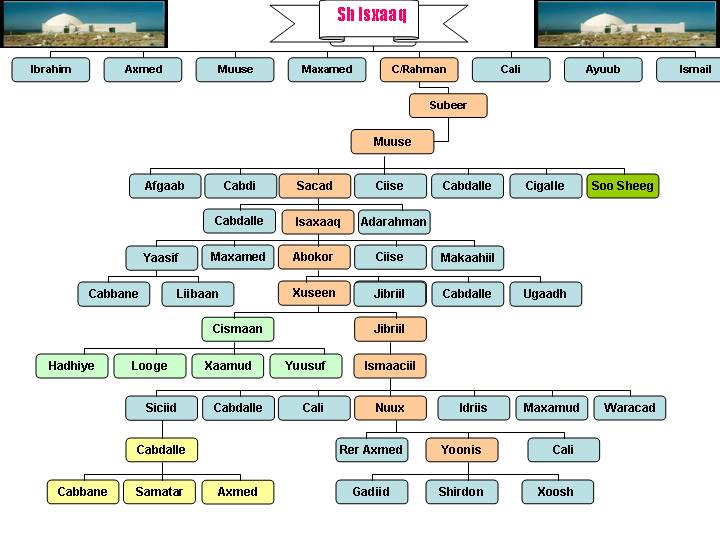
Subscribe to:
Posts (Atom)