Showing posts sorted by relevance for query Mogadishu. Sort by date Show all posts

Saturday, February 11, 2012

Response Somalia: Reer Hamar

Response Somalia: Reer Hamar
LANDINFO – WWW.LANDINFO.NO – E-MAIL: LANDINFO@LANDINFO.NO 17DECEMBER 2009 1
Response
Somalia: Reer Hamar
Topics/questions:
• How is the security situation for Reer Hamar at the moment? Can they protect
themselves, and can they rely on some sort of clan protection?
• Which groups fall under the broad term Benadiri? (Reer Hamar and subgroups such
as Bandhabow, Reer Merka, Ashraaf (are all Ashraaf considered Benadiri?),
Shangani, etc.)
• Which geographical area is Benadir exactly? Mogadishu-Marka only, or all the way
to Kismayo?
• Where is the dialect Reer Hamar spoken? Only in the traditionally Reer Hamar
districts in Mogadishu, or in other districts as well? What about areas outside
Mogadishu?
Security situation
During fact finding missions to Nairobi in June 2008 and March 2009, Landinfo discussed the
security and human rights situation related to minorities, i.e. Bantu, Midgan-groups and
Benadiris, with both international and Somali sources. None of them had specific updated
information concerning Benadiris, and there is for instance no credible information on the
number of Reer Hamar living in Mogadishu today.
The lack of updated information is due to the absence of international human rights observers
on the ground in South and Central Somalia, and to the fact that local Somali human rights
organizations do not have a specific focus on minorities. Somali NGOs are clan-based and
clan loyalties are strong. Some well-informed observers who cooperate with local Somali
NGOs informed Landinfo in 2007 that minorities’ rights are not at the top of the agenda,
neither for Somali politicians nor for Somali human rights defenders. These views were
shared by other well-informed sources in Nairobi in June 2008 and March 2009.
The lack of specific information could also be explained in another way: minorities, including
both Benadiris and other Somalis, face more or less the same security-related problems, cf.
that the ongoing fighting between the TFG forces and the insurgents mostly takes place in
residential areas. Civilians are killed by grenades or roadside bombs, regardless of their clan
Response Somalia: Reer Hamar
LANDINFO – WWW.LANDINFO.NO – E-MAIL: LANDINFO@LANDINFO.NO 17DECEMBER 2009 2
background or ethnic affiliation. There is no information indicating that members of the Reer
Hamar community are being specifically targeted. Assassinations and politically motivated
killings target journalists, TFG members and key personnel belonging to the police and
security forces.
Many members of the remaining Reer Hamar community have probably adapted to the
shifting security environment through the past decade, either by buying protection from the
various militias and local warlords that controlled the neighbourhoods of Mogadishu1 or by
marrying off their daughters to militia members; the so called black cat arrangement. These
kind of arrangements were common until the Union of Islamic Courts took control of
Mogadishu in 2006.2 Then the situation for the inhabitants of Mogadishu, including the Reer
Hamar community, improved, mainly because crime was reduced (interviews in Nairobi,
March 2007).
Which groups do fall under the broad term Benadiri?
The term Benadiri has only been used about people since 1991. Before that it was strictly a
geographical term referring to the southern Somali coast.
According to Reese (2008), the Benadiris belong to a number of largely urban lineages from
Mogadishu, Marka and Barawe (Brava). Some of these lineages claim foreign origins
(Yemen, Persia, Spain, etc.), while the Moorshe for instance regard themselves as an offshot
of the Ajuran, a pastoral group believed to have ruled the southern interior during the
sixteenth and seventeenth centuries. According to current oral traditions, five of the eight
Bandawow sub-lineages also have pastoral origins (Reese 2008). So the Benadiri do actually
not constitute a clan at all – that is, they do not all claim to be descendants from the same
ancestor. They are a group or category of clans, including sub-clans, of light skin (so called
gibilcad in Somali), and of partly Arab descent. They are allied with and indentified with
other sub-clans.
According to different Reer Hamar sources (interviews in Nairobi 2002-2007, interviews in
Oslo august 2005) there are four major Reer Hamar clans (Somali: afarta reer xamar). These
are the Moorshe, Iskashato, DhabarWeyne and the Bandawow. In addition to these, there are
many other smaller groups. Different sources mention different numbers of groups etc.,
1 According to representatives from the Shansiye, “every door” paid 3 000 somali shilling in protection money
on a daily basis (interview in Nairobi, September 2005).
2 According to representatives from Shansiye interviewed by Landinfo in Nairobi in September 2005, the socalled
dark-skinned Benadiris, i.e. Moorshe, Bandawow and Dhabarweyne, were protected by their Somali
neighbours because they were dark-skinned (and presumed to be more native Somali), while most of the lightskinned
Benadiris had fled at the beginning of the civil war (1991-1992). Furthermore, the majority of the darkskinned
Reer Hamar stayed until the mid 1990s, when many of them left the country. These representatives
claimed at the time that very few Reer Hamar still lived in Mogadishu, and a representative from the human
rights organisation DIJHRO told Landinfo in September 2005 that members of the minority communities that
used to live in Shangani had left during the civil war.
Several both Somali and international sources Landinfo met with during the fact finding mission in 2005, as well
as during later missions, stated that members of these groups were not targeted because of their ethnic origin.
One well-informed Somali source stated in 2005 that one of the deputy mayors of Mogadishu at that time was
Reer Hamar. Other sources have later explained that the so-called black cat arrangements are no longer a
necessity since the previous oppressors no longer are in control in Hamar Weyne.
Response Somalia: Reer Hamar
LANDINFO – WWW.LANDINFO.NO – E-MAIL: LANDINFO@LANDINFO.NO 17DECEMBER 2009 3
implying that some groups might actually be subgroups of other groups. The Ashraf in Bay
region, however, are not classified as Benadiris since they are part of the Rahanweyne clan
(Ashraf Sarman), while the Ashraf of Mogadishu do belong to the Reer Hamar. According to
representatives from Reer Hamar groups consulted by the joint British, Danish and Dutch
fact-finding mission to Nairobi in 2000, the Ashraf are divided into the following groups:
• Hussein: Reer Sharif Maqbuul, Sharif Ahmed, Sharif Ba-Alawi.
• Hassan: Mohamed Sharif, Sharif Ali, Sharif Ahmed, Ashraf Sarman.
According to another account, five major Ashraf lineages were found in Somalia at the end of
the nineteenth century (Reese 1996). The Ahmad, Jamal al-Leyl and Bah Alawi, claiming
descent from Husayn, formed the majority living in the coastal towns. The much smaller
Umar and Abdullah lineages, progeny of Hasan, lived as farmers and herders in the interior.
However, these lists must not be taken as definitive. There are other groups such as the Ashraf
Hassan al-Ahdali of Marka (Virginia Luling, e-mail communication 20 October 2006).
The Geledi and the Begedi could, according to the British anthropologist and researcher
Virginia Luling, also be considered as Benadiris because they consist of subclans which are
conventionally described as light-skinned (gibilcad), with members generally noticeably
lighter in complexion than their neighbours. (This is a conventional classification, however,
and not all the members of these subclans are equally light-skinned). These subgroups trace
their descent to the Arabian peninsula (e-mail communication 25 April 2005). Not all Geledi
are gibilcad – they include dark-skinned subclans as well. Dr Ahmed Sharif Abbas supports
this, and has stated that the Reer Hamar community itself recognises the Geledi and the
Begedi as Benadiri (interview, 16 March 2005).3
Some of the lineages in Mogadishu can also be found in Marka and Barawe, where these and
other lineages are collectively known as Reer Marka and Reer Barawe.
Which geographical area is Benadir exactly? Mogadishu-Marka only, or all the way to
Kismayo?
The Benadir region as the term is used today only includes Mogadishu and its surroundings,
but traditionally the term referred to the Benadir coast which included Mogadishu, Marka and
Barawe.
3 There is some confusion among scholars as to whether the Geledi should be classified as Benadiri or belonging
to the Digil clan-family. In fact, both are true. The Digil, which is one of the two big southern agricultural clanfamilies,
consists of many federated small groups, rather than being strictly all of one descent like the clans of
the northern/pastoral tradition, the Hawiye, Darod and Isaq clan-families. The other large southern clan-family is
the Rahanweyn (Mirifle). They also have a mixed or federal structure (the Geledi are also sometimes classified
as Rahanweyn). The essential point here is that in the northern/pastoral tradition a person cannot belong to two
different clans, unless one of them is a subdivision of the other. The same individual cannot be both Darod and
Hawiye. Among the Digil and Rahanweyn (Mirifle) on the other hand, it is, according to Lewis (1994) and other
sources, perfectly possible to belong to two clans or clan-families at once, because a group from one has been
adopted into the other or has federated with it. Many people in these southern clans have a dual identity in this
way (e-mail V. Luling, 25 April 2005).
Response Somalia: Reer Hamar
LANDINFO – WWW.LANDINFO.NO – E-MAIL: LANDINFO@LANDINFO.NO 17DECEMBER 2009 4
Where is the dialect Reer Hamar spoken? Only in the traditionally Reer Hamar districts
in Mogadishu, or in other districts as well? What about areas outside Mogadishu?
No linguistic work has been done in Somalia since the 1980s, and Marcello Lamberti’s study
Die Somali-Dialekte (1986) is one of the very few existing comparative studies of the various
Somali dialects. According to this study, as well as other Somali sources, including Dr
Ahmed Sharif Abbas, leader of the United Somali Benadiir Council in London (interview in
London, 16 March 2005), the Hamar-dialect is still spoken by Reer Hamar members in Hamar
Weyne. Dr Abbas also stated that Reer Hamar living outside Hamar Weyne, particularly the
older generation, have kept their dialect. Dr Abbas, who (at the time) cooperated with British
authorities in order to identify Benadiri asylum seekers, did, however, not exclude non-Hamar
speaking applicants from being Reer Hamar since obviously not all actually speak the dialect.
Dr. Martin Orwin, lecturer in Somali and Amharic at University of London’s School of
Oriental and African Studies (SOAS), has underlined (personal communication 16 November
2006) another important aspect: Other Somalis growing up and living in the same
neighbourhood as the Reer Hamar probably also know and speak the Hamar dialect.
Moreover, in most countries speakers of one dialect or language naturally come into direct or
indirect contact with those of neighbouring (or culturally) dominant languages or dialects
through business and trade relations, daily life or intermarriages. Whatever the degree or
nature of contact between neighbouring peoples, it is generally sufficient to lead to some kind
of linguistic interinfluencing, affecting not only the ethnic Somalis living in the Reer Hamar
neighbourhood, but also the Reer Hamar within Hamar Weyne and in other parts of the city.
A response consists of answers to specific questions presented to Landinfo by case workers
within the Norwegian immigration authorities. Responses are not intended to provide
exhaustive reviews of a topic or theme, but should answer the specific questions posed and
include relevant background information.
References
Written sources
• Danish Immigration Service (2000, December). Report on minority groups in
Somalia. Copenhagen: Danish Immigration Service. Available from
http://www.unhcr.org/refworld/docid/3ae6a5fa0.html [accessed 17 December 2009]
• Lamberti, M. (1986). Die Somali-Dialekte. Hamburg: Helmut Buske Verlag.
• Reese, S. (1996). Patricians of the Benadir. Unpublished thesis for the University of
Pennsylvania.
• Reese, S. (2008). Renewers of the age. Holy men and social discourse in colonial
Benaadir. Leiden/Boston: Brill.
Oral sources
• Abbas, Ahmed Sharif. Leader of the United Somali Benadiir Council in London.
Interview in London 16 March 2005.
Response Somalia: Reer Hamar
LANDINFO – WWW.LANDINFO.NO – E-MAIL: LANDINFO@LANDINFO.NO 17DECEMBER 2009 5
• International sources. Interviews in Nairobi, September 2005, March 2007, June 2008,
March 2009.
• Luling, Virginia. E-mail communications 25 April 2005 and 20 October 2006.
• Orwin, Martin. Lecturer in Somali and Amharic, University of London’s School of
Oriental and African Studies (SOAS). Personal communication 16 November 2006.
• Reer Hamar source. Interview in Oslo, August 2005.
• Somali sources. Interviews in Nairobi, September 2005, March 2007, June 2008,
March 2009.
© Landinfo 2009
The material in this report is covered by copyright law. Any reproduction or publication of this report or
any extract thereof other than as permitted by current Norwegian copyright law requires the explicit
written consent of Landinfo.

Monday, April 9, 2012

SOMALI BANADIRI , ASHRAAF AND ARABS OF THE SOUTH

The Benadiri elders distinguished:


- four Hamar groups:

• Qalmashube

• Dhabar Weyne

• Shanshiya

• Morshe (Moorshe)


Amarani, as part of the Benadiri. The Amarani, hardly a thousand in number, are supposed to be descendants of an Israeli group chased away from southern Arabia by Islam. Their name comes from one of the oldest areas of Mogadishu, Hamar Weyne, which they founded before the arrival of the Somali in the interior. They speak a dialect that is typically urban, Chimbelazi, that is tinged with Portuguese, Swahili, Arabic and Somali and which has come to be known as Cimini.


After some discussion they added that the Bandhawaw and Reer Faqi also belonged in this category.

- five Shangani groups, e.g.:

• Amudi

• Baa Fadal

• Reer Sheich

• Abakarow

- twelve 'caps' (sub-groups) in Merka, e.g.:

• Shukereere

• Ahmed Nur

• Reer Maanyo

• Ali'iyo Mohamed

• Duruqbe

• Gameedle

- and the Ashraf.

The elders explained that before the civil war the Benadiri in Mogadishu used to live only in the quarters of Hamar Weyne, Shingani and Bondere. Now Benadiri live in all quarters of Mogadishu.


Another sub-division is made between 'light-skinned' ('gibil ad') and 'black-skinned' ('gibil madow') Benadiri.

Benadiri intermarry, but the elders stated that 'light-skinned' Benadiri do not marry 'black-skinned' Benadiri like Moorshe or Dhabar Weyne.52


The delegation also held a meeting with representatives of the Ashraf (Asharaf, Asheraf, Sharifians) community in Nairobi including elders and women. They were all refugees from the coastal areas of Somalia.


The Ashraf elders interviewed by the delegation readily identified themselves as Benadiri. The Ashraf elders made it clear that only one Ashraf group (or clan) exists in Somalia.53 However, this group is further sub-divided on the lines of their male ancestors. The Ashraf of Bay and Gedo regions (Baidoa, Hoddur, Bardera) are the same group as the Ashraf in the coastal areas. One subgroup of the Ashraf called Ashraf Sarman lives mainly in Hoddur (Bakool region), Bay region, Bardera (Gedo region) and Mogadishu. Other sub-groups called Mohammed Sharif, Sharif Ali and Sharif Ahmed live mainly in Kismayo, Merka, Bardera, Jalalaqsi, Jowhar and Mogadishu.An NGO informant explained on an earlier occasion to the Netherlands Embassy in Nairobi that there are various sub-groups of the Ashraf, including the Sarman who reside in Bay region.

According to this source, the Ashraf Sarman have the same skin colour as Somalis, while the Ashraf in Merka have light skin.

The Ashraf elders sub-divided the Ashraf in the following way:

- Hussein:

• Reesharif Magbuul

• Sharif Ahmed

• Sharif Baalawi

- Hassan:

• Mohammed Sharif

• Sharif Ali

• Sharif Ahmed

• Ashraf Sarman.

The Ashraf elders trace their origin to the Prophet Mohamed, whose daughter Fatima had two sons with Ali, named Hassan and Hussein. Any member of the Ashraf community belongs to one of these two lines of descent, from Hassan or Hussein, and any Ashraf (both females and males from the age of two) is able to identify her- or himself as belonging to one of these two lines. The Prophet Mohamed conferred the title "Sharif" upon Hassan and Hussein. Since that time, all their descendants have the name Sharif as part of their name, added to the personal name and the father's, and sometimes the grandfather's, name. From this comes the name of the group, Ashraf being the

plural of Sharif. Ali had children by other wives after the death of Fatima, but they were not"Sharif".The Ashraf elders indicated that the Ashraf are living in southern and central Somalia, especially in urban locations like Bardera, Kismayo, Baidoa, Hoddur, Merka, Brava and Mogadishu.

In Mogadishu the largest concentration of Ashraf was to be found in the Shingani district, but they

also lived in Hamar Weyne. Ashraf used to live also in Ethiopia. Some Ashraf from Ethiopia

became exiled in Somalia at the time of the Ogaden war in 1977. These Ashraf came from Ogaden,

Oromia, Dire Dawa and Harar in Ethiopia and some of them fled Somalia in 1991-92. Those

remaining in Somalia reside with other Ashraf.

UN sources confirmed that Ashraf communities are also to be found in the Ogaden district of

Ethiopia.

The elders from Brava told the delegation that they consisted of two sub-groups: the Bravanese and

the Tunni. Both groups are from Brava and they share to a large extent the same culture. They

intermarry between their groups. However, the Bravanese consider themselves Benadiri, while the

Tunni do not. The Bravanese are of Persian/Arab/Portuguese/Spanish origin. According to the

Bravanese elders the Tunni belong to the Digil clan-family. They are originally from the region of

Brava. However, the elders gave the delegation a copy of a letter, written by the Baravani elders in

Nairobi to a number of organisations (including UNHCR, the US Immigration Department and

Amnesty International) on their situation in Kenya, in which the Tunni are mentioned with the

Bravanese as part of the Baravani community (see annex 8).

The UNHCR overview classifies the Tunni with the Digil (annex 3).

Report on minority groups in Somalia

42 17 – 24 Septemer 2000

The Bravanese sub-divided themselves into:

• Bida

• Hatimi

• Ashraf

The Tunni explained that they are sub-divided into the Tunni Torre plus five gamas (sub-groups):

• Da'afarad

• Goygal

• Daqtiro

• Hayo

• Werile

Perouse de Montclos54 notes that some of the Tunni Torre of the hinterland claim a relationship

with the Ajuran, the Gaaljaal and the Gurreh of the Hawiye clan family, while others claim a

relationship with the Helai and the Hadam of the Rahanweyn clan-family. In concrete terms, they

are the vassals of the Tunni Digil of the Brava Coast.

According to Perouse de Montclos, 'Reer Brava' designates a territorial community. The confusion

between territory and clan or ancestral identity brought about the grouping of a much larger body of

people than one would have expected from a minority group of traders of foreign origin.

Historically, in Brava (like in Merka) the Arabs from Zanzibar allied with the Tunni, a Digil clan, in

order to counter the Hawiye from the hinterland. Brava was the scene of numerous battles, against

the Portuguese, Omanis, British, Egyptians, Italians and Somali of the interior (Rahanweyn and

Dir), many of them establishing lineage. As a consequence, the races in the city were completely

'mixed up'. Although the common hardships and tragedies experienced during and after the 1990

civil war certainly reinforced the sentiment of an identity and uniqueness, on closer inspection we

discover communities with very diverse backgrounds despite numerous instances of intermarriage.

On the one hand there are immigrants of Arab origin, while on the other hand there are the Somali

of the Brava surroundings, whose minority status is more doubtful because they are part of the

Tunni lineage of the Digil.

7.2 Language

According to the Benadir community in Nairobi the Benadir populations in Somalia generally speak

a dialect that is different from the dialect of the major Somali clans. Even within this dialect there

are sub-dialects: the dialect spoken by the Benadiri of Mogadishu is called Af-Reer Hamar, that

spoken by the Benadiri of Merka is called Af-Merka, and the dialect spoken by the Benadiri in

Brava and further south is called Af-Brava. The Af-Brava dialect is not understood by the other

Benadiri.55 An informant of the Netherlands Embassy stated earlier that the Ashraf in Bay area

speak the Rahanweyn dialect.

Most of the Benadiri, including the women, are able to speak and understand the Somali language.

54 Perouse de Montclos (1997)

55 Cassanelli (1995) mentions that most Bravanese spoke Chimini, a dialect of Swahili, rather than Somali as their

primary language.

Report on minority groups in Somalia

17 – 24 September 2000 43

7.3 Socio-economic situation

7.3.1 Relationship with other groups and clans

The Benadiri elders told the delegation that the Benadiri who are still in Somalia have no protection

from any clan; on the contrary, they live under occupation by Somali clans and militias. In available

reports on the situation of the Benadiri before the war, no indications have been found that Benadiri

stood in a relation of clientship or protection to main Somali clans.

According to UN and NGO sources consulted earlier by the Netherlands Embassy, the Benadiri

look down upon pastoralists and keep to their own identity.

Intermarriage between Benadiri and the Somali clans was rare and not generally accepted.56

The Ashraf elders explained that the Ashraf have no particular affiliation with any of the major

Somali clans. They stated that they used to have good relations with all other clans in Somalia.

They were considered a highly respected clan of devout religious members. They travelled widely

throughout Somalia as religious teachers and were well received by other clans. Under the Siad

Barre regime the Ashraf did not as a group face any security or human rights problems in Somalia.

Intermarriage between members of the Ashraf community in Somalia and members of the major

Somali clans was rare, according to the Ashraf community in Nairobi, although some intermarriage

occurred with the Hawiye (while during the last ten years forced marriages took place with Hawiye

and even Majerteen). Marriage takes places almost exclusively within the Ashraf community itself.

A relatively large number of the representatives of the Ashraf community in Nairobi with which the

delegation met were related to each other.

7.3.2 Occupations

The Benadiri elders stated that the Benadiri were an urban and educated people, who worked almost

exclusively in commercial occupations. The elders mentioned business, fishery, construction, metal

work, carpentry, tailoring, weaving and gold smithing as the occupational sectors of the Benadiri.

They also mentioned that some Benadiri were medical doctors, engineers or economists. Benadiri

women might sell snacks or handicrafts.57

The Bravanese and Tunni elders said their people were also commercially orientated or working as

craftsmen.

The Ashraf elders explained that the Ashraf are a religious people. They were traditionally

considered a highly respected clan whose members travelled throughout Somalia as religious

teachers. Before the civil war a relatively large number of Ashraf received education in Somalia,

and during the Siad Barre administration a number of Ashraf were employed as civil servants in the

administration while others were businesspeople and therefore travelled frequently throughout the

country.

56 Cassanelli (1995) mentions that most of the established urban families tended to marry among themselves, as a

cultural preference and perhaps as a way of keeping wealth "in the neighbourhood".

57 See also Danish Immigration Service (Udlændingestyrelsen), Notat om Benadir-befolkningen i Somalia (in Danish),

(June 2000)

Report on minority groups in Somalia

44 17 – 24 Septemer 2000

Benadiri mostly were self-employed and had a reluctance to working for someone else. They have

great entrepreneurial talents.58

7.4 Security and human rights

All three groups of Benadiri elders stated that during the civil war in 1991 and 1992 the Benadiri

suffered seriously. Lacking any tradition of warfare and any militia, they were often attacked and

targeted by looters, who considered them to be very rich, owing to their trade.59 Cassanelli (1995)

claims that many southern minorities were accused by Somali militias of helping to sustain the

Barre government in its later years. The Ashraf, however, stated that they were not persecuted

because of any perceived close links with Siad Barre.

During its mission to Mogadishu in 1997 the Danish Immigration Service learned from the Dr.

Ismail Jum'ale Human Rights Organisation and from representatives of the Reer Hamar community

in Mogadishu that the Reer Hamar are considered a wealthy business community by members of

the Somali clans and the militias. Because of this, and because the Reer Hamar are unarmed, their

homes were repeatedly looted. The same sources estimated that more than 70% of the Reer Hamar

population in Mogadishu fled the country during the civil war. In January 1999 the War-torn

Societies Project (WSP) in Nairobi and other UN agencies informed the Danish Immigration

Service that the Benadiri community was still facing serious human rights violations in Mogadishu,

and that members of this community would probably never be able to return in safety to

Mogadishu.60

The Ashraf elders stated that there are several reasons why members of the Ashraf community have

fled Somalia. To some degree members of the Ashraf are considered as 'strangers' in Somalia by the

major Somali clans. The Ashraf claim to originate in Arabia and are called "Arabs" by other

Somalis. They are considered to be a weak, unarmed religious group with no social or legal rights.

Many Benadiri women were raped or forced into marriage, as the Benadiri elders confirmed to the

delegation. The Ashraf elders stated that their identity as a specific ethnic group has been weakened

since the war, as Ashraf women have been abducted, raped or forced into marriage with members of

other Somali clans.

Kalunga Lutato explained that the Bravanese would not normally intermarry with members of the

main Somali clans or other groups and consequently their own distinct ethnicity was fairly well

preserved. They were, in a way, an isolated and distinct people and their property, and their women,

were beyond the reach of members of the Somali clans. When the state collapsed and the Bravanese

lost their "protection" from the central government they soon became targets for various militias

that raged through the coastal areas of central and southern Somalia. The militias especially targeted

Bravanese women and many were raped or forced into marriage with non-Bravanese Somalis. The

Bravanese women were seen as "attractive" in the sense that before the collapse of government they

were "inaccessible" but when the government fell they were easy victims.

58 Refugee Information Series, Benadir refugees from Somalia (Washington 1996)

59 Human Development Report Somalia 1998, UNDP (Nairobi, 1998); Cassanelli (1995)

60 Danish Immigration Service/Swedish Immigration Board, Report on Nordic fact-finding mission to Mogadishu,

Somalia (Copenhagen 1997) and Danish Immigration Service (Udlændingestyrelsen), Notits om Benadir-befolkningen i

Somalia (Copenhagen, January 1999, in Danish).

Report on minority groups in Somalia

17 – 24 September 2000 45

The Benadiri have all lost property in Somalia during the war. The majority of Benadiri fled the

country, mainly to Kenya.61 Members of Somali clan militias took the majority of Benadiri homes.

The Benadiri elders stated that there are still Benadiri in Mogadishu and Merka today, although they

could not say how many. Those who are still living in Somalia have seen their houses taken by

members of Somali clan militias, although sometimes the owners could stay in one room of their

house.

The Benadiri elders were fairly sure that none of the Benadiri that fled to Kenya had since returned

to Somalia. They described the situation of the Benadiri that remained in Mogadishu and Merka as

difficult, as they cannot rebuild their businesses in the presence of the militias, for fear that their

resources would again be taken. The elders stated that a few Benadiri had relocated to Bosasso in

Puntland, either to seek work there or to move on from there to Yemen, although none of the elders

had personal knowledge of any person now in Bosasso, or Hargeisa.

The Bravanese and Tunni elders said that although in the civil war Brava was most affected62, the

majority of Bravanese remained in the town. They stated that today about 70% of the Bravanese

still live in Brava63, living under the occupation of Aideed's Habr


Which groups do fall under the broad term Benadiri?

The term Benadiri has only been used about people since 1991. Before that it was strictly a

geographical term referring to the southern Somali coast.

According to Reese (2008), the Benadiris belong to a number of largely urban lineages from

Mogadishu, Marka and Barawe (Brava). Some of these lineages claim foreign origins

(Yemen, Persia, Spain, etc.), while the Moorshe for instance regard themselves as an offshot

of the Ajuran, a pastoral group believed to have ruled the southern interior during the

sixteenth and seventeenth centuries. According to current oral traditions, five of the eight

Bandawow sub-lineages also have pastoral origins (Reese 2008). So the Benadiri do actually

not constitute a clan at all – that is, they do not all claim to be descendants from the same

ancestor. They are a group or category of clans, including sub-clans, of light skin (so called

gibilcad in Somali), and of partly Arab descent. They are allied with and indentified with

other sub-clans.

According to different Reer Hamar sources (interviews in Nairobi 2002-2007, interviews in

Oslo august 2005) there are four major Reer Hamar clans (Somali: afarta reer xamar). These

are the Moorshe, Iskashato, DhabarWeyne and the Bandawow. In addition to these, there are

many other smaller groups. Different sources mention different numbers of groups etc.,

1 According to representatives from the Shansiye, “every door” paid 3 000 somali shilling in protection money

on a daily basis (interview in Nairobi, September 2005).

2 According to representatives from Shansiye interviewed by Landinfo in Nairobi in September 2005, the socalled

dark-skinned Benadiris, i.e. Moorshe, Bandawow and Dhabarweyne, were protected by their Somali

neighbours because they were dark-skinned (and presumed to be more native Somali), while most of the lightskinned

Benadiris had fled at the beginning of the civil war (1991-1992). Furthermore, the majority of the darkskinned

Reer Hamar stayed until the mid 1990s, when many of them left the country. These representatives

claimed at the time that very few Reer Hamar still lived in Mogadishu, and a representative from the human

rights organisation DIJHRO told Landinfo in September 2005 that members of the minority communities that

used to live in Shangani had left during the civil war.

Several both Somali and international sources Landinfo met with during the fact finding mission in 2005, as well

as during later missions, stated that members of these groups were not targeted because of their ethnic origin.

One well-informed Somali source stated in 2005 that one of the deputy mayors of Mogadishu at that time was

Reer Hamar. Other sources have later explained that the so-called black cat arrangements are no longer a

necessity since the previous oppressors no longer are in control in Hamar Weyne.

Response Somalia: Reer Hamar

LANDINFO – WWW.LANDINFO.NO – E-MAIL: LANDINFO@LANDINFO.NO 17DECEMBER 2009 3

implying that some groups might actually be subgroups of other groups. The Ashraf in Bay

region, however, are not classified as Benadiris since they are part of the Rahanweyne clan

(Ashraf Sarman), while the Ashraf of Mogadishu do belong to the Reer Hamar. According to

representatives from Reer Hamar groups consulted by the joint British, Danish and Dutch

fact-finding mission to Nairobi in 2000, the Ashraf are divided into the following groups:

• Hussein: Reer Sharif Maqbuul, Sharif Ahmed, Sharif Ba-Alawi.

• Hassan: Mohamed Sharif, Sharif Ali, Sharif Ahmed, Ashraf Sarman.

According to another account, five major Ashraf lineages were found in Somalia at the end of

the nineteenth century (Reese 1996). The Ahmad, Jamal al-Leyl and Bah Alawi, claiming

descent from Husayn, formed the majority living in the coastal towns. The much smaller

Umar and Abdullah lineages, progeny of Hasan, lived as farmers and herders in the interior.

However, these lists must not be taken as definitive. There are other groups such as the Ashraf

Hassan al-Ahdali of Marka (Virginia Luling, e-mail communication 20 October 2006).

The Geledi and the Begedi could, according to the British anthropologist and researcher

Virginia Luling, also be considered as Benadiris because they consist of subclans which are

conventionally described as light-skinned (gibilcad), with members generally noticeably

lighter in complexion than their neighbours. (This is a conventional classification, however,

and not all the members of these subclans are equally light-skinned). These subgroups trace

their descent to the Arabian peninsula (e-mail communication 25 April 2005). Not all Geledi

are gibilcad – they include dark-skinned subclans as well. Dr Ahmed Sharif Abbas supports

this, and has stated that the Reer Hamar community itself recognises the Geledi and the

Begedi as Benadiri (interview, 16 March 2005).3

Some of the lineages in Mogadishu can also be found in Marka and Barawe, where these and

other lineages are collectively known as Reer Marka and Reer Barawe.

Which geographical area is Benadir exactly? Mogadishu-Marka only, or all the way to

Kismayo?

The Benadir region as the term is used today only includes Mogadishu and its surroundings,

but traditionally the term referred to the Benadir coast which included Mogadishu, Marka and

Barawe.

3 There is some confusion among scholars as to whether the Geledi should be classified as Benadiri or belonging

to the Digil clan-family. In fact, both are true. The Digil, which is one of the two big southern agricultural clanfamilies,

consists of many federated small groups, rather than being strictly all of one descent like the clans of

the northern/pastoral tradition, the Hawiye, Darod and Isaq clan-families. The other large southern clan-family is

the Rahanweyn (Mirifle). They also have a mixed or federal structure (the Geledi are also sometimes classified

as Rahanweyn). The essential point here is that in the northern/pastoral tradition a person cannot belong to two

different clans, unless one of them is a subdivision of the other. The same individual cannot be both Darod and

Hawiye. Among the Digil and Rahanweyn (Mirifle) on the other hand, it is, according to Lewis (1994) and other

sources, perfectly possible to belong to two clans or clan-families at once, because a group from one has been

adopted into the other or has federated with it. Many people in these southern clans have a dual identity in this

way (e-mail V. Luling, 25 April 2005).

Response Somalia: Reer Hamar

LANDINFO – WWW.LANDINFO.NO – E-MAIL: LANDINFO@LANDINFO.NO 17DECEMBER 2009 4

Where is the dialect Reer Hamar spoken? Only in the traditionally Reer Hamar districts

in Mogadishu, or in other districts as well? What about areas outside Mogadishu?

No linguistic work has been done in Somalia since the 1980s, and Marcello Lamberti’s study

Die Somali-Dialekte (1986) is one of the very few existing comparative studies of the various

Somali dialects. According to this study, as well as other Somali sources, including Dr

Ahmed Sharif Abbas, leader of the United Somali Benadiir Council in London (interview in

London, 16 March 2005), the Hamar-dialect is still spoken by Reer Hamar members in Hamar

Weyne. Dr Abbas also stated that Reer Hamar living outside Hamar Weyne, particularly the

older generation, have kept their dialect. Dr Abbas, who (at the time) cooperated with British

authorities in order to identify Benadiri asylum seekers, did, however, not exclude non-Hamar

speaking applicants from being Reer Hamar since obviously not all actually speak the dialect.

Dr. Martin Orwin, lecturer in Somali and Amharic at University of London’s School of

Oriental and African Studies (SOAS), has underlined (personal communication 16 November

2006) another important aspect: Other Somalis growing up and living in the same

neighbourhood as the Reer Hamar probably also know and speak the Hamar dialect.

Moreover, in most countries speakers of one dialect or language naturally come into direct or

indirect contact with those of neighbouring (or culturally) dominant languages or dialects

through business and trade relations, daily life or intermarriages. Whatever the degree or

nature of contact between neighbouring peoples, it is generally sufficient to lead to some kind

of linguistic interinfluencing, affecting not only the ethnic Somalis living in the Reer Hamar

neighbourhood, but also the Reer Hamar within Hamar Weyne and in other parts of the city.

A response consists of answers to specific questions presented to Landinfo by case workers

within the Norwegian immigration authorities. Responses are not intended to provide

exhaustive reviews of a topic or theme, but should a


..


HISTORY OF MOGADISHO 1200 AND AJUURAN RULERS

Mogadishu and Its Banaadir Hinterlands


HISTORY OF MOGADISHO 1200 AND AJUURAN RULERS


In the eighteenth and nineteenth centuries, the southern city of Mogadishu became Somalia's most important city. Mogadishu, Merca, and Baraawe, had been major Somali coastal towns in medieval times. Their origins are unknown, but by the fourteenth century travelers were mentioning the three towns more and more as important centers of urban ease and learning. Mogadishu, the largest and most prosperous, dates back at least to the ninth century, when Persian and Arabian immigrants intermingled with Somali elements to produce a distinctive hybrid culture. The meaning of Mogadishu's name is uncertain. Some render it as a Somali version of the Arabic "maqad shah," or "imperial seat of the shah," thus hinting at a Persian role in the city's founding. Others consider it a Somali mispronunciation of the Swahili "mwyu wa" (last northern city), raising the possibility of its being the northernmost of the chain of Swahili city-states on the East African coast. Whatever its origin, Mogadishu was at the zenith of its prosperity when the well-known Arab traveler Ibn Batuta appeared on the Somali coast in 1331. Ibn Batuta describes "Maqdashu" as "an exceedingly large city" with merchants who exported to Egypt and elsewhere the excellent cloth made in the city.

Through commerce, proselytization, and political influence, Mogadishu and other coastal commercial towns influenced the Banaadir hinterlands (the rural areas outlying Mogadishu) in the fifteenth and sixteenth centuries. Evidence of that influence was the increasing Islamization of the interior by sufis (Muslim mystics) who emigrated upcountry, where they settled among the nomads, married local women, and brought Islam to temper the random violence of the inhabitants.

By the end of the sixteenth century, the locus of intercommunication shifted upland to the well-watered region between the Shabeelle and Jubba rivers. Evidence of the shift of initiative from the coast to the interior may be found in the rise between 1550 and 1650 of the Ujuuraan (also seen as Ajuuraan) state, which prospered on the lower reaches of the interriverine region under the clan of the Gareen. The considerable power of the Ujuuraan state was not diminished until the Portuguese penetration of the East African coast in the seventeenth and eighteenth centuries. Among Somali towns and cities, only Mogadishu successfully resisted the repeated depredations of the Portuguese.


Tuesday, July 17, 2018

Somalia: Reports of clashes between Hawiye (or subclan Hawadle) and Dir clans/sub-clans in the area of Beledweyne [Beled Weyne, Belet Weyne] in Hiiraan [Hiiran, Hiiraan] and in Mogadishu; state of interclan relations between the Hawiye and Dir in Mogadishu (2014-April 2016) Research Directorate, Immigration and Refugee Board of Canada, Ottawa

SOM105510.E

Somalia: Reports of clashes between Hawiye (or subclan Hawadle) and Dir clans/sub-clans in the area of Beledweyne [Beled Weyne, Belet Weyne] in Hiiraan [Hiiran, Hiiraan] and in Mogadishu; state of interclan relations between the Hawiye and Dir in Mogadishu (2014-April 2016)
Research Directorate, Immigration and Refugee Board of Canada, Ottawa

1. Reports of Conflict in the Area of Beledweyne

Without providing further details about the clans involved, sources report that rival clan militias have clashed in the town of Beledweyne in October 2015 (Hiiraan Online 19 Oct. 2015; VOA 19 Oct. 2015). Shabelle Media Network, a Somali news agency based in Mogadishu (AllAfrica n.d.), reports that "heavy clash has erupted again between two clan militias" in Beledweyne in December 2015 (Shabelle Media Network 13 Dec. 2015). Sources state that the conflict in October was over "tax collection" (VOA 19 Oct. 2015) or "extortion" money (Hiiraan Online 19 Oct. 2015). According to sources, on 22 January 2015, "at least" 23 people were killed in a land dispute between the Dir and Hawadle clans in the towns of Burdhinle and Hada-Ogle in the Hiraan region (US 13 Apr. 2016, 13; AFP 22 Jan. 2015).
A 2015 report by the UN Office for the Coordination of Humanitarian Affairs (UNOCHA) states that there has been fighting between Dir and Hawadle clans in and around Deefow village, which is located "40km north east of Belet Weyne" (UN 25 June 2015, 1). The report states that fighting over a land dispute has been ongoing since 2013, leading to the death of "at least 100 people," which has "also resulted in displacement of about 90 percent of people from Deefow, Kabxanle and Dom-Caday villages into Belet Weyne" (ibid.). According to the report, "militia[s] from both sides clashed" on 3 June 2015, and on 22 June 2015, "militias from the Dir clan reportedly burnt down eight houses in Guri Caddo village about 28km northeast of Belet Weyne" (ibid.).
Horseed Media, a news site run by Somali diaspora in the Netherlands and Finland (Horseed Media n.d.), reports that in March 2015, militias from the Hawadle and Surre tribes clashed in Deefow: 12 people died during the fighting, and "dozens" were injured (ibid. 21 Mar. 2015). According to a 2015 UN Security Council report, the Surre is a Dir clan "with two branches, Abadalle and Qebeys, found in Mudug, Hiran, Gedo and the Jubbas" (UN 19 Oct. 2015, 241).

2. Hawiye and Dir Interclan Relations in Mogadishu

Information on clan relations between the Hawiye and Dir clans and sub-clans, including reports of conflict, could not be found among the sources consulted by the Research Directorate within the time constraints of this Response. According to sources, the Hawiye are a "predominant" (Mail & Guardian Africa 19 May 2015) or "the traditionally dominant" clan in Mogadishu (EU Feb. 2016, 50). In a report based on its 2015 fact-finding mission to Kenya and Somalia, the Danish Immigration Service states that Mogadishu is one of the "most complicated" towns when it comes to clan composition, due to 25 years of conflict, internal displacement and population movement (Denmark Sept. 2015, 41). For further information on the situation in Mogadishu, including diaspora returnees and the security situation, see Response to Information Request SOM105094.
This Response was prepared after researching publicly accessible information currently available to the Research Directorate within time constraints. This Response is not, and does not purport to be, conclusive as to the merit of any particular claim for refugee protection. Please find below the list of sources consulted in researching this Information Request.

References

Agence France-Presse (AFP). 22 January 2015. "At Least 23 Killed in Somalia Clan Violence." [Accessed 19 Apr. 2016]
AllAfrica. N.d. "Shabelle Media Network (Mogadishu)." [Accessed 22 Apr. 2016]
Denmark. September 2015. Danish Immigration Service. South Central Somalia: Country of Origin Information for Use in the Asylum Determination Process. [Accessed 22 Apr. 2016]
European Union (EU). February 2016. European Asylum Support Office (EASO). EASO Country of Origin Information Report: Somalia Security Situation. [Accessed 19 Apr. 2016]
Hiiraan Online. 19 October 2015. "8 Killed as Rival Clan Militias Fight in Beled Weyne." [Accessed 19 Apr. 2016]
Horseed Media. 21 March 2015. A. Abdirhaman. "Deadly Clan Violence Leaves over 10 Dead in Somalia." [Accessed 19 Apr. 2016]
Horseed Media. N.d. "About Horseed." [Accessed 19 Apr. 2016]
Mail & Guardian Africa. 19 May 2015. Mikolaj Radlicki. "Who Really Rules Somalia? - The Tale of Three Big Clans and Three Countries." [Accessed 19 Apr. 2016]
Shabelle Media Network. 13 December 2015. "Somalia: Tribal Clash Erupts in Western Beledweyne City." [Accessed 19 Apr. 2016]
United Nations (UN). 25 June 2015. Office for the Coordination of Humanitarian Affairs (OCHA). Inter-Agency Initial Investigation Report - Inter Clan Fighting in Deefow. [Accessed 5 Apr. 2016]
United States (US). 13 April 2016. Department of State. "Somalia." Country Reports on Human Rights Practices for 2015. [Accessed 15 Apr. 2016]
Voice of America (VOA). 19 October 2015. Harun Maruf. "Somalia Clan Clashes Kill 14." [Accessed 19 Apr. 2016]

Saturday, June 9, 2018

SOMALIA-POLITICS: No End In Sight To Banana War-war over Bimaal Lands


 How Hawiye Habar Gidir Subdued and took the Dir Banana Farms of Jammam and the war over Bimaal Lands


Moyiga Nduru
NAIROBI, Apr 24 1996 (IPS) - A banana war between two of Somalia’s main warlords is underway over the control of the lucrative banana export trade to Europe.

The forces of Gen. Mohamed Farah Aideed, the self-proclaimed president of Somalia, are pitted against the militiamen of his former financier-turned-foe, Ali Hassan Osman “Atto”, and the fighting has been fierce.


Aideed needs the revenues, estimated at around 800,000 dollars a month, to pay his soldiers as he tries to establish his control in the Bay and Bakol regions and take on the Rahenweyne clan. Atto, in a lose alliance with another self-proclaimed president, Ali Mahdi Mohammed based in northern Mogadishu, wants to deny him.
Renewed clashes beginning last month have left scores of people dead, including Atto’s son shot by a sniper, as business leaders and elders attempt to negotiate a truce.


“We are doing our best to stop the fighting. People phone me every day from Mogadishu that they are working very hard to stop the carnage,” Hussein Ali Dualleh of the Nairobi-based Somali Affairs Monitoring Committee told IPS.


“What’s happening in Mogadishu is not a political war. It’s purely an economic war. A war sparked by an attempt to control the port of Merca and Somalia’s lucrative banana trade. That’s why the fighting is not being joined by other Somali factions,” says the former Somali ambassador to Kenya.

Merca, a small and ancient port some 90 kms south of Mogadishu, is Aideed’s economic lifeline. “The port was renovated by two tiny foreign firms — an Italian company called Somali Fruit and an American company called Sombana — when the main port of Mogadishu was closed by Ali Mahdi following a quarrel over the banana trade last year,” Dualleh explained.

“The two companies renovated Merca and pay Aideed for every carton they export 20 cents. That comes roughly to about 800,000 dollars a month during the peak season from April to August,” he says.

Additional levies bring in an additional 200,000 dollars to Aideed’s coffers each month.

Atto and Ali Mahdi blocked Aideed from using Mogadishu port last October. Fighting again flared in March when Atto demanded that the warlord either share the revenues from Merca or see that port closed.


In the battle that followed, Aideed’s forces were overrun. A full-scale war was averted after elders of the Habir Gedir clan, to which the two warlords belong, persuaded Atto’s militia to withdraw.
As they pulled back to Mogadishu, Atto’s militia felt “humiliated and bitter”, according to a Somali elder here who refused to be named, “and they immediately attacked Aideed’s forces. That’s the origin of the present conflict.”


Before Somalia collapsed into the anarchy of warlord politics with the overthrow of former dictator Siad Barre in 1991, the country was earning some 20 million dollars annually from banana exports. That represented around 15 percent of the country’s total export earnings.


The money now goes to whoever can control the fertile Lower Shabelle region and a port. Fearing that he may lose out on the banana trade, Ali Mahdi has built his own port of Al Eel Maan, 30 kms north of Mogadishu.

The current round of fighting comes at a time when the majority of Somalis struggle to survive. With the withdrawal of the U.N. peacekeeping mission in 1995 and the sharp drop in the number of foreign aid agencies willing to risk operating in Somalia, jobs are scare.


A recent report by the U.N.’s Food and Agricultural Organisation warned that poor harvests due to drought and insecurity in parts of the country have led to sharp rises in the cost of food and, with the low purchasing power of most Somalis, has caused pockets of malnutrition.


Between 1991 and 1992, some 300,000 people died of starvation and famine-related diseases as a result of the civil strife, prompting the ill-fated four billion-dollar U.S. and U.N. intervention.
Aideed, whose armed opposition to the mission led to its demise, last June declared himself president of Somalia. He has appointed a government, announced a budget, tried to collect taxes and enforce his authority from his south Mogadishu headquarters. Only Libya has recognised him.


He is resisted by the other warlords, not least Ali Mahdi and his Abgal clan, which retains control of the northern half of a divided Mogadishu. In other parts of the country, clan-based statelets have emerged and, since 1991, the north-western region has proclaimed itself independent as Somaliland.


Last week, several small Somali political parties formed a consultation group here to seek a peaceful solution to their country’s agony after the failure of repeated attempts brokered by neighbouring Ethiopia and the Organisation of African Unity. But the meeting was not attended by Aideed, Ali Mahdi or Atto.

“I think the conference was just a political gimmick to show the world that they were still alive and kicking,” says Dualleh. “A conference to bring peace in Somalia should not be held in a hotel in Nairobi. It should be held in Somalia and the deliberations should take at least three months, not four days.”


However, the spokesman for the group, Mohamed Awale, justified the peace initiative. “The people of Somalia are suffering simply because there is no government in their country and their leaders cannot agree to produce one,” he stressed.


Somalia's post-conflict banana harvest revival
https://www.aljazeera.com/indepth/features/2015/07/somalia-post-conflict-banana-harvest-revival-150714074855951.html


https://www.tandfonline.com/doi/abs/10.1080/03056249508704133?needAccess=true&journalCode=crea20

http://www.ipsnews.net/1996/04/somalia-politics-no-end-in-sight-to-banana-war/
 
After Barren Years in Somalia, Signs of Growth in Bananas
     

n June, workers harvested bananas in Afgooye, Somalia, where the industry is being revived. Credit Daniel Berehulak for The New York Times


By ISMA’IL KUSHKUSH
Saturday, December 13, 2014

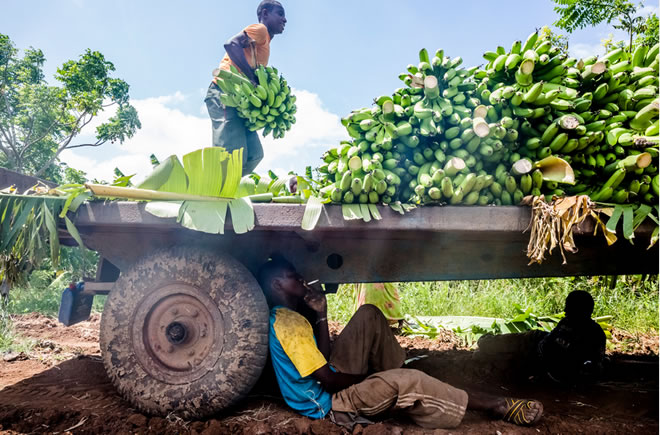
AFGOOYE, Somalia — Armed with machetes, the men push their way through the densely packed rows of trees, emerging every few minutes with large bundles of green bananas over their shoulders.
A guard, his chest crossed with bullet belts, his hands cradling a Russian-made rifle, scans the tree line for intruders as the men throw the bananas on a trailer before dashing back into the plantation for another load.

When the trailer is piled high with bananas, it is pulled by tractor to a nearby warehouse, where the fruit is sorted and boxed for transport to destinations across Somalia and as far away as the Middle East.

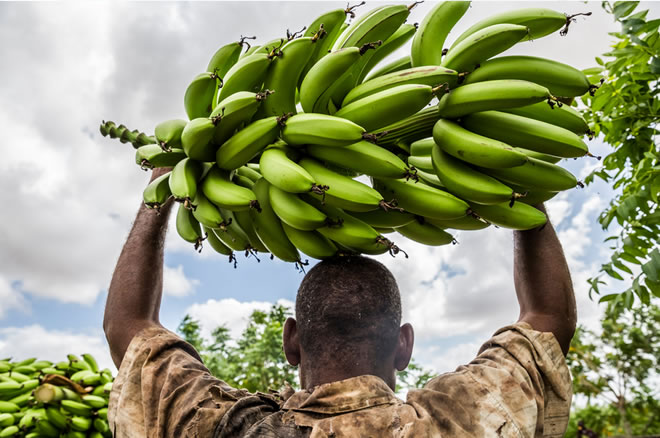
After years of warfare that decimated an industry that was once the largest in Africa, the banana is making a tentative comeback in Somalia. Farms are stepping up production and eyeing overseas markets that have been dormant for years.
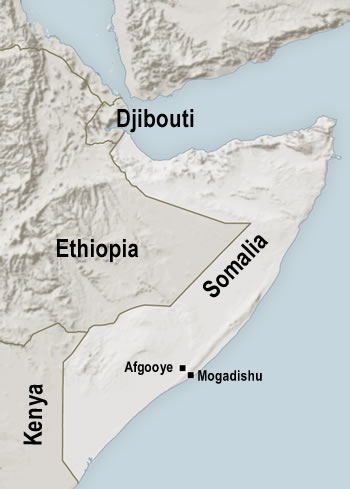
“Last April we exported to Saudi Arabia for the first time in 23 years,” said Kamal Haji Nasir, 30, whose father, owns this plantation in Afgooye, a town on the Shebelle River, about 45 minutes’ drive from Mogadishu. “We are excited and hopeful.”
For more than two decades, Somalia was the epitome of a failed state — a country rife with war, anarchy, famine, piracy and terrorism. Many of those problems persist — there has been a recent surge in attacks by Shabab militants, the government is riven with infighting and the United Nations has been warning of a growing risk of famine — but the country has nonetheless made some progress in the past few years.

Somalia elected a new president and adopted a constitution in 2012, bringing some stability, and attracting pledges of aid from international donors. Somali pirates, who once threatened international shipping in the Indian Ocean, have largely been contained and the Shabab have lost their grip over many towns.

“By any measure, Somalia today is in a better situation than it has been for the past 23 years,” said Nicholas Kay, the United Nations’ special representative for Somalia.

That stability has allowed farmers like Mr. Nasir, who studied agriculture at Mogadishu University, to return to a business that has been in his family for four generations.

Banana farming was brought to the fertile Shebelle and Juba river basins in the southern part of the country by Italian colonists in the 1920s. Soon, bananas became a major staple of Somali cuisine, consumed with rice or pasta, or just as a fruit, and farmers began exporting to Italy and the Middle East. With investment by Italian and American fruit companies, the banana trade reached its peak in the 1980s, led by the brand Somalita, which was partly owned by De Nadai, an Italian company. In 1990, Somalia’s banana exports were worth $96 million, according to Mohamood Abdi Noor, a former World Bank agricultural expert.

“The industry was doing very well and moving forward,” said Hasan Haji Osman, an agricultural consultant, who previously worked for Italian and Somali fruit companies.

That all came to a halt when civil war broke out in 1991. The government collapsed, and Somalia became a battleground in which warlords and Islamic extremists vied for control and pirates became the scourge of the surrounding seas. In what became known as “the banana wars,” rival warlords fought to control exports of the fruit as a source of hard currency. The once-thriving banana industry fell apart. Irrigation systems were damaged, plantations were abandoned, farmers were displaced and storage facilities and ports destroyed.

Mr. Osman shook his head sadly as he recalled farms lying damaged and unattended.
“What was in my head were the banana farms with no workers” and destroyed irrigation systems, he said. “I was thinking about that more than my family.”

The bananas harvested in Afgooye are sent to destinations as far away as the Middle East. Credit Daniel Berehulak for The New York Times
For those who continued to farm, the breakdown of supply chains and transport links proved to be disastrous. “There were no markets for our bananas,” said Abu Bakr Hirabe, 70, who has been farming bananas in Afgooye for decades. “We lost a lot of money.”

As the security situation began improving a few years ago, Mr. Hirabe, along with other banana farmers, set about trying to rebuild the industry. They repaired irrigation systems, hired new workers and security guards and set their sights on markets overseas. In 2011 they established a company, FruitSome, to market and export their bananas.

Mr. Hirabe said FruitSome had contacted Del Monte, Dole and fruit companies in the Middle East, but the response so far has been mixed.
Dole, which has in the past invested there, said it was cautious about committing to Somalia.
“The Somali banana industry has potential,” Xavier Roussel, the marketing and communication director at Dole Fresh Fruit Europe in Hamburg, Germany, said in an email. But, he added, “right now it seems difficult to develop any agriculture program in Somalia because of the local situation.”
The banana farmers, however, have had some success connecting with regional buyers, with some help from the United Nations’ Food and Agriculture Organization.

The FAO helped organize a conference in Dubai this year at which Somali businesses exhibited their goods to an international audience for the first time in years. FruitSome had its bananas on display.
“We let them taste them and they were surprised,” said Omar Farah, a FruitSome representative. “Some asked us, ‘How can we order this?’ ”

Since then, FruitSome has exported five containers to the Middle East and hopes that some of the contacts forged at the conference will yield further gains.

Somali bananas, experts say, have several advantages that make them marketable, including easy and short access to seaports from farms and proximity to markets in the Middle East.
And, aficionados say, they taste great.

“Sweet, slightly sour, creamy vanilla,” is how Edward Baars, an agricultural engineer with CGIAR, a group of research organizations, described their taste. “The quality of Somali bananas is near unmatched in taste and texture which is due to the unique growing conditions.”

Despite that, experts say that considerable issues need to be addressed before Somalia can once again become a leading banana exporter. Mr. Noor said that irrigation and drainage systems, roads and storage facilities all needed to be improved, as did quality control and packaging. And, he added, security was still an issue.

According to Jose Lopez of the United Nations’ Food and Agriculture Organization, the country needs to attract more private investment to rebuild the industry.

Mr. Farah of FruitSome, however, said he was optimistic about the future.

“When you try a Somali banana,” he said, “you can tell the difference.”

Source: New York Times


A prominent Bimal woman describes the post-war situation in Lower Shabelle: “in the past, land was seized with the pen, today, land is seized by gunpoint.”25 This notion is reiterated by a Somali employed by the World Bank. He states that “the last ten years of the military government, injustice was done using the pen, using government machinery. But in the last twelve years, injustice was done using guns.”26 He believes that “the key to conflict is
injustice. And inequitable, non merit based use of resources.”27 Accordingly, he argues that “injustice was the main accentuating [force] but now appears as if it is a resource conflict.”28

 
Another Bimal politician from the Shabelle region argues that unjust practices of land tenure and unequal resource distribution were rooted in the colonial regime:  After independence, the Italians have tried their best to introduce the element of [...] giving [people from the central regions] land titles. The colonial settlement policy was substituted by another national settlement policy followed by the administrations which have succeeded the Italian colonial administration. The local populations have been deprived from everything, their have been deprived of their political representation through electoral fraught, they have been deprived from having any access to any economic resources of the nation. There was a policy specifically engineered for their
marginalisation. After 1969, the socialist regime also followed the same path covering itself with ideological colours. And when that period was over at the beginning of the 1990s, the Hawiye
invasion took place spearheaded specifically by the Haber Gedir had led to the deprivation of the local population both in the Lower Shabelle region as well as in the Juba regions.29
In 1994, when banana production resumed in Lower Shabelle, the American firm Dole challenged De Nadai’s near monopoly; the latter’s banana plantations covered some 6,000 hectares.30 With two multinational corporations operating, both through local subsidiaries, Dole-Sombana31 and De Nadai-Somalfruit32, banana production recovered. Somalia’s banana production reached 80 per cent of the pre-war production in 1997, with an estimated 9,000


Taariikhda Madaxweynaha Galmudug Axmed Ducaale Geelle(Xaaf)


Waxaa arbacadii magaalada Cadaado lagu doortay Axmed Ducaale Geelle(Xaaf)  isaga oo noqon doona madaxweynaha KMG ah ee maamulka Galmudug labada sano ee soo socota.
Axmed Ducaale Geelle(Xaaf), waxaa uu Galkacyo  ku dhashay 1949-kii, isla magaaladaas ayuu ku soo qaatay waxbarashada hoose/dhexe.

Mr. Xaaf waxaa uu sidoo kale wax ku bartay magaalada Muqdisho, dugsi sare Jamaal Cabdinasir kadib waxaa uu dhaqaalaha ka dhameeyay Jaamacadda umadda Soomaaliyeed 1976-dii.

Dhanka shaqada, waxaa uu ka shaqeeyay bangiga dhexe 1975-1979-kii, waxaa uu bruburkii kadib aasaasay shirkadda dhismaha ee ADCO Groups 1993dii oo Dib u hawlagisay Garoonka NO 50 iyo Dekada Ceel Macaan ee Gobolka Shabellaha Dhexe intii u dhaxeysay 1992-2011-kii .

Axmed Ducaale Geelle(Xaaf), waxaa uu hirgeliyay Shirkadii Dhoofka Mooska ee Sambana taasoo Xiriir la lahayd Dole Group oo Mareykanka  laga lahaa, waxaana Ku diirsaday oo ka faa’idestay  mashruucaasi  Kumanaan Garab rarato iyo Xirfadlayaal arimaha wax soo saarka ah .

Sidoo kale Mudane Xaaf waa aasaasihii iyo hawlgeliyihii diyaaraddii ugu horeysay ee ka hawlgasha Somaliya (Daallo Airlines),  waxa kale ee uu Ceelal Biyood u sameeyay xoola dhaqato Soomaaliyeed Gaar ahaan Gobolada Sh/Hoose Hiiraan Galgaduud iyo Mudug.

Arimaha Dib u heshiisiinta ayuu ku laha door weyn Xaaf oo ka mid ahaa ganacstada maalgaliyay isku keenida iyo Walaalaynta Beelah Soomaaliyeed.

Axmed Ducaalle Geele Xaaf Sanadkii 2000 waxaa uu noqday xildhibaan, waxaana lagu xusuustaa gacantii uu ku lahaa fududaynta ergooyinkii Somaaliyeed ee ka qaybgashay Shirkii Magaalada Carta ee Wadanka Jabuuti, laguna soo doortay Madaxweyne Cabdiqaasim Salaad Xasan,waxa uuna Xildhibaan soo ahaa illaayo sanadkii tagay ee 2016-kii.

Shaqooyinkii uu soo maray ka hor Ganacsigiisa iyo Siyaasada Axmed Xaaf waa Mudadii burburka ka hore Wuxuu la soo shaqeeyay qaar ka mid ah Hay’adaha Qaramada Midoobe sida WFP, Save Children, FAO  ACRC SOS Canoko.

Ugu dambayn Madaxweyne Xaaf wuxuu ku hadlaa marka laga Tago Luuqadeena Hooyo Sadex luuqadood oo  kala ah Ingiriis, Carabi Iyo Talyaani.

Banana Wars of Somalia


https://www.tandfonline.com/doi/abs/10.1080/03056249508704133?needAccess=true&journalCode=crea20

http://www.ipsnews.net/1996/04/somalia-politics-no-end-in-sight-to-banana-war/

SOMALIA-POLITICS: No End In Sight To Banana War


Moyiga Nduru
NAIROBI, Apr 24 1996 (IPS) - A banana war between two of Somalia’s main warlords is underway over the control of the lucrative banana export trade to Europe.

The forces of Gen. Mohamed Farah Aideed, the self-proclaimed president of Somalia, are pitted against the militiamen of his former financier-turned-foe, Ali Hassan Osman “Atto”, and the fighting has been fierce.


Aideed needs the revenues, estimated at around 800,000 dollars a month, to pay his soldiers as he tries to establish his control in the Bay and Bakol regions and take on the Rahenweyne clan. Atto, in a lose alliance with another self-proclaimed president, Ali Mahdi Mohammed based in northern Mogadishu, wants to deny him.
Renewed clashes beginning last month have left scores of people dead, including Atto’s son shot by a sniper, as business leaders and elders attempt to negotiate a truce.


“We are doing our best to stop the fighting. People phone me every day from Mogadishu that they are working very hard to stop the carnage,” Hussein Ali Dualleh of the Nairobi-based Somali Affairs Monitoring Committee told IPS.


“What’s happening in Mogadishu is not a political war. It’s purely an economic war. A war sparked by an attempt to control the port of Merca and Somalia’s lucrative banana trade. That’s why the fighting is not being joined by other Somali factions,” says the former Somali ambassador to Kenya.

Merca, a small and ancient port some 90 kms south of Mogadishu, is Aideed’s economic lifeline. “The port was renovated by two tiny foreign firms — an Italian company called Somali Fruit and an American company called Sombana — when the main port of Mogadishu was closed by Ali Mahdi following a quarrel over the banana trade last year,” Dualleh explained.

“The two companies renovated Merca and pay Aideed for every carton they export 20 cents. That comes roughly to about 800,000 dollars a month during the peak season from April to August,” he says.

Additional levies bring in an additional 200,000 dollars to Aideed’s coffers each month.

Atto and Ali Mahdi blocked Aideed from using Mogadishu port last October. Fighting again flared in March when Atto demanded that the warlord either share the revenues from Merca or see that port closed.


In the battle that followed, Aideed’s forces were overrun. A full-scale war was averted after elders of the Habir Gedir clan, to which the two warlords belong, persuaded Atto’s militia to withdraw.
As they pulled back to Mogadishu, Atto’s militia felt “humiliated and bitter”, according to a Somali elder here who refused to be named, “and they immediately attacked Aideed’s forces. That’s the origin of the present conflict.”


Before Somalia collapsed into the anarchy of warlord politics with the overthrow of former dictator Siad Barre in 1991, the country was earning some 20 million dollars annually from banana exports. That represented around 15 percent of the country’s total export earnings.


The money now goes to whoever can control the fertile Lower Shabelle region and a port. Fearing that he may lose out on the banana trade, Ali Mahdi has built his own port of Al Eel Maan, 30 kms north of Mogadishu.

The current round of fighting comes at a time when the majority of Somalis struggle to survive. With the withdrawal of the U.N. peacekeeping mission in 1995 and the sharp drop in the number of foreign aid agencies willing to risk operating in Somalia, jobs are scare.


A recent report by the U.N.’s Food and Agricultural Organisation warned that poor harvests due to drought and insecurity in parts of the country have led to sharp rises in the cost of food and, with the low purchasing power of most Somalis, has caused pockets of malnutrition.


Between 1991 and 1992, some 300,000 people died of starvation and famine-related diseases as a result of the civil strife, prompting the ill-fated four billion-dollar U.S. and U.N. intervention.
Aideed, whose armed opposition to the mission led to its demise, last June declared himself president of Somalia. He has appointed a government, announced a budget, tried to collect taxes and enforce his authority from his south Mogadishu headquarters. Only Libya has recognised him.


He is resisted by the other warlords, not least Ali Mahdi and his Abgal clan, which retains control of the northern half of a divided Mogadishu. In other parts of the country, clan-based statelets have emerged and, since 1991, the north-western region has proclaimed itself independent as Somaliland.


Last week, several small Somali political parties formed a consultation group here to seek a peaceful solution to their country’s agony after the failure of repeated attempts brokered by neighbouring Ethiopia and the Organisation of African Unity. But the meeting was not attended by Aideed, Ali Mahdi or Atto.

“I think the conference was just a political gimmick to show the world that they were still alive and kicking,” says Dualleh. “A conference to bring peace in Somalia should not be held in a hotel in Nairobi. It should be held in Somalia and the deliberations should take at least three months, not four days.”


However, the spokesman for the group, Mohamed Awale, justified the peace initiative. “The people of Somalia are suffering simply because there is no government in their country and their leaders cannot agree to produce one,” he stressed.


Waa kuma madaxweynaha xilkiisa lagu muransan yahay ee Xaaf 

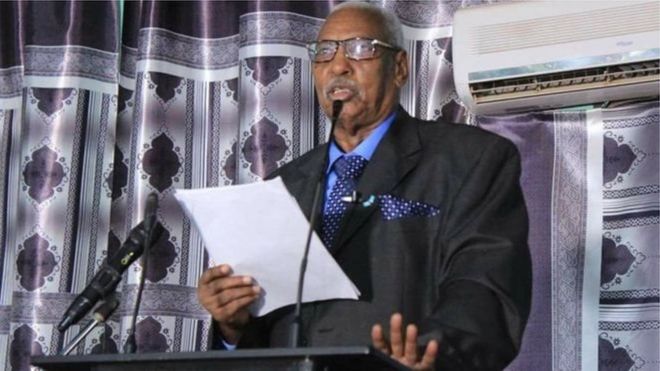
Xaaf, madaxweynaha xilkiisa la isku haysto ee GalmudugLahaanshaha sawirka .
Image caption Xaaf wuxuu diiday in xilka laga qaaday
Axmed Ducaale Geelle (Xaaf) waxaa lagu tilmaamaa in uu yahay nin ka duwanaan kara madaxda kale ee maamul goboleedyada.
Mar waa oday dhaqameed oo wuxuu ka mid ahaa odayaashii dhaqanka ee ka qayb galay shirkii Carta ee horraantii 2000. Xilligaas ayuuna siyaasadda si toos ah ugu soo biiray.
Xilligaasi ka hor lama oran karo siyaasadda Soomaaliya kuma lug lahayn. Wuxuu ka mid ahaa raggii aadka u taageeri jiray Jeneraal Maxamed Faarax Caydiid.
Siyaasadda wuxuu kaga soo biiray waddadii uu markii horeba jeexday ee dhanka dhaqanka maadaama hannaanka wax qeybsiga uu ahaa, yahayna 4.5.
Wuxuu miisaan siyaasadeed iyo mid dhaqan ku leeyahay gobolka Galmudug iyo magaalada Muqdisho oo muddo uu ku noolaa.
Dhan kale, waa nin ganacsade ah oo tan iyo billowgii todobaatameeyadii ku soo jiray ganacsiga Soomaaliya.
Sanadihii sagaashameeyadii, wuxuu ka mid ahaa ganacsatadii dibadda u dhoofin jirtay mooska Soomaaliya. Wuxuu xiriir wanaagsan la lahaa shirkadda khudaarta ee Dole, oo Maraykanka laga leeyahay.
Shirkaddaas oo madax uu ka ahaan jiray Xaaf iyo mid kale oo lagu magacaabo Somalfruit ayaa mooska Soomaaliya caalamka u iibgeyn jiray.
Isla sanadahaa, wuxuu aad u kobciyay hantidiisa ma guurtada ah ee uu ku leeyahay gobollada qaar ee Soomaaliya.
Wuxuu ka mid ah ahaa dadkii billaabay in dayaaradaha ay ka shaqeeyaan Soomaaliya. Wuxuu dhisay garoonka dayaaradaha ee Lambar-50, inkastoo hadda uusan gacantiisa ku jirin.
Wuxuu horraantii sagaashameeyadii, Muqdisho iyo qaybo ka mid ah bartamaha iyo koofurta Soomaaliya ka hirgaliyey xafiisyada iyo duullimaadyada shirkadda dayaaradaha ee Daallo oo ilaa iyo hadda ay maamulaan xubno ka mid ah qoyskiisa.
Siyaasadda, taajirnimada, galaangalka siyaasadeeda, aqoontiisa hoose oo dhisan, iyo shabakadaha uu ku leeyahay gobollada dalka, waxay u saamaxeen in dhowr goor uu xubin ka noqdo baarlamaanka Soomaaliya.
Baarlamaanka kaliya ee uu ka maqnaa tan iyo dawladdii Carta waa kan iminka jira, taa bedelkeeda, wuxuu hantiyey madaxtinimada maamul goboleedka Galmudug.
Waxaa lagu tilmaamaa in uu yahay nin garanaya sida dadka loola saaxiibo, dhanka kalena wuxuu ku xeeldheer sida loo qaato go'aanno u baahan calool adeyg.
Sidaa darteed, waa go'aan laga filan karo in uu ku adkeysto diimadiisa ah in xilka madaxweynaha Galmudug laga qaaday, ka dib markii xubno ka mid ah baarlamaanka maamulka ay ku andacoodeen.

Maamul Goboleedyo ayaa la saftay Xaaf

Markii Khilaafka uu xoogeystay ka dib, madaxweynayaasha maamul goboleedyada qaar ee Soomaaliya ayaa soo saaray warsaxaafadeed ay ku cambaaraynayaan xildhibaanno sheegay in ay xilka ka qaadeen madaxweynaha Galmudug Axmed Ducaale Geelle Xaaf.
Warsaxaafadeedka oo ay ku wada xusnaayeen madaxweynaha Puntland Cabdiwali Maxamed Cali Gaas, kan Jubbaland Axmed Maxamed Islaam, Koonfur Galbeed Shariif Xasan Sheekh Aadan, kan Hirshabeelle Maxamed Cabdi Waare iyo Galmudug Axmed Ducaale Geelle ayaa sidoo kale lagu cambaareeyay farogalin la sheegay in dowladda dhexe ay ku hayso arrimaha Galmudug.
Madaxtooyada Jubbaland ayaa BBC-da u xaqiijisay in ay warsaxaafadeedka qeyb ka tahay, balse maamul goboleedyada kale ayaan wali dhankooda ka hadlin in warsaxaafadeedkan ay wax ka og yihiin.
Madaxweynayaasha ayaa madaxda dowladda dhexe ugu baaqay in ay dib uga laabato go'aanka lagu taageeray hadalka xildhibaanada Cadaado, waxaana laga digay in talaabadan ay qalqal siyaasadeed iyo mid amni ka abuuro karto gudaha dalka.
Ugu dambeyntii madaxweynayaasha ayaa shaaciyay in ay shir degdeg ah ay isugu tagayaan magaalada Kismaayo si looga wada xaajoodo arrimaha taagan. Shirkan ayaa waxaa horey ugu baaqay madaxweynaha Jubbaland Axmed Maxamed Islaam.
Dhanka kale madaxweynaha Galmudug Axmed Ducaale Geelle Xaaf ayaa mar uu BBC-da waraysi siiyay waxa uu waxbo kama jiraan ku tilmaamay xil ka qaadis la sheegay in ay ku sameeyeen qaar ka mid ah xildhibaanada, wuxuuna intaas ku daray in dastuurka Galmudug uu qabo in aanan madaxweynaha xilka laga qaadi karin lixda bilood ee ugu horeysa xilka, isaga uu hadda xilka hayo afar bilood uun.

Ma haystaan ciidammo u gaar ah

Galmudug waxaa ka hawlgala ciidammada dowladda federaalka haddii ay ahaan lahaayeen xoogga dalka iyo waliba kuwa nabad suggida oo si toos ah uga amar qaata dowladda dhexe.
War saxaafadeedkii isbuucii hore kasoo baxay wasaaradda arrimaha gudaha federaalka ee lagu taageeray xil ka qaadista madaxweyne Xaaf ayaa qodobka ugu dambeeya waxaa amar lagu siiyay ciidamada kala duwan ee Galmudug ku sugan in ay sugaan amniga, kana hortagaan wixii qalqal ku ah amniga.
Xasan Xayle oo arrimaha siyaasadda ka faalloodo wuxuu qabaa in madaxweyne Xaaf ku dadaalayo sidii uu Galmudug uga samayn lahaa ciidamo isaga si toos ah uga amar qaata, si awoodiis xukunka uu salka ugu dhigo.
Arrin kale oo muujinaysa in uu jiro isku tashi xag ciidan ayaa waxa ay tahay in guddoomiyaha baarlamaanka Galmudug Cali Gacal Casar oo mar BBC-da la hadlay wuxuu sheegay: "Halkan waxaa ka taagan arrin aad u cakiran oo ciidamadii la uruurinaayo, oo la isku duba ridayo, meel loo wado ma garanayno."
Gudoomiyaha oo la sheegay in xilka laga qaaday iyo Madaxweyne ku xigeenka ayaa diidan go'aan uu Xaaf ku taageeray xulafada Sucuudiga oo Qadar go'doomiyay.
Dowladda Soomaaliya ayaa sheegtay in arrinta Khaliijka dhexdhexaad ay ka tahay.


Sunday, May 29, 2011

Beelah Somalia GENEALOGICAL TABLE OF SOMALI CLANS


QEYBTA DIR EE SAWIRKA OO KHALDAN IYO BEENO KU JIRA ISKA JIR EEGSE

GENEALOGICAL TABLE OF SOMALI CLANS


CLANS & SUBCLANS
RESIDENTIAL LOCATIONS
(By Region)
I - IRIR Somalia, Ethiopia, Kenya
1. -Hawiye
2. -Harire
3. -Ge’dere
4. -Hobor
5. -Gurre
6. -Meyle
7. -Gerrire
8. -Meqare(Ajuran)
9. -Hamere
Somalia, Ethiopia, Kenya
Ethiopia
Ethiopia
Ethiopia
Ethiopia
Ethiopia
Ethiopia
Kenya
Ethiopia

1 -Hawiye
1.1 -Jambele(Hintire)
1.2 -Haskul
1.3 -Rarane
1.4 -Gorgarte
1.5 -Gugundabe
1.6 -Karanle
1.7 -Hawadle
Somalia, Ethiopia, Kenya
Ethiopia
Hiran, Ethiopia
Ethiopia
Somalia, Ethiopia
Kenya, Ethiopia, Somalia
Somalia, Ethiopia
Hiran, Ethiopia, (Gedo before civil war)
1.4 - Gorgarte
1.4.1 -Dame
1.4.2 -Mohamed(Geboyo)
1.4.3 -Mohamud
Somalia, Ethiopia
Mudug, Galgadud
Mudug, Galgadud, Middle Shabelle
1.4.1 - Dame
1.4.1.1-Madarki’is(Habar Gidir)
1.4.1.2-Mudulod
1.4.1.3-Duduble
1.4.1.4-Mertile
Mudug, Galgadud
Mudug, Galgadud, Hiran
Somalia, Ethiopia
Galgadud
Mudug

1.4.1.1 - Madarki’is
1.4.1.1.1-Sa’ad
1.4.1.1.2-Sarur
1.4.1.1.3-Ayr
1.4.1.1.4-Salaiban
Mudug, Galgadud, Hiran
Mudug
Galgadud
Galgadud, Hiran
Galgadud, Mudug
1.4.1.2 - Mudulod
1.4.1.2.1-Ujejen
1.4.1.2.2-Darendole
1.4.1.2.2.1-Hilibi
1.4.1.2.2.2-Osman
Somalia, Ethiopia
Ethiopia, Hiran
Middle Shabelle, Lower Shabelle, Mogadishu
Middle Shabelle, Lower Shabelle
Middle Shabelle, Lower Shabelle, Mogadishu


1.4.1.2.2.2 - Osman
1.4.1.2.2.2.1-Wa’dan
1.4.1.2.2.2.2-Moblen
1.4.1.2.2.2.3-Ilaway
1.4.1.2.2.2.4-Abgal(Ali)
1.4.1.2.2.2.4.1-Harti
1.4.1.2.2.2.4.2-Wa’budan
1.4.1.2.2.2.4.3-War’ulus
Middle Shabelle, Lower Shabelle, Mogadishu
Lower Shabelle, Middle Shabelle
Middle Shabelle, Lower Shabelle
Lower Shabelle, Middle Shabelle
Middle Shabelle, Mogadishu
1.5 -Gugundabe
1.5.1-Jibedi
1.5.2-Jidle
1.5.3-Herre
Kenya, Ethiopia, Somalia
Hiran, Middle Shabelle
Middle Shabelle, Ethiopia
Kenya, Somalia, Ethiopia
1.5.1 -Jibedi
1.5.1.1 -Badi Ade
1.5.1.2-Jejele
Hiran, Middle Shabelle
Hiran, Ethiopia
1.5.3-Herre
1.5.3.1-Degodi
1.5.3.2-Isse (Garjan)
1.5.3.3-Masare
1.5.3.4-Galje’el
Kenya, Somalia, Ethiopia
Kenya, Ethiopia
Hiran, Middle Shabelle
Kenya, Ethiopia
Hiran, Lower Shabelle, N/E Kenya, Ethiopia
1.6-Karanle
1.6.1-Murasade
1.6.2-Wadere
1.6.3-Sahawle
1.6.4-Kadir
Somalia, Ethiopia
Somalia
Galgadud, Ethiopia
Ethiopia
Galgadud, Mogadishu, Lower Shabelle
1.6.1 -Murasade
1.6.1.1-Sabti
1.6.1.2-Fol Ulus
Somalia
Galgadud, Mogadishu, Lower Shabelle

1.7-Hawadle
1.7.1-Samatalis
1.7.1.1-Rer Ugas
1.7.1.2-Dige
1.7.1.3-Abdalle
1.7.1.4-Abdi Yussuf
Hiran, Ethiopia, (Gedo before civil war)
Hiran,
Hiran,
Hiran,
Ethiopia, (Gedo before civil war)

II – DIR
Ethiopia, Djibouti, Somalia, Kenya
1. -Madahwayn
2. -Madoobe Isse
3. -Medelug (Gadabursi)
4. -Mehe
Ethiopia, Somalia, Kenya
Djibouti, Ethiopia, Somalia
Somalia, Ethiopia
Somalia, Ethiopia


1-Madahwayne
1.1-Akisho,Gurgure,Guure Barsuuq,
1.2-Ali (Wardey)Hordare, Alaabweyn
Ethiopia, Somalia, Kenya
Ethiopia
Bay, Kenya
2-Isse
2.1-Eleye
2.2-Hoile
2.3-Walaldon
Djibouti, Ethiopia, Somalia
Awdal, Ethiopia
Djibouti, Ethiopia
Ethiopia
3-Medelug
3.1-Mahad Asse
3.2-Makahil
3.4-Habar Afar
Somalia, Ethiopia
Awdal, Ethiopia
Ethiopia, Awdal
Awdal, Ethiopia
4-Mehe
4.1-Surre Abdalee & Qubeys
4.2-Hassan
Somalia, Ethiopia, Kenya
Ethiopia, Gedo, Galgadud, Hiran
Somalia, Ethiopia, Kenya
4.1-Surre
4.1.1-Abdalle
4.1.2-Qubays Ethiopia, Gedo, Galgadud, Hiran
Ethiopia, Gedo, Galgadud, Hiran
Ethiopia, Gedo, Hiran, Mudug

4.2-Hassan
4.2.1-Biyamal
4.2.2-Bajimal
4.2.3-Quranyow
4.2.4-Issak Somalia, Ethiopia, Kenya
4.2.5-Dabruube
4.2.6-Qurac
Lower Shabelle
Ethiopia, Hiran
Lower Shabelle, Ethiopia, Kenya
Somalia, Djibouti, Ethiopia

4.2.4 Issak
4.2.4.1-Ibrahin
4.2.4.2-Mohamed (Ibran)
4.2.4.3-Tolje’lo
4.2.4.4-Musse
4.2.4.5-Arab
4.2.4.6-Ayub
4.2.4.7-Garhajis
4.2.4.8-Awal
Somalia, Djibouti, Ethiopia
W/Galbed, Togdheer
Togdheer, W/Galbed
Togdheer, Sanag
Togdheer, Sanag
W/Galbed, Ethiopia
Togdheer, W/Galbed, Ethiopia
W/Galbed, Togdheer, Djibouti
W/Galbed, Djibouti, Ethiopia
4.2.4.4-Musse
4.3.4.4.1-Abokar
4.3.4.4.2-Samane
4.3.4.4.3-Mohamed
Togdheer, Sanag
Togdheer, Sanag
Togdheer, Sanag
W/Galbed, Ethiopia


4.2.4.8-Awal
4.2.4.8.1 -Issa
4.2.4.8.2 -Sa’ad
4.2.4.8.3 -Afgab
4.2.4.8.4 -Egalle
4.2.4.8.5 -Abdalle
4.2.4.8.6 -Eli
W/Galbed, Djibouti, Ethiopia
W/Galbed, Togdheer
W/Galbed, Djibouti, Ethiopia
W/Galbed, Togdheer
W/Galbed, Togdheer
W/Galbed, Togdheer
W/Galbed, Togdheer

III – DIGIL & MIRIFLE
Somalia, Kenya, Ethiopia
DIGIL
1. -Geledi
2. -Begedi
3. -Tunni
4. -Shanta Alen
5. -Jiddo(Jarer)
6. -Garre
7. -Dabarre
Lower Shabelle
Lower Shabelle
Lower Shabelle, Middle Jubba
Lower Shabelle
Lower Shabelle, Hiran, Mogadishu, Ethiopia.
Lower Shabelle, Kenya, Ethiopia, Gedo
Bay, Middle Jubba
MIRIFLE (Rahanweyne)
Eight 8 (Known as clan name)
1. -Elay
2. -Harin
3. -Leisan
4. -Haraw
5. -Disow
6. -Emid
7. -Omal
8. -Yelatle
9. -Jirron
10. -Ma’allin Wayne
11. -Garwale
12. -Rer Dumal
13. -Wanjel

Bay, Gedo
Bay
Bay
Bay
Bakol
Bay
Bay
Bay
Bakol
Bakol
Bay
Bay, Bakol
Bay

Nine 9 (Known as clan name)
1. -Gasare Gude
2. -Gabawayn
3. -Jilible
4. -Geledle
5. -Hadame
6. -Luway
7. -Yantar
8. -Huber
9. -Eyle
Gedo
Gedo, Ethiopia
Bakol
Bay, Middle Jubba, Gedo
Bakol
Bakol, Bay
Bay
Bay
Bay, Hiran


IV - DAROD
Somalia, Ethiopia, Kenya
1. -Kablalah
2. -Sede
3. -Tanade
4. -Isse
5. -Yussuf Somalia, Ethiopia, Kenya
Somalia, Ethiopia, Kenya
Somalia, Ethiopia
Ethiopia, Mudug
Mudug, Lower Jubba

1-Kablalah
1.1-Kombe
1.2-Kumade

1.1-Kombe
1.1.1-Geri
1.1.2-Harla
1.1.3-Harti Somalia, Ethiopia, Kenya
Somalia, Ethiopia, Kenya
Ethiopia, Kenya, Somalia

Somalia, Ethiopia, Kenya
Ethiopia
Ethiopia
Somalia, Ethiopia

1.1.3-Harti
1.1.3.1-Warsengeli
1.1.3.2-Majerten
1.1.3.3-Dhulbahante
1.1.3.4-Ahmed
Somalia, Ethiopia
Sanag, Lower Jubba
Somalia, Ethiopia
Sol, Nugal, Togdheer
Bari
1.1.3.1-Warsengeli
1.1.3.1.1-Omar
1.1.3.1.2-Dubays
Sanag, Lower Jubba
Sanag, Lower Jubba
Sanag
1.1.3.2-Majerten
1.1.3.2.1-Ali (Bi’idyahan)
1.1.3.2.2-Mohamud
1.1.3.2.3-Mohamed
Somalia, Ethiopia
Ethiopia
Bari
Mudug, Nugal, Bari, Lower Jubba
1.1.3.2.3-Mohamed
1.1.3.2.3.1-Saleiban
1.1.3.2.3.1.1-Ali
1.1.3.2.3.1.2-Ugadh
1.1.3.2.3.1.3-Osman
1.1.3.2.3.1.4-Abdirahin
1.1.3.2.3.1.5-Mohamud
Bari
Bari
Bari
Bari
Bari
Bari
Mudug, Nugal, Bari, Lower Jubba
1.1.3.2.3.1.5- Mohamud
1.1.3.2.3.1.5.1- Osman
1.1.3.2.3.1.5.2- Omar
1.1.3.2.3.1.5.3- Isse
1.1.3.2.3.1.5.4 -Nuh
Mudug, Nugal, Bari, Lower Jubba
Mudug, Nugal, Bari
Mudug, Nugal, Bari
Nugal, Bari, Lower Jubba
Mudug
1.1.3.3-Dhulbahante
1.1.3.3.1-Ahmed
1.1.3.3.2-Musse
Sol, Nugal, Togdheer
1.2-Kumade
1.2.1-Abdi
1.2.2-Absame
1.2.2.1-Bal Ad
1.2.2.2 -Wayten
1.2.2.3 -Jidwak
1.2.2.4-Ogaden
Ethiopia, Kenya, Somalia
Ethiopia
Ethiopia, Kenya, Somalia
Ethiopia, Lower Jubba
Ethiopia, Kenya
Ethiopia, Somalia
Ethiopia, Kenya, Somalia
1.2.2.3 -Jidwak
1.2.2.3.1-Bartire
1.2.2.3.2-Abasgul
1.2.2.4.3-Yabareg
Ethiopia, Somalia
Ethiopia, Lower Jubba
Ethiopia
Ethiopia
1.2.2.4-Ogaden
1.2.2.4.1-Miyir Walal
1.2.2.4.2-Makabul
Ethiopia, Kenya, Somalia
1.2.2.4.1-Miyir Walal
1.2.2.4.1.1 -Bahale
1.2.2.4.1.2 –Talomuge
Ethiopia, Kenya, Somalia
Ethiopia, Kenya
1.2.2.4.1.1 -Bahale
1.2.2.4.1.1 .1 -Ali Jedid
1.2.2.4.1.1 .2 -Awl Yahan
1.2.2.4.1.1 .3 -Ali Balul
1.2.2.4.1.1 .4-Bah Geri
1.2.2.4.1.1 .5-Zuber

1.2.2.4.1.2 –Talomuge
1.2.2.4.1.2.1 –Abudwak
1.2.2.4.1.2.2 – Abdalle
1.2.2.4.1.2.3 –Rer Mohamed
Ethiopia, Kenya, Somalia
Ethiopia
Lower Jubba, Middle Jubba, Kenya,
Ethiopia
Ethiopia
Ethiopia, Kenya, Lower Jubba, Middle Jubba

Ethiopia, Kenya
Kenya, Ethiopia
Ethiopia, Kenya
Ethiopia, Kenya
1.2.2.4.2-Makabul
1.2.2.4.2.1-Rer Sad
1.2.2.4.2.2-Makahil
Ethiopia, Kenya, Somalia
Ethiopia
Ethiopia, Lower Jubba, Kenya

2.-Sede
2.1-Fa’ayo
2.2-Marehan
2.2.1-Urmidig
2.2.2-Aw Same
Somalia, Ethiopia, Kenya
Gedo, Ethiopia, Kenya
Somalia, Ethiopia, Kenya
Gedo, Kenya
Gedo, Galgadud, Ethiopia, Lower & Middle Jubba
2.2.1-Urmidig
2.2.1.1-Idigsor
2.2.1.2-Ayahud
2.2.1.3-Arah Adag
Gedo, Kenya
Gedo, Kenya
Gedo, Kenya
Gedo, Kenya
2.2.2-Aw Same
2.2.2.1-Hassan
2.2.2.2-Issak
Gedo, Galgadud, Ethiopia, Lower & Middle Jubba
Gedo, Ethiopia, Lower & Middle Jubba
Gedo, Galgadud, Lower & Middle Jubba, Ethiopia
2.2.2.1-Hassan
2.2.2.1.1-Lebiyal
2.2.2.1.2-Waqmashe Gedo, Ethiopia, Lower & Middle Jubba
Gedo, Ethiopia, Lower & Middle Jubba

2.2.2.2-Issak
2.2.2.2.1-Sonfure
2.2.2.2.2-Amanrer
2.2.2.2.2.1-Talhe
2.2.2.2.2.2-Wagarda’a
2.2.2.2.2.3-Hawrarsame
2.2.2.2.2.4-Radamir
Gedo, Galgadud, Lower & Middle Jubba, Ethiopia.
Gedo, Kenya
Gedo, Galgadud, Lower & Middle Jubba, Ethiopia
Gedo, Lower Jubba, Middle Jubba, Kenya
Galgadud
Gedo, Ethiopia, Lower & Middle Jubba
Gedo, Lower Jubba, Middle Jubba, Ethiopia

3.Tanade
3.1-Musse
3.2-Hussein
3.3-Ali
Somalia, Ethiopia
Mudug, Ethiopia
Mudug, Ethiopia
Mudug

V – SHEKHAL

Somalia, Ethiopia
1. Lobogay
2. -Aw Qudub
3. -Gendershe
4. -Aw Hassan Lower Jubba, Hiran
Ethiopia
Lower Shabelle
Hiran

VI – BARAWAN

Somalia
1. -Gibil Ad
2. -Gibil Madow Lower Shabelle
Lower Shabelle


VII – BANTU
1. -Mushunguli
2. –Swahili
3. –Bajuni

Lower Jubba, Middle Jubba

VIII - ASHARAF
Religious Groups can be found in major towns


IX – RER HAMAR

Mogadishu


X - ARABS
Mogadishu, Lower Shabelle, Lower Juba, Bay


Minority Groups Residential Location
By region
1. -Geboyo Mudug, Galgudud, Ethiopia, Middle Shabelle
2. –Yibro W/ Galbeed, Togdheer, Ethiopia
3. –Yaharo Hiran, Middle Shabelle
4. –Tomal Bari, Mudug, Nugal, Ethiopia
5. -Madhiban Mudug, Nugal, Bari
6. -Hawrarsame Gedo, Ethiopia, Lower Juba, Galgudud
7.-Fiki Yakub Gedo, Lower Juba,
8. –Jaaji Mudug
9. –Lo’jir Sanag
10. -Waat Ethiopia, Kenya
11. –Bajuni Lower Juba
12. -Mushunguli Lower Juba, Middle Juba, Lower Shabelle
13. –Swahili Lower Juba, Middle Juba, Lower Shabelle
14. -Gabawayn Gedo
15. –Buunle Ethiopia


NB: 1/ Latin numbers indicate Clans
2/ Arabic consequent numbers indicate sub-clans and relationship of the sub-clan to the major clan. For example: 1. Hawiye => 1.4 Gorgarte is considered as Hawiye’s fourth son who, in turn, had three children (Dame, Mohamed (Geboyo) and Mohamud) and who have since given rise to sub-clans in their own right and so on.


HERE IS FULL FAMILY TREE OF DAROOD ISMAIIL IN SOOMAALI:

DAAROOD. wuxuu dhalay :
-Maxamed(Kablalax), Axmed(Sade), Xuseen(Tanade),Yuusuf(Awrtable), iyo Ciise (waa iskubah)
-Suhurre iyo Cibaadi(waa iskubah).
-Agarone, Hodme, Kooxdin, Haas, iyo Dhegadheere (waa iskubah).

KABLALAX. wuxuu dhalay :
-Koombe iyo Koomade (waa iskubah).

KOOMBE. wuxuu dhalay :
-Hantiile, Geri, Cabdi (waa iskubah).
-Xarte, Jiiraan, Saleebaan (waa iskubah).

HANTIILE. wuxuu dhalay :
-Harti iyo Yabarahe. (waa iskubah).
HARTI. wuxuu dhalay :
-Maxamed(Majeerteen), Maxamuud(Moorasaante), Axmed(Mooracase) (waa iskubah).
-Saciid(Dhulbahante), Geesaguule, Liibaangashe iyo kaskiqabe.(waa iskubah).

MAXAMED (Majeerteen). wuxuu dhalay :
-Aawe, Wabeeneeye. (waa iskubah).
-Tabale, Warwaaqsame. (waa iskubah).
AAWE. wuxuu dhalay :
- Cumar, (Sorore), Janbalaq, Xaashi iyo Ismaaciil (Cardadub) (waa iskubah)
- .
CUMAR (Sorore). wuxuu dhalay :
-Nooleys, Ammaanle, Nuux iyo Halmoog (waa iskubah).

NOOLEYS. wuxuu dhalay :
-Maxamed, Cabdikariim, Abokar iyo Muuse(Idigfacle) (waa iskubah).
-Rabin iyo Hantiile (waa iskubah).
-Ooga Cadde iyo Cabdalle(Daanweyne) (waa iskubah)

MAXAMED. wuxuu dhalay :
-Walaal Yabare.
WALAAL YABARE. wuxuu dhalay :
-Xajiijle.
XAJIIJLE. wuxuu dhalay :

-Talareer, Yuusuf, Haylaciyo Wacdanwaaq (waa iskubah).
-Gumasoor iyo Reer Waarag (waa iskubah).
-Fiilkucaag, Deylac iyo Duudmariye (waa iskubah).

TALAREER. wuxuu dhalay :
-Xasan(Himidoor), Huseen(Siwaaqroon) iyo Xamarwaaq (waa iskubah).
-Wadalmogge iyo Isaaq (waa iskubah).
-Yuusuf, Barkataale, Macalwaaq, Caqdaar iyo Saleebaan (waa iskubah).

XASAN (Himidoor). wuxuu dhalay :
-Toljecle, iyo Gudoonwaaq (waa iskubah).
TOLJECLE. wuxuu dhalay :

-Maxamed(Ummadnebi), Ibraahim, Cali, Cusmaan, Cumar iyo Axmed (waa iskubah).
MAXAMED(Ummadnebi). wuxuu dhalay :

-Jibraahiil, Cumar, Isxaaq, Xuseen iyo Nuux (waa iskubah).
-Qaasim, Saciid, Zakariye, iyo Cabdikarim (waa iskubah).
-Cali, Cabbaas, iyo Ciise (waa iskubah).
-Muuse iyo Makaahiil (waa iskubah).
-Subeyr iyo Abamakaa(Makanne) (waa iskubah).

Proff. Hirschi, oo ah aqoonyahan raad xoog badan ku leh aqoonta bulshada social science , ayaa sannadkii 1974-kii wuxuu soo bandhigay aragti uu ku magacaabay ilaalada xiriirka bulshada Control of Social Relation. Aragtidaas oo qiimayn ku yeelatay dadka ku howlan culuuntan, waxay tilmaameysaa in bulshada ishaysata oo is taqaan ay ku yar tahay dhaqanka aan wanaagsanayn iyo akhlaaqda xun. Sannadkii 1990-kii waxaa aragtidaas akiday aqoonyahan kale oo Mareykan ah oo la yiraahdo Proff. Gottfrydson. Beelaha reer miyiga Soomaaliyeed waxay ka mid yihiin bulshooyinka dunida ku yar oo sida xooggan u xiriirsho nidaamka beelaha. Taasi waxay dhaxalsiisay in ay si guud iyo si gaar ahba ugu faanaan dhaqanka wanaagsan oo ay ka heleen xiriirka adag ee dhexdooda yiil.

Sheekooyinka xiisaha leh oo arrintaas inoo tilmaamaya waxaa ka mid ah mid dhexmartay Ugaas Maxamuud Dhoore oo u dhashay beesha Mareexaan iyo sarkaal Talyaani ah oo mas'uul looga dhigay degaanka waqooyiga Jubba bilowgii sannadihii 1920-aadkii. Sarkaalku mar uu damcay in uu tiriyo geela beelaha Mareexaan ee ku dhaqan gobolka Gedo, ugaaska ayaa ka diiday oo ku yiri : " Geela Mareexaan oo aad tirokoobtaa waxaa kaa xiga xusulkaaga oo aad leeftaa ".

Sarkaalka oo aanan dareensanayn in xusulka aanan la leefi karin ayaa isku dayay in uu xusulkiisii leefo, markuu carrabka la gaari waayay ayuu ugaaskii la hadlay oo uu ku yiri :
" Haddii aan cududda jebiyo, markaas carrabka waan la gaarayaa xusulka ".
Ugaaskii : " Taas macnaheeda sow ma ahan in dhibaato faraha lala galo ".
Sarkaalkii : " Haa ".
Ugaaskii : " Dhibaatadaas ayaa kaa xigta geelayaga oo aad tirisaa ".
Beelihii Mareexaan waxay ku shireen meel la yiraahdo Yaaq, halkaas oo ay ku guddoonsadeen in ay muddo 24 saacadood ah ay geelooda ka tallaabiyaan xuduudda. Dhacdadaas waxaa loo yaqaan Seero Goys. Talyaanigii wuxuu la yaabay sid SO ENJOY MY LABOR O0 O0

Blog Archive