Saturday, July 28, 2018

The Sheikh Hussein Shrine in Bale the Custodians of the Shrine are from the Dir clan Surre who moved from Merca long ago Aba xuseen of Bale

This ancient shiekh was a Somali - prof. Andreski (the famous linguist) interviewed his descendant in Merca - the head of the main mosque is a direct descendant. Merca is a Somali town on the Indian Ocean (inhabited the Somali Dir clan). The custodians of the shrine/tomb of shiekh Hussein are Somalis - the tradional custodians have always been Somali. Again the role of Somalis in propergating Islam has never been recognised by Western Scholar? Why? Even the Maldive Islands off India rembere how the Somali Sheikh (13th century) called Shiekh. Awbarkhadle came and converted them - he is remembered in Somalia - and also appears in Arabic/Ethiopic MSS. in associating with the Walsama Dynasty (Muslim Dynasty eastern Shoa/Hawas - old Somali-Afar Sultans of Awfat/Adal) - Waqooyi Galbeed Holy shrine of Shiekh Hussein is an extremely impotant Islamic > centre - This ancient shiekh was a Somali - prof. Andreski (the famous > linguist) interviewed his descendant in Merca - the head of the main mosque is > a direct descendant. Merca is a Somali town on the Indian Ocean (inhabited the > Somali Dir clan). The custodians of the shrine/tomb of shiekh Hussein are > Somalis - 


Tomb of the Saint


The town is named after what, in some Ethiopian Muslim eyes, is the most sacred place in that country: the tomb of the thirteenth century Somali saint called Sheikh Hussein, who introduced Islam to the Sidamo people living in the area at the time, and is said to have performed many miracles. A number of these miracles have been recorded in a hagiography published in Cairo in the 1920s, entitled Rabi` al-Qulub. Although this town is now within the homelands of the Oromo people, it has continued to be the destination of approximately 50,000 pilgrims from Muslim Ethiopia twice a year during the Muslim months of Hajj and Rabi' al-Awwal.[3] The first pilgrimage is to celebrate his birth, the second his death. They traditionally carry cleft sticks known as "Oulle Sheikh Hussein", which are too small to serve as walking sticks and are not utilized for any practical purpose. Once they arrive at the shrine, the pilgrims take their turns entering the saint's tomb by crawling through a small doorway.[4]


The extensive religious complex dedicated to the saint includes the town and the nearby valley of Kachamsare. In the 18th century, Emir `Abd al-Shakur ibn Yusuf of Harar constructed a shrine to the Baghdadi saint `Abd al-Qadir al-Jilani near the tomb of Sheikh Hussein, inside the shrine compound. A graveyard has also been consecrated as part of the complex.[3] Other landmarks of the complex include the pond of Dinkiro, 300 meters south of the mosque, built in dry stone masonry; associated with the pond is a spring with "miraculous" water. At the entrance of the holy area are two wild fig trees called kiltu (identified as Ficus sycomorus) in the Oromo language. Near another pond, of Imaro, there is the mosque of Sheikh Hussein's father, both with a gubba of Harar type. Also nearby are several caves—a "cave of serpents", a "cave of herbs", and a "cave of honey"—and rock formations said to be petrified persons.[4]


Posted: Mon Sep 24, 2007 5:36 am Post subject: HOW ISLAM CAME TO SOMALIA AND ROLE DIR PLAYED


________________________________________
quote="Muddane Warsame"]E-mail Uu ii Soo Diray nin Direed (Surre)


qoraalada iga yaabshay oo uu dhalintaan ka qoreen islamka iyo doorka suuban ay Dir ka dheeshay fiditaanka Dinteena Suuban iyo fiqiyaasha Suure/

1)Qorahan waxaa uu sheegayaa in nin Direed oo looyaqaanya Sh. Yusuf Al Kownin ama ka weyne uu alifay qurmada Quraanka xafihiisa sida-- Alif la kor dhabee, La hosdhabe-- iyo higaada ku saleysan af keena hooyo ee Somaliga ah. Waxaa uu sheegayaa in xitaa magacayada Surre ee Fiqi (uu ka yimid Qareen diinta Islamka iyo Shareecada) madaama uu odeyga Surre ahaa wadad ku fidiyay Diinta Islamka oo uu wiilashiisa oo Fiqiyo ah u kala diray daafaha Somalia


HOW ISLAM CAME TO SOMALIA AND ROLE DIR PLAYED

According to our noble Dir brothers of Somalia. The eldest son and most ancient clan of the Somalis. 1) Islam came to Somalia in the first Hijra when the followers of the prophet fled to East Africa and came to Ethiopia as refugees. 2) So Islaam come to Somalia before Mecca was recaptured from the pagan Qurishi. The eldest Son of the Dir Ali madaxweyn who lived at this time around 643 Ad accepted the faith and sent a delegation to the Khilifa in 732-67 Ad. Shortly after that period even the illustrious Sheikh Ahmed (Mohamed Xiniftire studied in Yamen and returned to Somalia via the Dahlak Island where he fathered the Maxamed Xiniftire branch of the Dir which includes The Isaaq Axmed(Maxamed), Biyomaal maxamed ,Gadsan clans.

(Posted by guest: W.A)
reply
posted at Tue Feb 08 03:59:07 EST 2005 wax is weydiin
abdi taariikhda aad noo sheegtay waa taariikh xiiso leh ee tixraac maleedahay?

(Posted by guest: abraac)

Agoon History of Islam in Somalia from the Time of Mohamed (Saws)

Shortly after the Hijra (670's) the Quraish or prophet's tribe started persucuting muslims and hundreds of the prophets followers fled across the Indian Ocean to present day Zaila and through Erithrea.

It was in this period that the Somalis and their cousines the Afar-Oromo-Harararis and other nations of the horn of Africa converted to Islam.

According to most Historians the people of Zaila who were of Dir origin and Issas-Gadabursi-Isaaq origins, Islam became well established by 800 A.D. By the 1300 century the whole horn of Africa up to Kenya and Zanziber we have Muslim cities flourishing and Muslim sulltanes like Ifat and Adal all over Somali.


As a matter of fact, it was in 1300's that the ancient Somali Dir saint Sheikh Yusuf Alkownin (Aw Barkadle) innvented the Alif-La-Kordhabee or Somali way of reading and learning to read the Quran scriptures. And around this time, another Sheikh by the name of Sheikh Hussein Al Bale of the Bale Oromo Arsi region left Northren Somali and Islam was well established in Southren Ethiopia all the way to northren Ethiopia.

So the Islam of Somalia dates back to the time of the Hijra and many Somalis became muslims even before the Prophet Islamized the Arabs and Islam succeded in Arabia.

Later in he 1400 AD, the Qadiriya Sufi order of Sheikh Cabdul Qadir Al-Jilani spread to Somalia and Ethiopia revitalizing the ancient faith and further incorporating more Kushitics. The earliest leaders of Qadiriya Order were mostly from the saintly Dir sub-clan of Surre. The earliest Surre rulers were called Fiqis (Islamic Scholars of Diin and Lawyers of Sharia). The Oldest of the Surre clan the Qubeys and his younger brother, the Abdalles fathered some of the best Islamic Scholars in the 1600 century and they spread the Islamic faith all over the Somali coast. Imam Surre sent his numerous sons whom he named Fiqis to central Somalia, South, and North.


By 1456 AD, he Muslim Kings of Ifat, led by a Somali worrior, Imam by the name Imam Axmed Gurey (Left-Handed) was fighting Ethiopian Christian Habasha kings who tried to conquer Somalilands. W.A.


]E-mail Uu ii Soo Diray nin Direed (Surre)


Beelah Direed ee konfurta Somalia (Mudug/Galgaduud/Sh.Hoose) dagan waxa
ay sheegan in odeyga Direed uu dhalay Afar wiil oo kala ah:

Madaxeyne Direed oo curad ah, Mahe Direed oo ku xigeen ah, iyo labada
kale oo kala ah Madoobe Direed iyo Mandaluug Direed oo ugu yar da'a
ahaan marka la eego.

Taarikhiyan waxa ay rumeysanyihiin Dirka Galbeedka iyo Konfurta dagan
dhoor qodob oo ku saabsan tariikhda hore:

1)Dadka Direed in ay ka yimaadeen dhankan Galbeedka bilawgii, kunsano
ka hor.

2)Magaca Dir in uu macnahiisu yahay "Fir" ama Ab. Oo lagu macneyn karo
geesi ama Dhiire.

3)Konfurta Dirta dagan wexey rumeysan yihiin in ay Dirka xukumi jireen
Saladiin loo yaqiin ROOBLE oo ahaa ilaaliyaasha Xeerka iyo caadada
beesha.

Rooble- Xeerbeegti,Qareemo, amanduuleyaal,Roobdoonayal,iyo mareynta
reerka ayaa lagu aqoon jiray.Guud ahaana waxa ay ilaalin jireen xeerka
oo Dirku rumeysnaa in ay ka dhaxleen Dir Aji abkoodi hore.

Madaxdan oo loo aqoon jiray Roobleyaash dadku wey ixtiraami jireen ila heer xitaa
isha laguma godi jirin, oo xitaa "ILKULULe" ayaa loo aqoon jiray.

4)Waxa kaloo ay rumeysan yihiin in Zeylac magalada la yiraahdo ay Dir
badan soo jidatay qarnigii (700 AD) halkaas oo ay ka soo dageen Asxaab
badan oo Rasuulka(Caleyhi salatu wa salaam) u soo diray magaalada
Zailac Hijradii koowad. Oo dadka Direed iyo Canfarta (Oday Caliga) ay
waagii danbe ka wada asaseen labo boqortooyo oo la kala dhihi jiray
CIFAT iyo CAdal.

5)Dirta koonfurta iyo Galbeedka dagan waxa ay rumeeysan yihiin oo kale
in 1400 ay dhaceen dagaalo far badan oo xabashida iyo muslimiinta is
dagaaleen. Ilaa ay xabashida oo adeegsaneysa (Portugees)burtaqiis ay
cagta mariyeen boqortooyoyinkii Musliminta oo kuwa Direed ee Cifat iyo
Awda ka mid ahayeen

6)Dhamaan waxa ay rumeysan yihiin Dirka in ay door weyn ka ciyaareen
fidinta diinta Somalia iyo Ethiopia dhexdooda.

Sheekhyada waaweyn ee geeska Afrika sida Sheikh Xuseen Bali, Aw
Barkadle, Awbarre iyo qaar kale ay Cadal iyo Cifad ka soo jeedan
4)Beelaha Biyomaal iyo Suure iyo Guure waxa ay sheegan in 1600-1750 ay
u soo guureen duleedka dalka (Gobalada dhexe iyo labada wabi dhexdooda)
mudo yar ka dib dagaladii Axamed Gurey iyo Amxaarada.

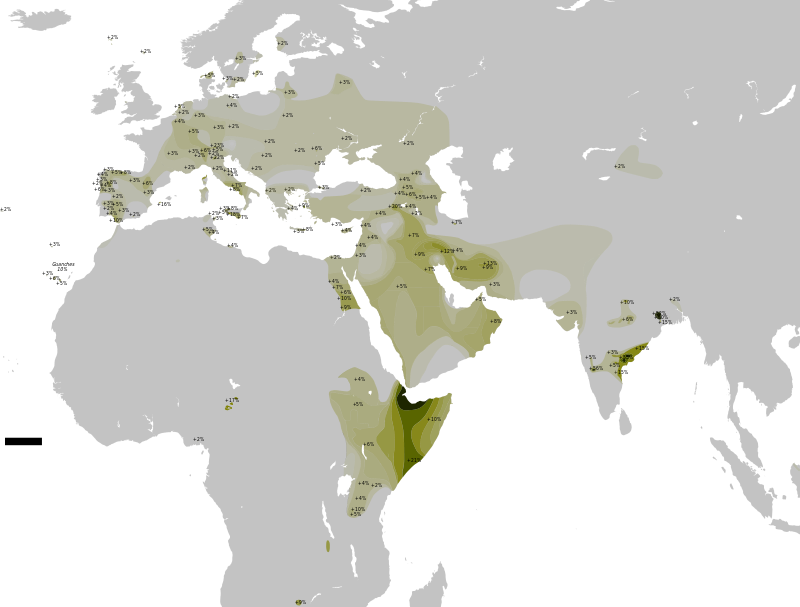
Dir Somali clan members in Djibouti. DNA analysis of Dir clan members inhabiting Djibouti/ Ethiopia all of the individuals belonged to the Y-DNA T1 paternal haplogroup


In the age of enlightment and science there is no need to believe in the Arab man with the flying carpet myth arriving at the Somali shores and breeding with the locals .

 DNA of West Burco/East Hargeisa/Sanaag community - T1 Haplogroup


Somalis (Dir clan) Somali (East Cushitic) Djibouti 24/24 100% [76] Dir Somali clan members in Djibouti. DNA analysis of Dir clan members inhabiting Djibouti found that all of the individuals belonged to the Y-DNA T1 paternal haplogroup.[49] All genetic analysis carried out on Gadabuursi male clan members have so far shown that they exclusively belong to the T1 paternal haplogroup.[50][51][52]

DNA analysis of Dir clan members inhabiting Djibouti found that all of the individuals belonged to the Y-DNA T1 paternal haplogroup.

-M184 (xM70) 2.1; T1-L206 (xM70) 2.2; T1a1-L162 (xL208) 2.3; Northern ..... The paternal haplogroup T-M70 varies between 3% and 24% of male lineages in Germany. ...... Bauris are thought to be descendants of a native tribe of the Central ... 14/17, 82.4%, Dir sub-clans of Dire Dawa are Issa, Gurgura and Gadabuursi.

DNA analysis of Dir clan members inhabiting Djibouti found that all of the individuals belonged to the Y-DNA T1 paternal haplogroup

DNA of Gabiley/West Hargeisa community - E1b1b Haplogroup

 The full document: Somali Demes

https://docs.google.com/spreadsheets/d/1MWpljgkrKUhJZUFnzB5nboKRE28BgiBLGTSGHe4fRVY/pub?gid=6#

Maakhiri 20-25% of Somalis have T Haplogroup it is not rare.

Basically the GX community, Galbeedi's Borama community,

Waraabe community of Djibouti and Dhire Dhaba, the water

folks of Merka, the Shower folks of central Somalia (many from

those communities have been tested and came out as T

haplogroup). It seems Galbeedi is closer to me DNA wise than

someone from Gabiley who happen to share the "flying Arab

man" myth with me.


T Haplogroup is found in the highest frequencies among

Northern Somalis around 70-90% specially the "D" community

and the GX folks. But yes T is rare in other Somali communties

if you are not one of those two groups.

"The maximal worldwide frequency for Haplogroup

T-M184 is observed in the "D" Clan of Somalia,

Djibouti and Ocaden region, where it accounts for

approximately 70 to 90% of the male lineages"


Issa and Gurgura Liberation Front-DAL (Democratic Action League)-GLF (Gurgura Liberation Front) led by Abdelasis Ahmed(Dir)HDP (Horiyal Democratic Party - The Dir Politica Parties of 1990s Led by Issas Gadabursi and Gurgure Dir


Issa and Gurgura Liberation Front

Issa and Gurgura Liberation Front (IGLF) was a political faction in eastern Ethiopia, led by Riyaale Ahmed. IGLF, which is based amongst the Issa clan in northern Hararghe, evolved out of the Iil Tire division of the Western Somali Liberation Front. During its initial period of existence, it engaged in clashes with the Somali National Movement around the Ethiopia-Somalia border.

Around 1992 IGLF was involved in clashes with the dominant Ethiopian People's Revolutionary Democratic Front (EPRDF). During this period IGLF sabotaged the Addis Ababa - Djibouti Railway.

However, later IGLF reconciled with the government. In 1993 it took part in the formation the government of the Somali Region, together with the Ogaden National Liberation Front. Mahdi Ahmed became the secretary of the government.

In 1994 IGLF merged into the Ethiopian Somali Democratic League, the EPRDF partner in the Somali region.

January 1993: The founding conference of the council for Region 5 began 21 January. The executive committee members elected Abdullahi Muhammed Sa=di President, Siyad Badri Muhammed Vice President, and Mahdi Ahmad Warsameh Secretary. The president and vice president are from the ONLF and Warsameh is of the Isa and Gurgura Liberation Front.

12 February 1994: Ten Ethiopian Somali organizations merged to form the Ethiopian Somali Democratic League (ESDL).

Elsewhere in eastern Ethiopia, the TGE experienced problems with the Isa and Gurgura Liberation Front (IGLF). On October 4, 1991, clashes between government forces and IGLF rebels resulted in the temporary closure of the Addis Ababa- Djibouti railroad near Dire Dawa and the disruption of trade between the two countries. The fighting also disrupted famine relief distribution to nearly 1 million refugees in eastern Ethiopia. By early 1992, the IGLF still had refused to recognize the EPRDF's right to maintain security in the Isa-populated area around Dire Dawa. By 1993, nonetheless, improved conditions allowed the Addis Ababa-Djibouti railroad to operate on a fairly regular basis.

Bordode/Mieso

http://www.africa.upenn.edu/eue_web/jijigmay.htm

The Horyaal Democratic Party was founded by the Dir Gadabursi clan; their area of influence straddles the Somaliland border and incorporated the Dire Dawa, Jijiga and the Awbar zones.

On 9 February 1994, at a meeting in Hurso near Dire-Dawa a new political party called the Ethiopian Somali Democratic League (ESDL) was founded. This party claims to represent the objectives and needs of the Ethiopian-Somali people; giving particular attention to and observing the cultural and traditional practices of the people; and giving due regard to the local constitution (Heer).

This new party aims to develop a stronger link with the Transitional Government in accordance with Article 9, Title 6 of the ESDL constitution which states: " I am fed up of my father and my father brought me his father! " states a Somali proverb. (Posted by guest: shalac) (Posted by guest: sahal)

GLF (Gurgura Liberation Front) led by Abdelasis Ahmed; HDP (Horiyal Democratic Party), from the WSLF (Western Somali Liberation Front), led by Abdi Ismail and representing the Gadabursi; the IGLF (Issa and Gurgura Liberation Front), headed by Riyaale Ahmed, which, since a split in 1991, only defends Issa interests (essentially the control of the Djibouti-Ethiopian railway line).

The pro-government ESDL which hope to become part of the EPRDF is headed by current Transport minister Abdulmejid Hussein (Issa Habar Awal). It has 76 of the 139 seats in the Regional Council and 15 of the Somali Region's 23 seats in the House of Peoples' Representatives, as well as the two seats for the autonomous city of Dire Dawa.

However, later IGLF reconciled with the government. In 1993 it took part in the formation the government of the Somali Region, together with the Ogaden National Liberation Front. Mahdi Ahmed became the secretary of the government.

In 1994 IGLF merged into the Ethiopian Somali Democratic League, the EPRDF partner in the Somali region.

THE ETHIOPIAN SOMALI POLITICAL PARTIES ETHIOPIAN SOMALI DEMOCRATIC LEAGUE

§ The pro-government ESDL which hope to become part of the EPRDF is headed by current Transport minister Abdulmejid Hussein (Issa Habar Awal). It has 76 of the 139 seats in the Regional Council and 15 of the Somali Region's 23 seats in the House of Peoples' Representatives, as well as the two seats for the autonomous city of Dire Dawa. Though it has little support among the Ogaden, the ESDL is backed by the northern clans, the Issaq, Dir (Issa, Gadabursi, Gurgure) and the non-Ogaden Darod (Bartire, Yabare, Mejertein, Dhulbahante).

The ESDL was set up in February 1994 by merging some dozen Somali political and clan groups, including

§ DAL (Democratic Action League) led by Mohamed Shek Ibrahim, representing Ethiopian Issas Dir

§ ESDM (Ethiopian Somali Democratic Movement), close to the SNM (Somali National Movement) of Somaliland

§ and very divided; GLF (Gurgura Liberation Front) led by Abdelasis Ahmed(Dir);

§ HDP (Horiyal Democratic Party), from the WSLF (Western Somali Liberation Front), led by Abdi Ismail and representing the Gadabursi Dir

§ IGLF (Issa and Gurgura Liberation Front), headed by Riyaale Ahmed, which, since a split in 1991, only defends Issa interests (essentially the control of the Djibouti-Ethiopian railway line).

§ Isa Tigers Association (ITA) Riyaale Ahmed

The Horyaal Democratic Party was founded by the Dir Gadabursi clan


The Horyaal Democratic Party was founded by the Dir Gadabursi clan; their area of influence straddles the Somaliland border and incorporated the Dire Dawa, Jijiga and the Awbar zones.

On 9 February 1994, at a meeting in Hurso near Dire-Dawa a new political party called the Ethiopian Somali Democratic League (ESDL) was founded. This party claims to represent the objectives and needs of the Ethiopian-Somali people; giving particular attention to and observing the cultural and traditional practices of the people; and giving due regard to the local constitution (Heer).

This new party aims to develop a stronger link with the Transitional Government in accordance with Article 9, Title 6 of the ESDL constitution which states: " I am fed up of my father and my father brought me his father! " states a Somali proverb. (Posted by guest: shalac) (Posted by guest: sahal)

GLF (Gurgura Liberation Front) led by Abdelasis Ahmed; HDP (Horiyal Democratic Party), from the WSLF (Western Somali Liberation Front), led by Abdi Ismail and representing the Gadabursi; the IGLF (Issa and Gurgura Liberation Front), headed by Riyaale Ahmed, which, since a split in 1991, only defends Issa interests (essentially the control of the Djibouti-Ethiopian railway line).

The pro-government ESDL which hope to become part of the EPRDF is headed by current Transport minister Abdulmejid Hussein (Issa Habar Awal). It has 76 of the 139 seats in the Regional Council and 15 of the Somali Region's 23 seats in the House of Peoples' Representatives, as well as the two seats for the autonomous city of Dire Dawa.

However, later IGLF reconciled with the government. In 1993 it took part in the formation the government of the Somali Region, together with the Ogaden National Liberation Front. Mahdi Ahmed became the secretary of the government.

In 1994 IGLF merged into the Ethiopian Somali Democratic League, the EPRDF partner in the Somali region.

THE ETHIOPIAN SOMALI POLITICAL PARTIES ETHIOPIAN SOMALI DEMOCRATIC LEAGUE

Political Organizations Of Issas
  • Democratic Action League DAL early political movement of Issas in Ethiopia was led by Mohammed Sheikh Ibrahim
  • Issa Gurgure Libration Front IGLF led by Riyaal Ahmed uniting two powerful Dir clans until the Gurgure split in 1991, IGLF name continued even though a Gurgure by the name Abdul Aziz formed the independent Gurgure Libration Front which worked with their next door cousins.

Riyaale Xaamud- Founder of Issa Tigers Association (ITA) and Issa and Gurgure Liberation Front (IGLF).


Riyaale wuxuu ku dhashay magaalada Diridhabe 1959kii. Wuxuu Somaaliya yimid isaga oo yar. Wuxuu dugsiga hose/dhexe ku dhameeyey Muqdisho,Dugsiga Maxamud Xarbi

Kadib sannadkii 1976-dii wuxuu aaday dalka Sudan oo uu ku qaatay waxbarashada dugsiga sare.

Kadib wuxuu Sudan ka aaday Sacuudi Carabiya 1978dii halkaas oo uu Jaamacadda kaga soo baxay. Markii uu jaamacadda dhameeyey wuxuu shaqo macalinimo ka helay dalka Jabuuti oo uu 1982 ilaa 1992 bare ka ahaa.Wuxuu Riyaale ku soo laabtay dalkii hooyo 1992gii . Wuxuu markiiba aas-aasay ururka lagu magacaabi jiray Isa Tigers Association (ITA). Muddo kadib, isla 1992 ayuu Guddoomiye u noqday Isa Tigers ; Issa and Gurgure Liberation Front (IGLF).

Riyaale Xaamud waa halgamaa weyn oo caan ku ah geyiga Soomalida Itoobiya gumeysato. Riyaale wuxuu ka soo jeedaa qoys halgamaa ah. Riyaale aabihii, Xaamud Axmed (Xaamud Laangadhe) wuxuu ahaa halgamaa weyn oo ka mid ahaan jiray madaxdii Jabhaddii WSLF. 16kii Juune 1990 ayey gumeysatada Itoobiya dishay Marxuum Xaamud Laangadhe, Riyaale aabihiiWuxuu muddo dheer xidhiidh la lahaa halganka hubaysan ee ay hogaaminayso Jabhadda Waddaniga Xoreynta Ogaadenya (JWXO).

Wax yar ka dib isaga oo u arkayey in xal lagu gaadh karo balan qaadka Cahdigii ku meel gaadhka ahaa ee caddaynayey aayo ka talinta shucuubta la gumeysto ayuu ka qayb galay dawladii Kililka sannadkii 1993dii oo uu ka noqday wasiirka Shaqada iyo Arrimaha Bulshada. Wuxuu mar labaad noqday wasiirka dal Xiiska.

Halgame Riyaale Xaamud Axmed, sannadkii 1995 wuxuu ka qayb-galay baarlamaakii kililkak. Markii uu habka gumesigu ula dhaqmayo shacabka ka soo horjeedsaday laguna tuhmay inuu xidhiidh la leeyahay halganka hubaysan ayaa isla 1995kii 10kii October la xidhay. Halkaas ooh al sano xidhnaa. Maadama ay ku tuhmayeen inuu xidhiidh hoose la leeyahay JWXO ayaa loo dortay ergay dhexdhexaadin Itoobiya iyo JWXO 1997kii.

Dhamaadkii 1997kii ilaa 1998ki wuxuu ahaa Madaxweyne ku Xigeenka Kililka. Wax yar kadib waa laga qaaday xilkii Madaxweyne ku Xigeenka. Markaas ayuu bilaabay inuu dib u hababeeyo Ururkii Xisbiga Dimoqraadiga Somali Galbeed (WSDP) oo ka soo dhex baxay ururkii WLSF. Waxaa Riyaale loo doortay Hog-hayaha Guud, oo ilaa iyo haatan matalayo.


Friday, July 27, 2018

ISSA REBELS CLASH WITH SOMALILAND TROOPS- 10 Aug 95


(SWB 12 Aug 95 [RFI in French, 10 Aug 95])The Jibuti army has this morning been put on alert along the country' s border with the self- proclaimed Republic of Somaliland. The Jibuti authorities fear a flare- up of clashes between the Somaliland army and the Issa militias of the United Somalia Front [untraced; in French: Front de la Somalie Unifiee]. Yesterday the militias attacked the locality of Barisle, less than five kilometres from the border. According to Radio Hargeisa, two soldiers and nine militiamen were killed. The Issa rebels admit to five deaths from among their ranks and say that 31 soldiers were killed. Our reporter is Abdi Aden:[Aden] Today the Somaliland soldiers and the Issa rebels are facing each other at Tokhoshi, some 20 km from the Jibuti border, and fighting is likely to flare up anew.The reason for the fighting is to see who can win control of a nine- square- kilometre area claimed by Issa nomads, who are also demanding regional autonomy based on the Boorama charter. The charter is supposed to regulate intertribal affairs in Somaliland. The government of Muhammad Ibrahim Egal does not see things that way, however. He wants to set up an administration which, he says, will represent the three main tribes that live in this area bordering on Jibuti. The tribes in question are the Issa, the Gadaboursy and the Issaq. The Somaliland Issas have categorically rejected this formula, which they suspect is a ploy to manoeuvre them out of the Somaliland political arena.Jibuti, for its part, has put its troops along the border with Somaliland on a state of alert in order to prevent any fighting from spilling over the border.Abdi Aden in Jibuti for RFI.

Wednesday, July 25, 2018

The Makahil Gadabuursi - numbering 300,000 and Founding -Somalia Democratic Alliance (SDA) in 1989 Ethiopia- Gilkes, P.S.

None of the sources consulted by the DIRB refer to the Makahil as a subclan of the Ogaden clan.


According to Gilkes, the Makahil, after the Madahasi, is the "second main subclan" of the Gadabursi, whom he estimates number 300,000 or about 8 per cent of the northern population (July 1992, 49). The northern area, former British Somaliland, is home to three clan families: the Isaaq Dir, the Dir (consisting of the Issa and the Gadabursi clans), and the Darod (ibid., 43). The Gadabursi clan consists of the Madahasi subclan (which is the largest), the Makahil and the Arfan (ibid., 49). According to Gilkes, the Makahil are  more significant politically with such subclans as the Jibril Yunis around Boroma and Lafayisa; the Rer Ugas, mostly in Ethiopia around Aw Bare (also called Teferi Bar) and west; and the Rer Nur Yunis centred on Dilla but also across the border around Aw Bare (inside Somalialand, they also neighbour the Jibril Abokr and have poor relations with them)" (ibid.).


Gilkes states that the Gadabursi set up the Somalia Democratic Alliance (SDA) in 1989, but that it subsequently split into factions (ibid.). The Makahil created their own political grouping, the Horval Democratic Front, in late 1991 in Ethiopia, where they have an established political and historical base (ibid.).
A genealogy chart prepared by the General Survey of British Somaliland in 1944 depicts the following Makahil tribes as belonging to the Gadabursi clan: Makahil Mikadore, Musa Makahil, Makahil Dera, Ali Makahil Dera, Elli Makahil and Egeh Makahil (1944, 5-6). The same survey lists the Ogaden clan under the Darod clan family (ibid., 21).

References

 
Africa Confidential [London]. 18 December 1992. Vol. 33, No. 25. "Somalia: Beyond the Pax Americana."
Somali Tribes. 1989. Jean-Peirre Gaithier. "Arbre généalogique des clans de la tribu Somali." (Includes John A. Hunt. 1944. "Genealogies of the Tribes of British Somaliland and the Mijertein.")
Gilkes, P.S. September 1994. The Price of Peace: Somalia and the United Nations 1991-1994. Bedfordshire: Save the Children Fund UK.
Gilkes, Patrick. July 1992. "Ethnic and Political Movements in Ethiopia and Somalia."
Indian Ocean Newsletter [Paris]. 29 October 1994. No. 644. "Aideed's 'G12'."
Laitin, David D. and Said S. Samatar. 1987. Somalia: Nation in Search of a State. Boulder, Col.: Westview Press.
Samatar, Ahmed I. 1988. Socialist Somalia: Rhetoric and Reality. London: Zed Books.
Attachments
Gilkes, P.S. September 1994. The Price of Peace: Somalia and the United Nations 1991-1994. Bedfordshire: Save the Children Fund UK, pp. 133-36.
Gilkes, Patrick. July 1992. "Ethnic and Political Movements in Ethiopia and Somalia." pp. 43-56.

 http://www.refworld.org/docid/3ae6ac3b44.html

Blog Archive